
Parametric EQ
Bevel EQ
The first-call EQ.
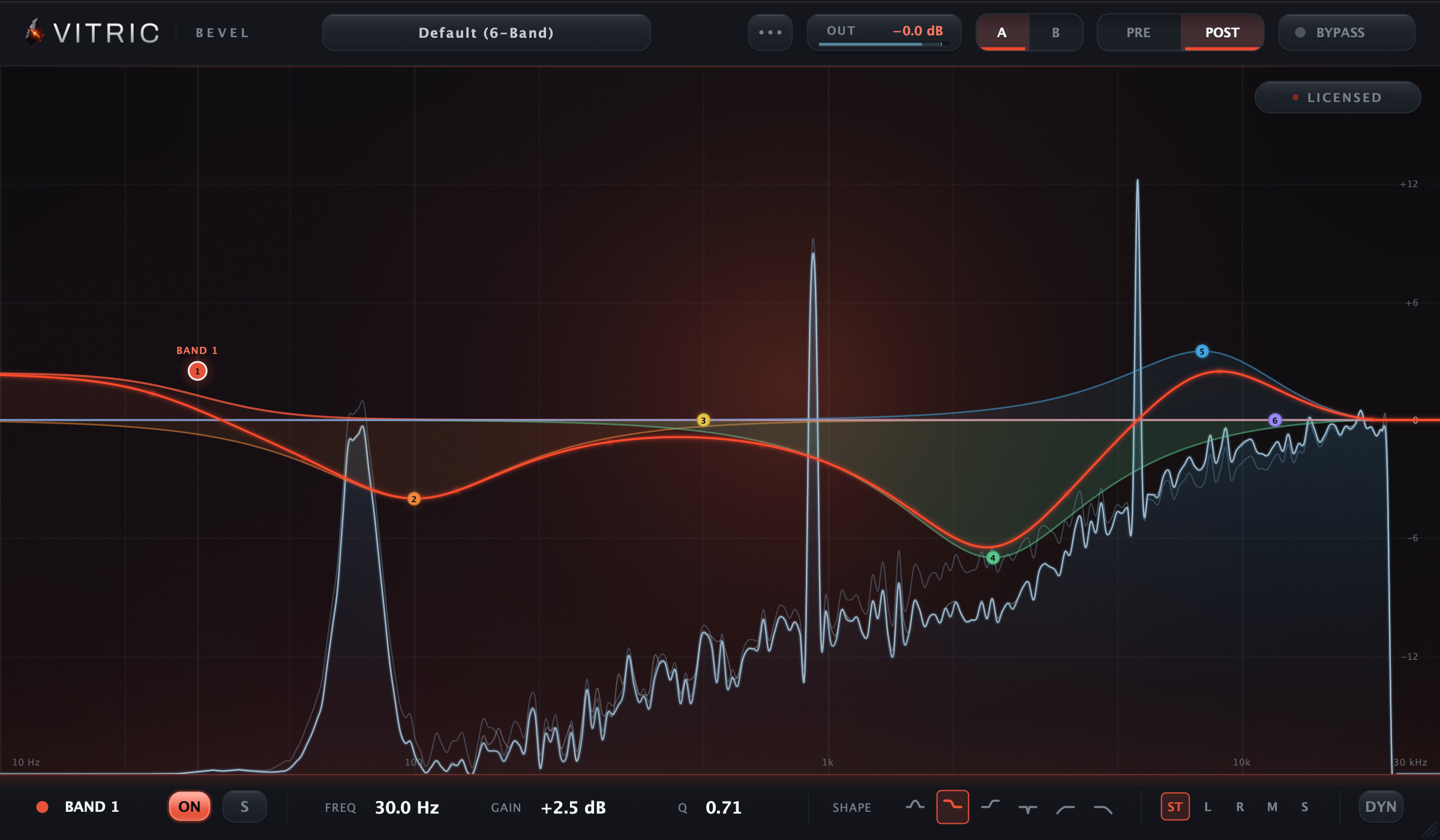
A 24-band EQ for cleanups, broad tone moves and dynamic cuts. Put each band in stereo, left, right, mid or side, and work directly on the spectrum.
3 machines over the license’s lifetime · Yours to keep
No card required. Your full license arrives by email.
VST3 / AU / AAX · macOS & Windows · v1.2.0
Read the Bevel EQ manualIN MOTION
Bevel EQ, running.
IN YOUR SESSION
Clean up the problem. Keep the character.
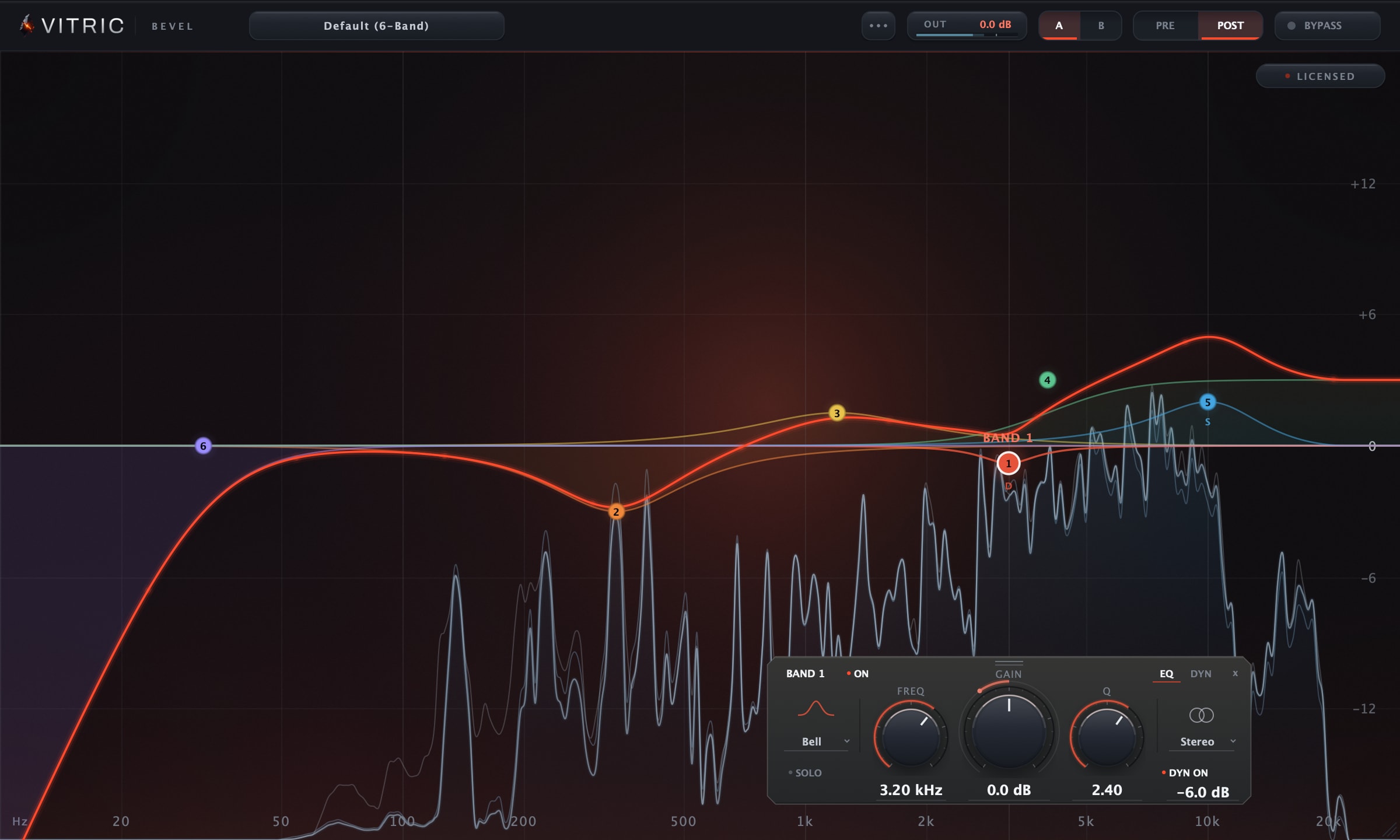
Cut rumble, isolate a resonance or add a broad shelf on the same curve. When a harsh frequency comes and goes, use a dynamic bell or shelf instead of a constant cut. Each band can work on the full stereo signal, one channel, the mid or the sides.
LIGHT ON GLASS
Clarity, all the way through.
Twenty-four bands, precise response curves, and a live view of your spectrum. Bevel puts the shape of your sound in front of you.
A material study of the Bevel interface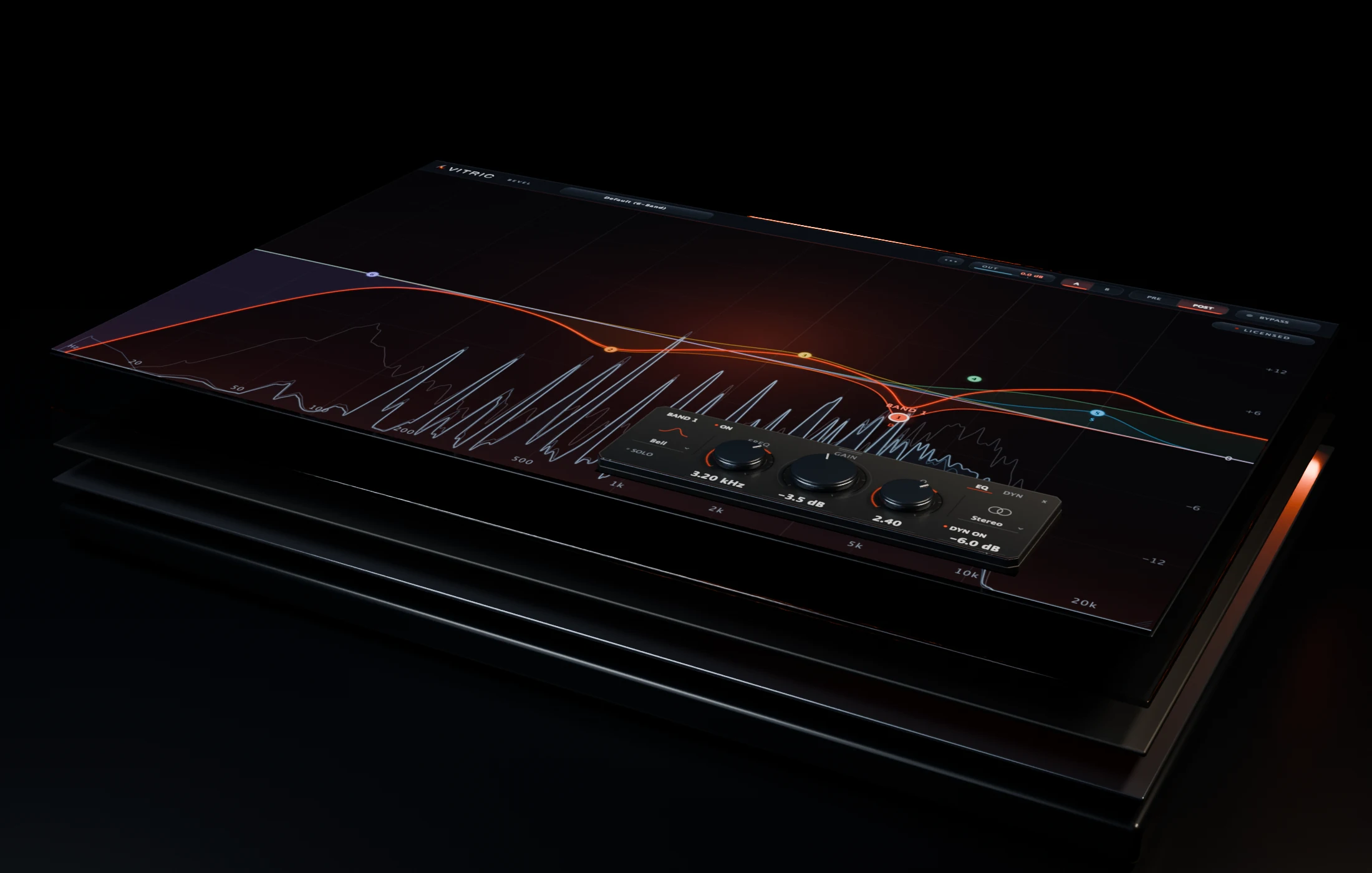
THE LISTENING ROOM
Listen to Bevel EQ.
One performance. Two perspectives. Loudness matched.
Low-mid cut and high shelf: −3 dB near 340 Hz, +3 dB near 4 kHz.
About this demo
Rendered through Bevel EQ 1.1.5 on macOS. Input and processed excerpts are matched in loudness. Switching keeps your place.
Open input audio ↗Open processed audio ↗A CLOSER LOOK
Inside Bevel EQ.
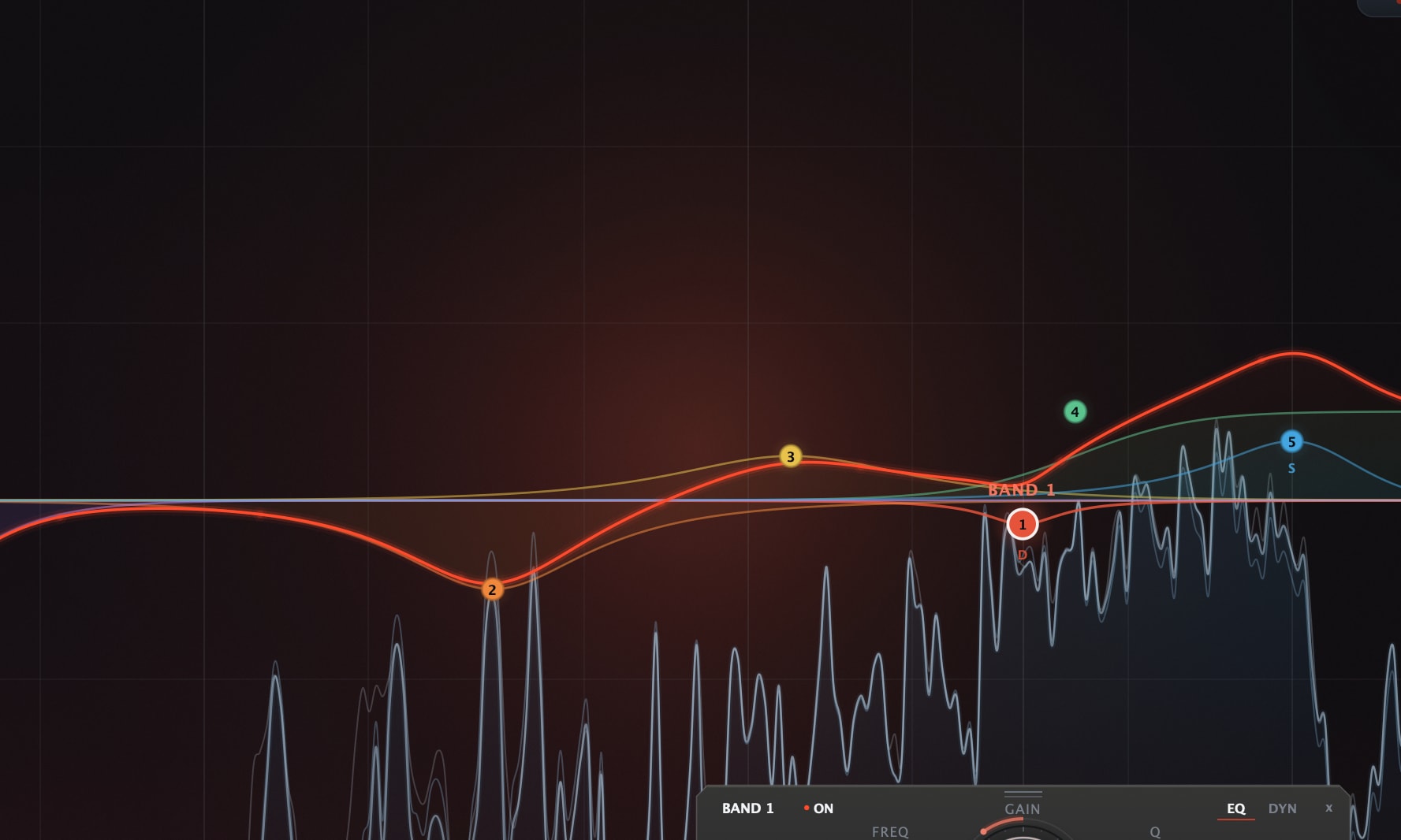
Freeform bands
Twenty-four slots can take bell, shelf, notch, high-pass or low-pass shapes, and the band plate sits inside the spectrum beside the band you select.
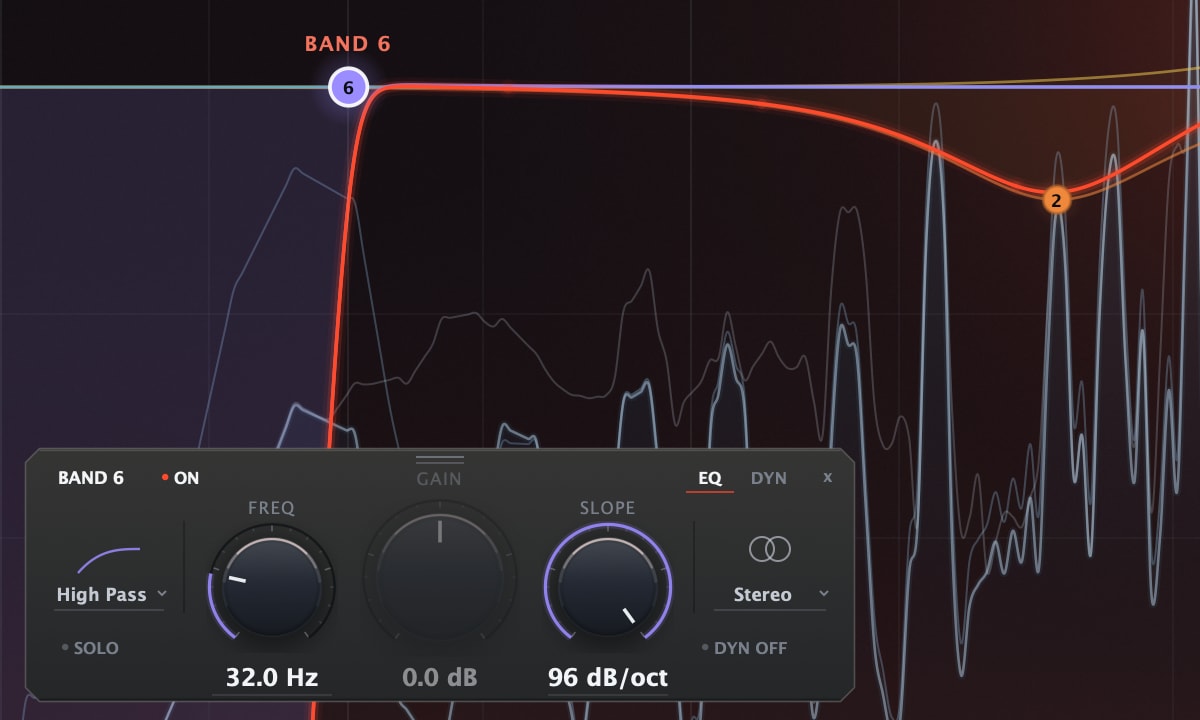
Filter slopes
High-pass and low-pass slopes run from 12 to 96 dB/oct. Band 6 here is a 96 dB/oct high-pass at 32 Hz, the near-brickwall, and its plate shows the slope.
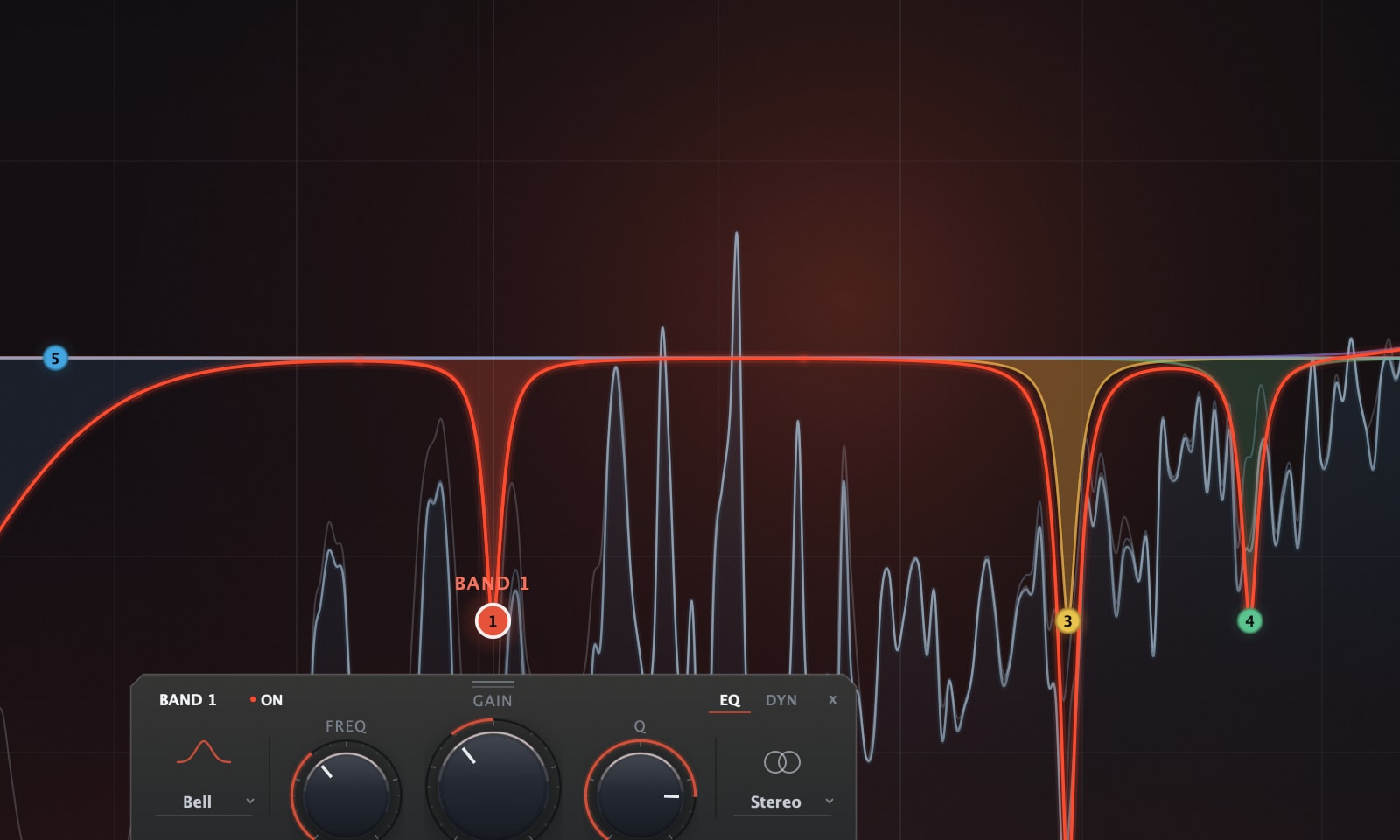
Pre/post analyzer
The pre and post traces are drawn together under the summed response, from the program material the meter path actually sees.
All features & controls
- 24 freeform bell, shelf, notch, high-pass and low-pass bands
- Stereo, left, right, mid and side placement per band
- Dynamic bell/shelf processing with threshold, signed range and timing
- EQ and DYN pages with separate DYN ON/OFF
- 12–96 dB/oct high-pass and low-pass slopes
- Pre/post analysis, band solo and exact numeric entry
- Movable selected-band plate with remembered position
- A/B states, undo and redo
- Graph: Command-drag fine; Shift frequency-only; Alt+Shift gain-only (Mac modifiers)
Dynamic bands
Bell and shelf bands have threshold, signed range, attack and release on the DYN page. DYN ON/OFF enables processing separately; switching pages alone does not change the sound.
Stereo, mid or side, per band
Each band carries its own placement. Band 5 here lifts the sides only: its plate reads Side and the S tag sits under the node.
Per-band solo
SOLO on the band plate auditions the band's own frequency region, filtered to the band's shape.
Exact values, typed
Click a readout in the band plate and type the value in its own units. Return commits it, Escape cancels.
A/B states, on the bar
A/B stores two full EQ states. PRE/POST chooses the main analyzer trace; Options can show both together. Compare at similar levels. A/B does not adjust gain for you.
Edit on the node
Double-click a node and its value bubble opens on the curve: FREQ, GAIN and Q, each a field you can type into without leaving the display.
Every band, any job
| Band type | What it does | Reach for it on |
|---|---|---|
| Bell | Boost or cut around a centre, Q from broad to surgical | Resonances, presence, body |
| Shelf | Lift or lower everything past a corner | Air, warmth, mud |
| Notch | Remove a single frequency | Hum, whistles, ringing |
| High pass | 12 to 96 dB/oct floor control | Rumble, stage noise, low mud |
| Low pass | 12 to 96 dB/oct ceiling control | Hiss, harsh cymbals, lo-fi moves |
Put it to work.
Vocal cleanup
High-pass rumble, use band solo to locate a resonance, then shape the top with a shelf.
Intermittent harshness
Let a dynamic bell reduce an aggressive frequency when it crosses threshold, with signed range and timing you control.
Stereo finishing
Place a shelf or corrective cut in the mid or sides without building separate EQ chains.
Fast tonal decisions
Compare pre/post spectra under the curve, type exact values and keep two settings in A/B.
THE DETAILS
Fits your setup.
- Bands
- 24, freeform
- Per band
- Stereo / L / R / Mid / Side · solo · dynamic on bells and shelves
- Dynamics
- Threshold -72 to 0 dB · signed range ±24 dB
- Filter slopes
- 12 to 96 dB/oct
- Analyzer
- Pre + post together, 4096 to 16384-pt FFT
- Oversampling
- Zero Latency / 2x / 4x, host-compensated
- Mono-maker
- 20 to 500 Hz, 24 dB/oct
- Formats
- VST3 and AAX on macOS and Windows · AU on macOS
- Platforms
- Windows 10+ (64-bit) · macOS 10.15+ Intel / 11+ Apple Silicon
- Made in
- Studio 4, Cleveland OH
- Windows
- Windows 10 or later, 64-bit. VST3, AAX, Standalone.
- macOS
- macOS 10.15 or later on Intel; macOS 11 or later on Apple Silicon. AU, VST3, AAX.
- Hosts
- A 64-bit host supporting your platform’s plugin format. Your DAW may require a newer operating system.
Use it in Pro Tools, Logic Pro, Ableton Live, Cubase, Studio One, FL Studio, REAPER, Bitwig Studio, and other compatible hosts.
Find the right format for your DAW ↗Questions about Bevel EQ.
Which bands can be dynamic?
Bell, low-shelf and high-shelf bands. Use DYN ON/OFF to enable dynamics; the DYN page only reveals its controls. Notch and pass shapes retain those settings while they are inactive.
Can bands use different stereo placements?
Yes. Each band can work in stereo, left, right, mid or side.
Can I see the input and output together?
Yes. Enable Show pre and post together in Options. PRE/POST chooses which tap is the main trace.
Can I move the band controls out of the way?
Yes. Drag the plate’s grip or empty area to reposition it inside the graph. Double-click the grip to restore its automatic position.
PART OF THE COLLECTION
Bevel EQ, in a bundle.
Bevel EQ is included in these bundles. Compare their contents and current offers.
Find its next partner.
Explore all plugins ↗
Hear it in your own session.
Bevel EQ. Free, with a full license.
No card required. Your full license arrives by email.