How to EQ guitar and piano in a mix: acoustic, electric and piano, frequency by frequency
Where to EQ an acoustic guitar, an electric guitar and a piano: the high-pass under the lowest note, the mud and boxiness bands, pick and hammer attack, and air. Starting settings in dB and Q, and how to keep guitar, piano and vocal out of each other's way.
Guitar and piano share the midrange with the lead vocal, so most of their EQ is about making room: a high-pass under the lowest note, a cut where chords pile up into mud, and a small lift where the pick or hammer gives the part its edge. Treat every number below as a place to start listening, with the rest of the mix playing.
What frequencies do guitar and piano cover?
A guitar in standard tuning is strung E2, A2, D3, G3, B3, E4. The low E is 82.4 Hz, and the high E string reaches E6, about 1.3 kHz, on an electric with 24 frets; an acoustic with 20 frets stops at C6, 1,047 Hz. A piano's 88 keys run from A0 at 27.5 Hz to C8 at 4,186 Hz.
Harmonics carry each instrument higher: useful acoustic guitar content reaches about 14 kHz and piano about 12 kHz, while an electric stops near 6 kHz, because guitar speakers roll off steeply above about 5 kHz. A male singer covers about 82 to 523 Hz, a female singer about 175 Hz to 1 kHz. All three have notes in the same few octaves, which is why they mask each other.
How do you EQ an acoustic guitar?
High-pass. No note in standard tuning sits below 82.4 Hz, so a 12 dB per octave high-pass under the low E clears the rumble below the notes. Raise the corner until the guitar starts to lose body in the full mix, then back it down; with bass and kick in the track it can sit near 100 Hz.
Boom. Body boom sits around 80 to 200 Hz and grows when the mic is close to the sound hole. Cut 1 to 3 dB there with a bell at Q 1 to 2, rather than raising the high-pass and thinning the low strings.
Mud and boxiness. Strummed chords pile up between 200 and 400 Hz: if the part clouds the piano or vocal, cut 2 to 4 dB at Q 1 to 2. A hollow, cardboard tone is usually one ring between 300 and 700 Hz; sweep a narrow boost to find it, then cut 2 to 5 dB at Q 4 to 8.
String and pick detail. Around 3 to 5 kHz. A broad 1 to 2 dB lift at Q 0.7 to 1 helps a strum read in a dense mix; check it at a loud listening level before you keep it. If only the hardest strokes click, use a dynamic band there instead.
Air. Sparkle lives above 10 kHz. A wide 1 to 3 dB high shelf from around 10 to 12 kHz opens the guitar up; stop when pick and finger noise start to lead.
How do you EQ an electric guitar?
Tighten the low end. The floor is the same 82.4 Hz, lower in drop tunings: drop D takes the low string to D2, 73.4 Hz. High-pass below the lowest note the part plays. A rhythm guitar's chunk, around 100 to 250 Hz, sits on the bass and kick. Keep it, but give guitar and bass their own lanes: where you boost one, cut the other a little at the same frequency (the bass side is in how to EQ bass).
Mud. On electric it usually sits higher, around 300 to 500 Hz, and doubled rhythm parts stack it. Cut 2 to 4 dB at Q 1 to 2 on the guitars, not on every track.
Harsh upper mids. Some guitar tones honk between 800 Hz and 1.5 kHz: if the part sounds nasal, cut 1 to 3 dB at Q 2 to 4 around 1 kHz. Bite lives at 2 to 4 kHz, where the ear is most sensitive. If it stings, cut 1 to 3 dB at Q 1 to 2 right where it hurts, or use a dynamic band if it only stings on some chords.
Cut through without fizz. A 1 to 2 dB lift at Q 0.7 to 1 in the bite brings a guitar forward better than a treble boost. A guitar speaker gives little back above about 5 kHz, so a distorted guitar's top end is often just fizz and hiss: sweep a low-pass down until the guitar dulls, then back it up a little. Judge it with the band playing; a guitar that sits well in the track often sounds thin on its own.
How do you EQ a piano?
Low end that fights the bass. A piano reaches 27.5 Hz, below a bass guitar's low E1 at 41 Hz, and left-hand octaves land in the bass player's range. For solo piano, or piano and voice, leave the lows alone or filter near 30 Hz. In a band, raise a 12 dB per octave high-pass toward 100 Hz by ear, or cut 1 to 3 dB with a low shelf to keep some weight; the low notes stay recognizable through their harmonics.
Mud. The body is in the low mids, and left-hand chords build up between 200 and 400 Hz, more so when a guitar plays the same chords. Cut 2 to 4 dB at Q 1 to 2 where it clouds. A boxy recording gets the same sweep as the acoustic and a 2 to 5 dB cut at Q 4 to 8 between 300 and 700 Hz.
Hammer attack. Around 2 to 5 kHz. A 1 to 2 dB lift at Q 0.7 to 1 gives definition under a busy arrangement. Hard-played notes are brighter than soft ones, so if only the loud chords clang, a dynamic band beats a static cut that dulls the quiet passages. Air and room sound sit above 10 kHz: use the same wide shelf as on acoustic guitar.
A stereo piano in mid/side. The mid is what both channels share, the side what differs. The vocal sits in the middle, so a 1 to 3 dB cut at Q 1 to 2 in its 2 to 4 kHz presence region, on the mid only, clears room for the singer while the sides keep the piano bright and wide. Check in mono afterwards: mono keeps only the mid, so side-only moves vanish there (see mono vs stereo).
How do you stop guitar, piano and vocals masking each other?
All three have notes between about 80 Hz and 1 kHz, so EQ alone cannot pull them apart. Work in this order:
- Arrangement. If guitar and piano play the same chords in the same octave, move one up or down an octave, or thin one part. That frees more room than any cut.
- Panning. Keep the vocal in the middle and put guitar and piano on opposite sides.
- Lanes. Give the vocal 2 to 4 kHz, where a 1 to 2 dB lift adds clarity, and cut the guitar and piano 1 to 3 dB at Q 1 to 2 at the same spot. If acoustic and piano play together, only one of them gets a presence lift.
- Mud. Cut 200 to 400 Hz on the tracks that pile up, not on all of them.
- Dynamics. If an instrument only buries the singer while they sing, a dynamic band keyed from the vocal dips its presence region during the lines alone. Start with a downward range of 2 to 3 dB.
Judge each move in the full mix, at matched loudness. A spectrum analyzer shows where parts overlap, but overlap on a display is not a problem until you hear one; see how to read a spectrum analyzer, and for the singer's side, how to EQ vocals.
Starting EQ settings for guitar and piano, in one table
| Move | Acoustic guitar | Electric guitar | Piano |
|---|---|---|---|
| High-pass, 12 dB/oct | Below the low E (82 Hz); toward 100 Hz in a band | Below the lowest note: 82 Hz, or 73 Hz in drop D | None or near 30 Hz alone; toward 100 Hz with a bass |
| Low end | Boom, 80 to 200 Hz: cut 1 to 3 dB, Q 1 to 2 | Chunk, 100 to 250 Hz: keep; trade with the bass | Below 100 Hz in a band: low shelf, cut 1 to 3 dB |
| Mud | 200 to 400 Hz: cut 2 to 4 dB, Q 1 to 2 | 300 to 500 Hz: cut 2 to 4 dB, Q 1 to 2 | 200 to 400 Hz: cut 2 to 4 dB, Q 1 to 2 |
| Box or honk | Ring at 300 to 700 Hz: cut 2 to 5 dB, Q 4 to 8 | Honk, 800 Hz to 1.5 kHz: cut 1 to 3 dB, Q 2 to 4 | Ring at 300 to 700 Hz: cut 2 to 5 dB, Q 4 to 8 |
| Attack | Pick and strings, 3 to 5 kHz: lift 1 to 2 dB, Q 0.7 to 1 | Bite, 2 to 4 kHz: lift 1 to 2 dB, Q 0.7 to 1; if it stings, cut 1 to 3 dB, Q 1 to 2 | Hammer, 2 to 5 kHz: lift 1 to 2 dB, Q 0.7 to 1; if it clangs, cut 1 to 3 dB, Q 1 to 2 |
| Top | Wide high shelf, 1 to 3 dB from 10 to 12 kHz | Low-pass by ear; the speaker rolls off above about 5 kHz | Wide high shelf, 1 to 3 dB from 10 to 12 kHz |
These are separate moves, not a preset: most parts need two or three, and a clean recording may need none. Q follows the constant-Q definition in what is a parametric EQ, where Q 1.41 is one octave wide and Q 4.32 a third of an octave; plugins differ, so match the width you hear. More starting points are in EQ settings: where to start, and slopes in low-pass and high-pass filters.
Setting it up in Bevel EQ
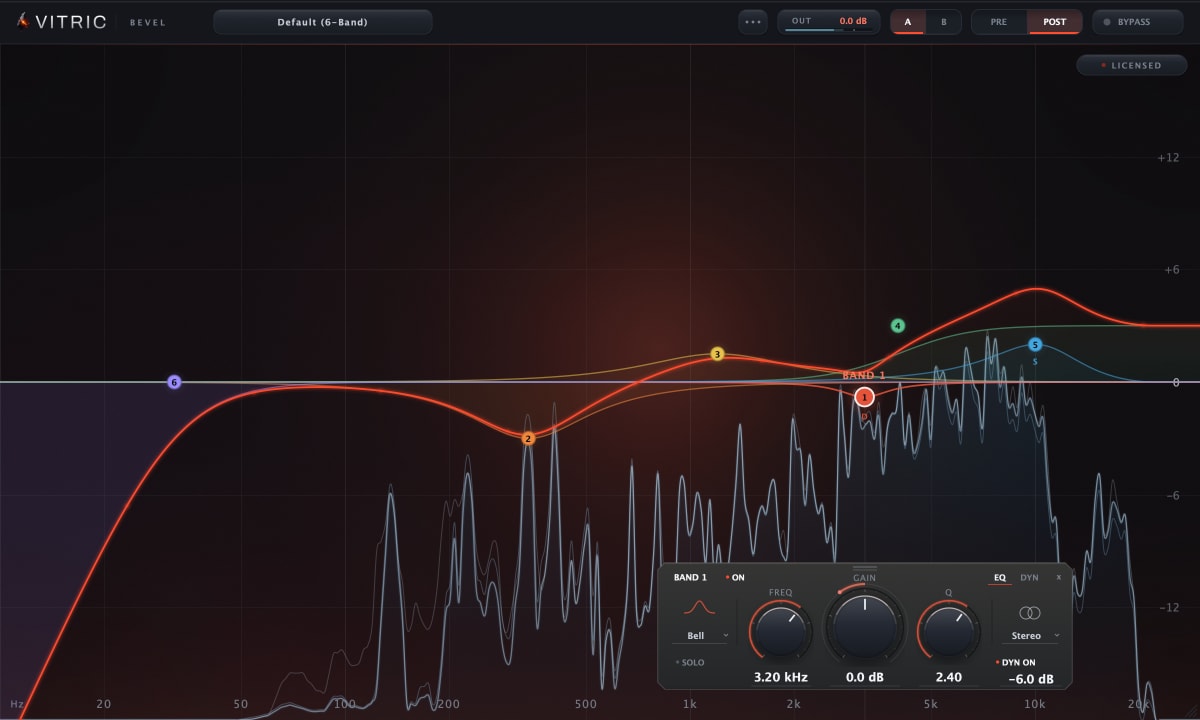
Bevel EQ has 24 freeform bands, each a bell, shelf, notch, high-pass or low-pass, so every move in one column of the table fits in a single instance.
- Set a band to high-pass at 12 dB/oct. Click its frequency readout and type the value; it takes Hz, kHz or a note name, so E2 puts the corner on a guitar's low E. Then drag it lower by ear.
- For mud or boxiness, press SOLO on a bell's band plate to hear only its region while you sweep, then turn the boost into a cut. The hover readout names the nearest note: a peak on a note the part keeps playing may be the music, not a fault.
- Turn on Show pre and post together in Options and watch the cut open a gap between the two traces.
- On a stereo piano, set the band's placement to Mid or Side.
- For the vocal-keyed dip (VST3 and AU), right-click the band, choose Dynamic source, External sidechain, and route the vocal to Bevel's sidechain input. On the DYN page, switch DYN ON and set a negative Range.
- Compare A and B at matched level: A/B does not adjust gain for you, though the optional auto-gain compensates the curve's overall boost or cut.
The Bevel EQ manual covers every control.