
Kiln Synthesizer Wavetable synth plugin
Push the bass hard and keep the sub clean underneath.
Plugin for Mac & Windows.
Try it free on your computer.
Hear the demo. Loudness matched.
About this demo
Factory preset Cinder Basin: a written off-beat 16th-note part from D5 to C6, tuned −21 cents to the beat and mixed 8 LU under it.
The beat is not made with Kiln; only the pluck part is. It was rendered with Kiln 0.2.11 (the same factory preset ships in 0.3.0) and mixed under the beat at one fixed level. Input and processed excerpts are matched in loudness. Switching keeps your place.
Open input audio ↗Open processed audio ↗A wavetable synth plugin with a bass engine, Chord Glide, Glass resonance and 624 factory presets. Shape your own sound, or let Anneal search locally for editable patches inspired by a recording.
Sale price
Pay by card, PayPal, Apple Pay or Google Pay.
By buying, you agree to the EULA and Terms of Service.
Try free for 3 daysOne-time purchase · 3 computers at a time · 14-day money-back guarantee
Instant download: your license key arrives by email right after payment.
Or get all 12 with Vitric Access, $20 a month
Secure checkout by Paddle. No card required for the trial.
Mac & Windows · VST3, AU and AAX · version 1.0.0
Prices in US dollars. Checkout charges in your local currency where available. US and Canadian sales tax is added at checkout. In the EU, UK, Japan and Australia, tax is already included.
The trial uses the full plugin. Install it in your DAW, then start the 3-day trial from its license screen. No card required.
Read the Kiln manualTHE LISTENING ROOM
Listen to Kiln.
One performance. Two perspectives. Loudness matched.
Factory preset Cinder Basin: a written off-beat 16th-note part from D5 to C6, tuned −21 cents to the beat and mixed 8 LU under it.
About this demo
The beat is not made with Kiln; only the pluck part is. It was rendered with Kiln 0.2.11 (the same factory preset ships in 0.3.0) and mixed under the beat at one fixed level. Input and processed excerpts are matched in loudness. Switching keeps your place.
Open input audio ↗Open processed audio ↗IN YOUR SESSION
Move from an idea to an editable patch.
Kiln is a wavetable synthesizer with three oscillator slots: each runs as one of its wavetable oscillators, an analog morph or a sample player. Build across oscillators, filters, modulation and effects, or drop audio into Anneal and let an evolutionary search breed four ordinary, editable patches toward it on your own machine. The result is a starting point for editing, not a promise of exact resynthesis. Either way you end up in the same place: a patch made of ordinary parameters you can keep shaping.
NEW IN 1.0
New in Kiln 1.0.
Chord Glide
Play chord to chord and every note slides from the nearest note of the chord before. Voices never cross, chords of different sizes work, and chords rolled live work too, with no added latency.
A bass engine
Every voice gets its own drive, with six characters and a Low Keep that holds the sub clean underneath. A pitch knock on every note, smooth exponential glide, clean legato, Bass Mono and a clipper on the master.
New sounds
70 new factory presets: sustained sub-bass synths, 808s, growls and grit basses, plus six leads, each with four working macros. 624 in all.
Vibrato that fades in
Each LFO can fade in after the attack, over up to 5 seconds, so vibrato blooms in.
A cleaner engine
Cleaner drive when you push it hard, and voice stealing without clicks: a note that takes over a voice fades it out.
A new interface
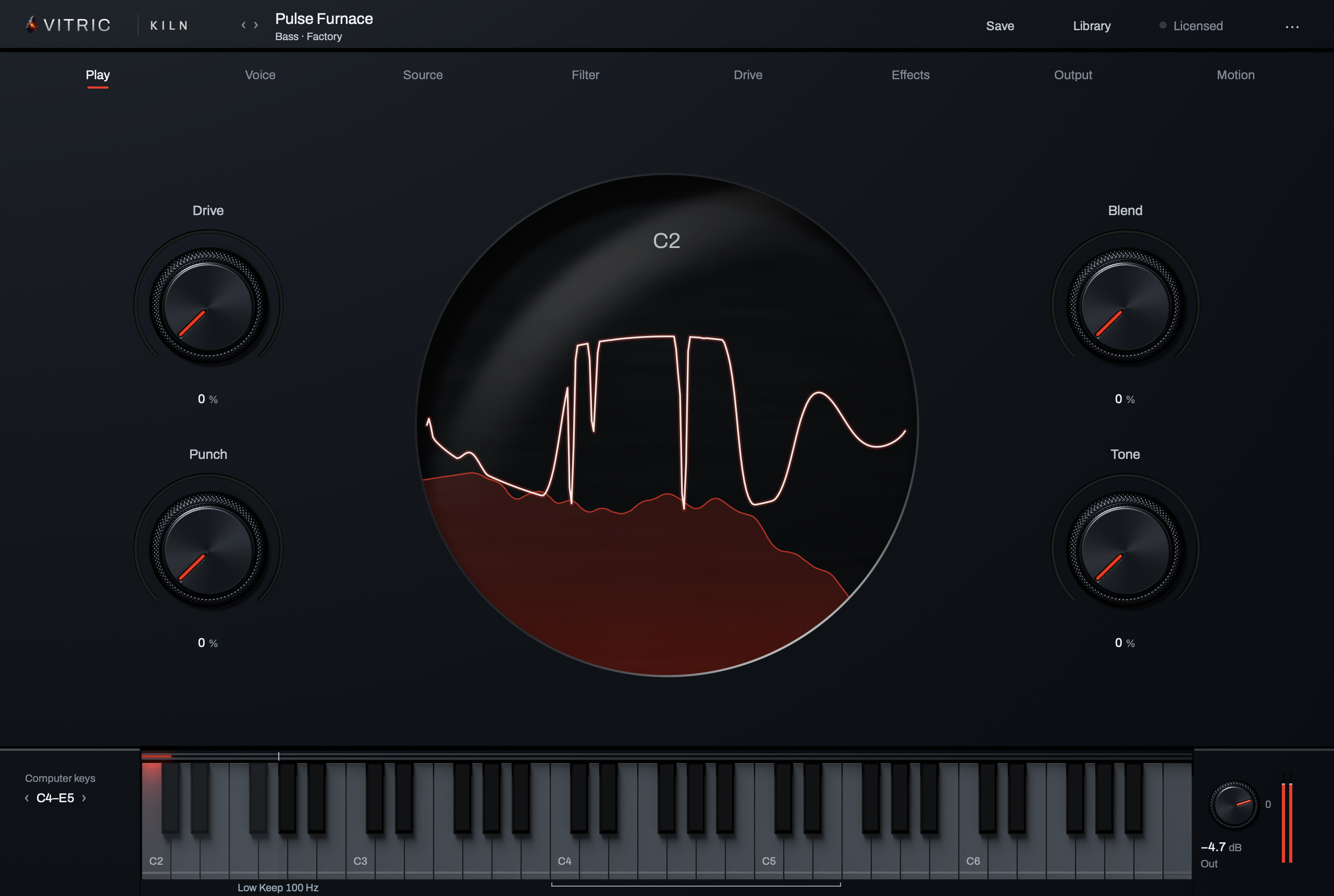
The Play page is one deck of black glass with a round window in the middle that shows the sound as you play: the waveform over its spectrum, with the note or chord name above it.
Projects made with earlier versions open and sound exactly as before.
A CLOSER LOOK
Inside Kiln.
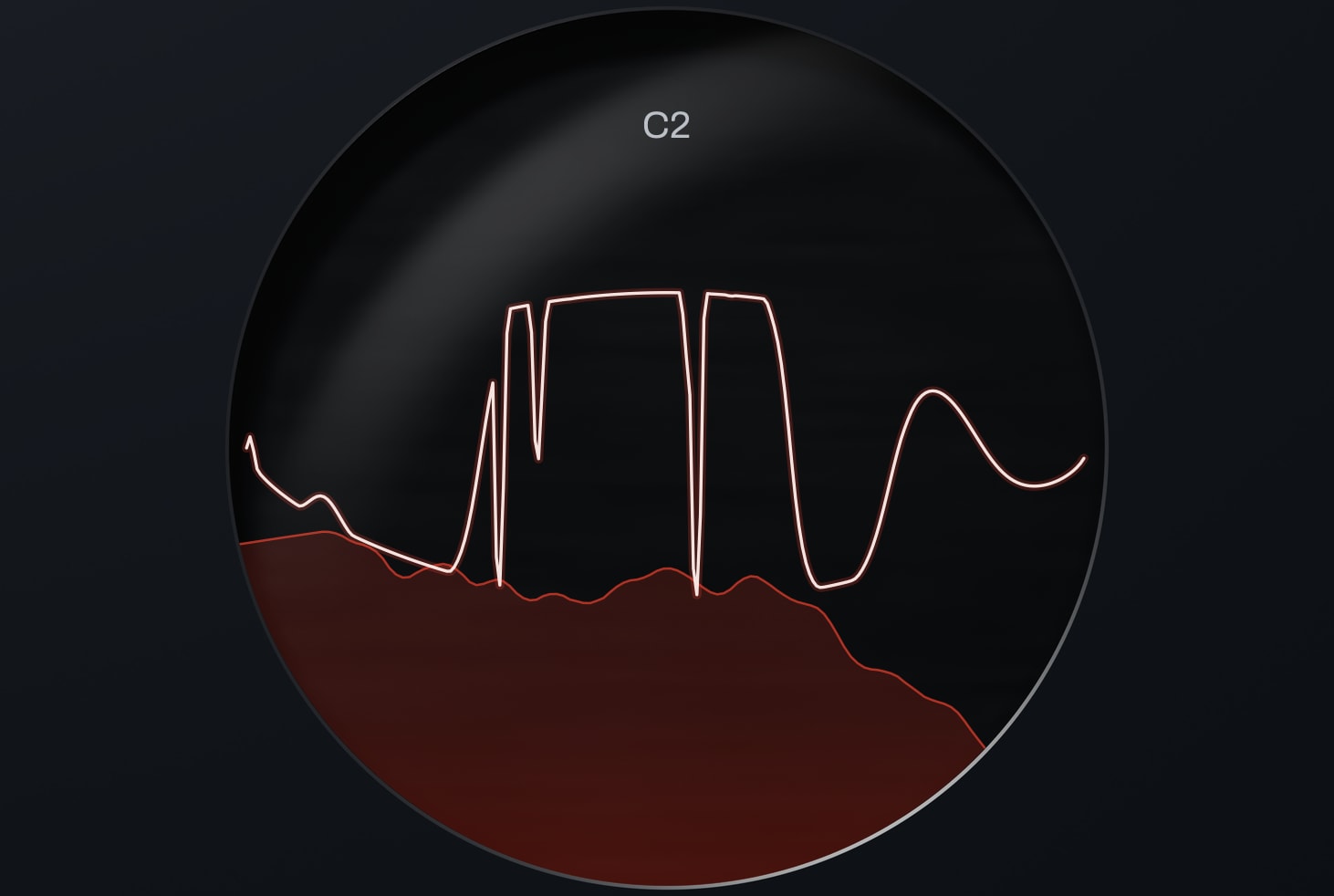
The glass window
The Play page shows the sound as you play it: the waveform over its frequency spectrum, with the note or chord name above. The preset's four macros sit either side, each named for the preset.
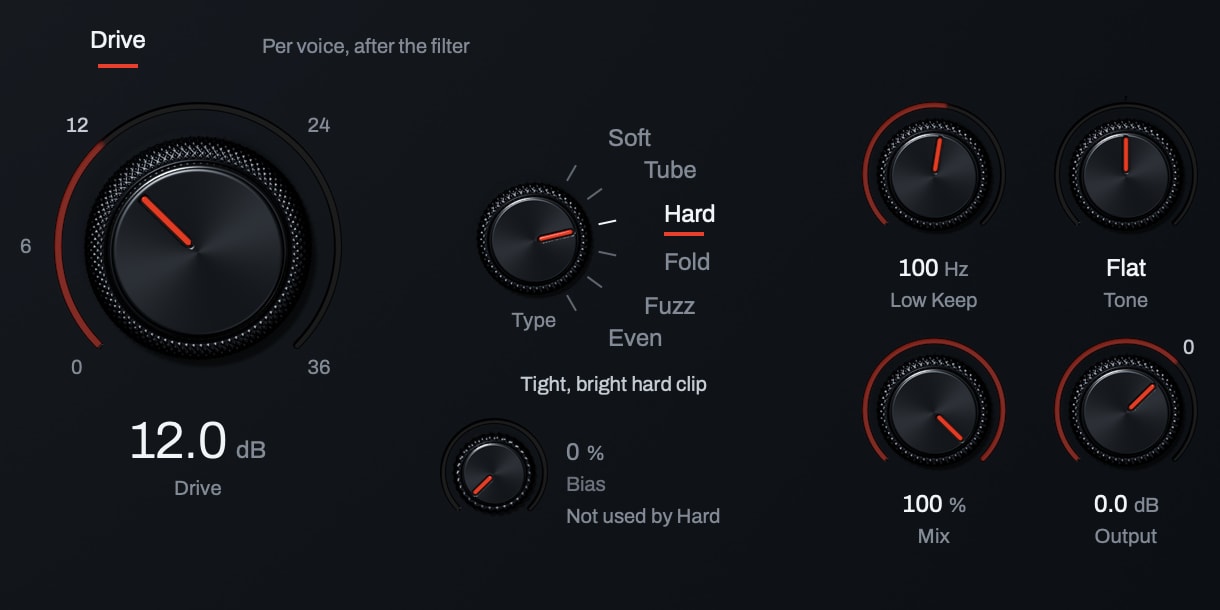
Drive in every voice
Each voice runs its own drive after the filter, in six characters: Soft, Tube, Hard, Fold, Fuzz and Even. Low Keep holds the sub clean underneath, and the meter shows the heat added.
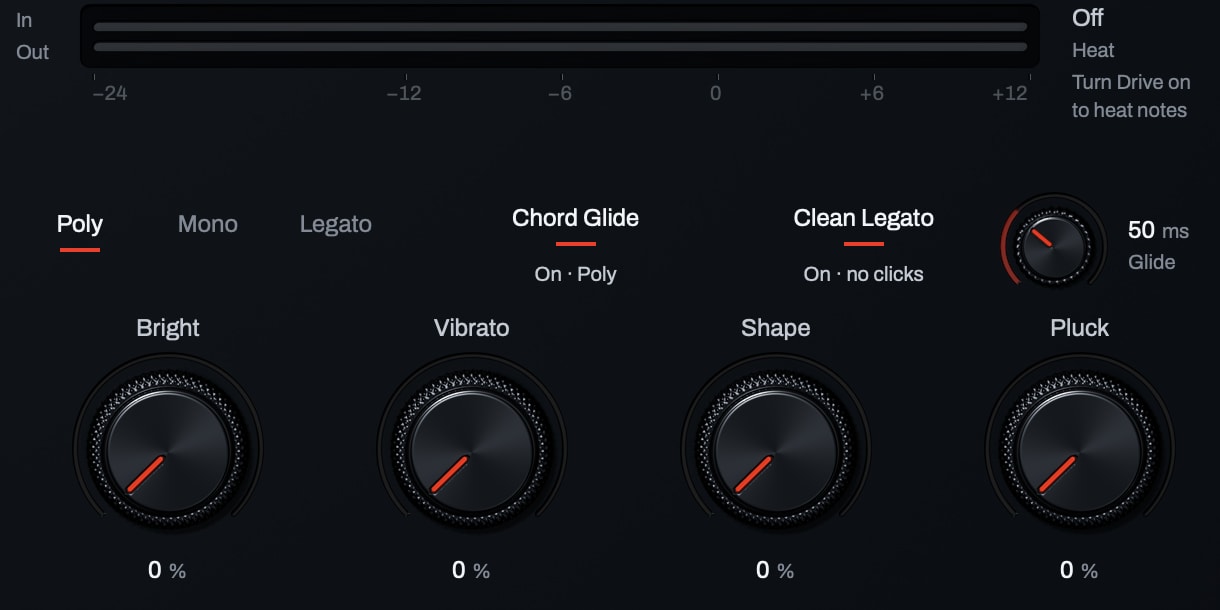
Chord Glide
In Poly, turn on Chord Glide and each note of a chord slides from the nearest note of the chord before, on the same Glide time and curve as mono glide. Clean Legato slides and re-attacks without clicks.
All features & controls
- Chord Glide: each note of a chord glides from the nearest note of the chord before; voices never cross, no added latency
- Per-voice drive in six characters: Soft, Tube, Hard, Fold, Fuzz and Even
- Low Keep holds the sub clean under heavy drive
- A pitch knock on every note, exponential glide and Clean Legato
- Bass Mono below a frequency you set, and a clipper on the master
- LFO fade-in after the attack, up to 5 seconds per LFO
- Cleaner drive and soft clip; voice stealing without clicks
- Projects made with earlier versions open and sound exactly as before
- Three oscillator slots: wavetable, analog morph or sample (WAV, AIFF or FLAC) in each
- Dedicated sub and noise sources beside the three slots
- 16-voice unison per slot; FM between slots
- 80 in-house wavetables, zero third-party content
- Two filter slots: SVF, ladder, comb, formant or Glass
- The ladder self-oscillates in tune within plus or minus 0.1 cents across five octaves
- Per-voice analog drift is seeded: a fresh instance plays the same notes with the same drift
- Glass modal resonator as a first-class per-voice filter: Material, Size, Position and Damp, with Shimmer as a modulation target
- 82 factory Glass patches carry the signature timbre
- 48-slot modulation matrix; depths automatable and themselves modulatable
- Four DAHDSR envelopes, four LFOs, random and chaos sources
- Four macros as matrix sources: every factory patch routes macro 1; other macro routes depend on the patch
- Nine effects; Ultra quality when the host reports offline rendering
- Anneal: fully local sound-guided patch search returning four editable patches
- Purchased licenses work offline; trials require an internet connection
- MPE per-note bend (the standard 48-semitone range), pressure and slide; bend accuracy measured at minus 0.2 cents
- MTS-ESP microtuning, plus Scala .scl scales and .kbm keyboard maps saved with the session
- 624 factory presets, tagged by category; the basses from before 1.0 stay under Legacy Bass
- 28 MPE patches and a Learn tag in the library
- AU, VST3 and AAX on macOS; VST3 and AAX on Windows
624 presets, tagged
The library searches by name and filters by tag: All, Bass, Lead, Pad, Keys, Pluck, Glass and FX. The basses from before 1.0 stay in the library under Legacy Bass.
Anneal
Drop audio into Anneal. It analyzes the first four seconds and searches locally for editable patches with a related tone and envelope.
Any source, any slot
The Source page holds three oscillator slots. Each switches between WT, ANA and SMP, loads a wavetable, and sets level, table and shape over its unison, detune, spread, pan, octave, semitone, fine, pulse width and FM rows.
Tuning, drive and recovery, measured
| Claim | Measured |
|---|---|
| Old projects sound the same | Every shipped preset rendered in 0.3 and in 1.0: 1236 of 1236 identical |
| Low Keep holds the sub | Within 2 dB under heavy drive, while the harmonics above 150 Hz rise more than 12 dB |
| Bass Mono | The side signal below 60 Hz falls more than 30 dB; the top is left alone |
| Voice stealing | A stolen voice fades out over 5 ms instead of being cut |
| The ladder tracks | Self-oscillates in tune within plus or minus 0.1 cents across five octaves |
| MPE bend lands | Bend accuracy measured at minus 0.2 cents over the standard 48-semitone MPE range |
| Scala tuning lands | A +50 cent .scl table plays A4 at +50.000 cents in the test suite |
| Anneal recovers | Self-recovery eval: 6 of 6 within the family bar |
| Seeded drift | Per-voice analog drift is seeded, so a fresh instance plays the same notes with the same drift |
Put it to work.
Start from a reference sound
Drop audio into Anneal and choose from four editable patches generated on your own machine.
Basses and leads
Drive every voice and keep the sub clean under it, glide legato without clicks, and narrow the low end with Bass Mono. Three oscillator slots with 16-voice unison each and FM between slots add weight and bite that stay tuned.
Textures and keys
The Glass modal resonator turns any source physical: Material, Size, Position and Damp on the panel, Shimmer as a modulation target, per voice, with 82 factory Glass patches to start from.
Performance
MPE with per-note bend, pressure and slide, bend accuracy measured at minus 0.2 cents, four macros as matrix sources, and 28 dedicated MPE patches in the library.
THE DETAILS
Fits your setup.
- Oscillators
- 3 slots (wavetable · analog morph · sample) + sub + noise
- Unison
- 16 voices per slot; FM between slots
- Filters
- 2 slots · SVF, ladder, comb, formant · Glass modal resonator
- Modulation
- 48 slots · 4 DAHDSR · 4 LFOs · random and chaos · 4 macros
- Effects
- 9
- Library
- 624 presets · 80 in-house wavetables · 82 Glass patches
- Bass engine
- Per-voice drive (6 characters) · Low Keep · knock · glide curve · Clean Legato · Bass Mono · master clipper
- Glide
- Mono and legato glide · Chord Glide in Poly
- Tuning
- MTS-ESP · Scala .scl and .kbm
- MPE
- Per-note bend (48 semitones), pressure, slide; bend accuracy minus 0.2 cents
- Formats
- VST3 and AAX on macOS and Windows · AU on macOS
- Platforms
- Windows 10+ (64-bit) · macOS 10.15+ Intel / 11+ Apple Silicon
- Made in
- USA
- Windows
- Windows 10 or later, 64-bit. VST3, AAX, Standalone.
- macOS
- macOS 10.15 or later on Intel; macOS 11 or later on Apple Silicon. AU, VST3, AAX.
- Hosts
- A 64-bit host supporting your platform’s plugin format. Your DAW may require a newer operating system.
Use it in Pro Tools, Logic Pro, Ableton Live, Cubase, Studio One, FL Studio, REAPER, Bitwig Studio, and other compatible hosts.
Find the right format for your DAWQuestions about Kiln.
What is new in Kiln 1.0?
Chord Glide, a bass engine with drive in every voice, 70 new factory sounds, vibrato that fades in, a cleaner engine and a new interface.
Will my Kiln projects still sound the same?
Yes. Projects made with earlier versions open and sound exactly as before. They keep the previous engine, and every new control is off in them.
What is Anneal?
A local audio-analysis and patch-search workflow. Drop a sound and an evolutionary search breeds four ordinary, editable patches toward it. It is a starting point for editing, not exact resynthesis.
Does Anneal need an internet connection?
Anneal’s analysis and search run locally. Purchased licenses work offline; trial licenses need a live internet connection, and the plugin checks in every few minutes.
Which oscillator types are present?
Wavetable, analog morph or sample in each of the three slots, plus dedicated sub and noise sources. SMP plays a WAV, AIFF or FLAC file you click to load or drop on the OSC panel; the session saves a copy of it, or a link to the file past 16 MB per patch.
Does the ladder filter track?
It self-oscillates in tune within plus or minus 0.1 cents across five octaves. Per-voice analog drift is seeded, so a fresh instance plays the same notes with the same drift.
Which formats and platforms?
AU, VST3 and AAX on macOS; VST3 and AAX on Windows. Check the system requirements and your DAW’s supported formats.
Is there a free trial?
Yes. Every released Vitric plugin has a free 3 day trial with every feature available during the trial window. Trials need a live internet connection; the plugin checks in every few minutes. Purchased perpetual licenses work offline. Get the installer from the downloads page and request your machine-bound trial license on the trial page. At the signed expiry the plugin’s output goes silent until you install a purchased license or a valid subscription grant. The plugin can still load, so projects and saved settings are not deleted.
Own Kiln Synthesizer? Leave a verified review from your account.
Vitric Sounds
More sounds for Kiln.
Preset expansions that load in Kiln's own browser. Preview every preset, and get every pack with Vitric Pro.

FREE STUDIO TOOLS
Work out the next move.
Measure a mix or find a starting point. These tools run in your browser, with no account required.
GUIDES & JOURNAL
The technique behind Kiln.
Practical explanations, build stories and examples to try in your own session.
PART OF THE COLLECTION
Kiln, in a bundle.
Kiln is included in these bundles. Compare their contents and current offers.
Find its next partner.
Explore all plugins
Hear it in your own session.
Kiln. $49, or try it free for 3 days.
By buying, you agree to the EULA and Terms of Service.
Try free for 3 daysOne-time purchase · 3 computers at a time · 14-day money-back guarantee
Instant download: your license key arrives by email right after payment.
Or get all 12 with Vitric Access, $20 a month