How to EQ bass: low end, mud and definition
Where to EQ a bass guitar, synth bass or 808: the weight in the low notes, the mud above them, and the growl and pick noise that make a bass heard. Frequency ranges, first moves, and how to keep it clear of the kick.
Bass EQ is mostly about two things: keeping the low end solid without letting it turn to mud, and giving the bass enough upper detail to be heard on small speakers and against the kick. The ranges below are where to listen first. Judge every move with the kick playing, and with the whole mix, not soloed.
Before you EQ
Get the part right first. On an 808, check the tuning and the note lengths: an 808 is often the bass instrument and its fundamental follows the notes, so a fixed deep notch that suits one note can hollow out another. See how to tune an 808.
Weight: the low notes
A four-string bass guitar's low notes start at E1, 41 Hz (a five-string adds B0, 31 Hz), and an 808 usually plays from C1 to G2, about 33 to 98 Hz. For more weight, try 1 to 3 dB around 60 to 100 Hz with a broad bell, and compare at matched loudness. Be careful with automatic high-pass filters: one set at 40 Hz can weaken the very part you meant to keep. Filter below the lowest note you want only if there is unwanted energy down there. More on the lowest band in sub bass.
Mud: the low mids
Between about 200 and 400 Hz, a bass can blur into the guitars, keys and vocal. If the low mids sound muddy, the cut often belongs on the guitars, keys or pads piling up there; cut the bass a little only if it is the one adding it. On an 808, the upper bass around 150 to 300 Hz can crowd the vocal or keys: audition a 1 to 2 dB cut at Q 1 to 2, but only if those harmonics are excessive, because they also help the 808 remain audible on small speakers.
Definition: growl and pick
A bass guitar's growl sits around 600 Hz to 1 kHz, and its string and pick noise around 2 to 5 kHz. A small boost around 800 Hz to 1.5 kHz, where a bass's upper harmonics live, helps it read on phones and laptops, whose speakers cannot play the low fundamentals. On a synth bass or 808 that is almost a pure tone, EQ cannot add what is not there: add harmonics with saturation instead.
Bass and kick
The kick and the bass share the low end. Give them their own lanes: where you boost one, cut the other a little at the same frequency. If the bass still covers every kick hit, level, note length or sidechain ducking may solve it more directly than EQ. For the kick side, see how to EQ drums.
Notes that boom
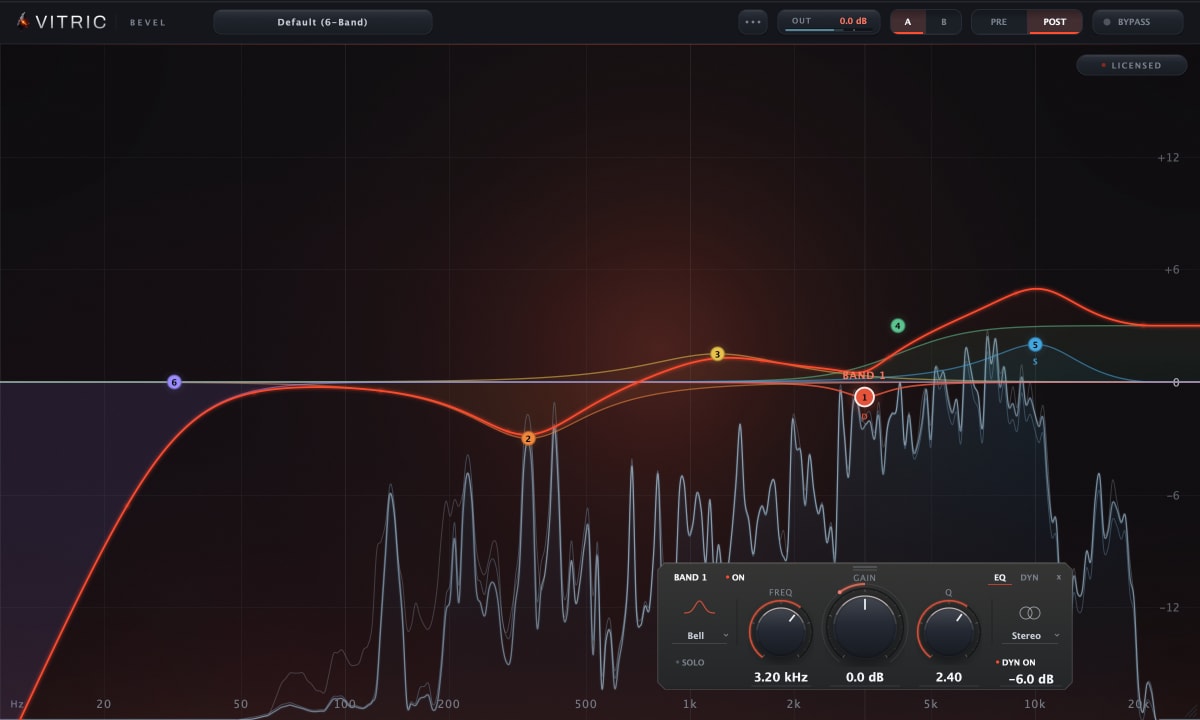
If only a few notes jump out, a static cut can thin the rest. Turn those notes down with clip gain, or use a dynamic EQ band at the offending frequency so it only cuts when that note rings.
Bass EQ with Vitric plugins
- Bevel EQ is a 24-band dynamic EQ for resonances that come and go, so a booming note can be cut only when its band crosses the threshold you set. Each band can work in stereo, left, right, mid or side.
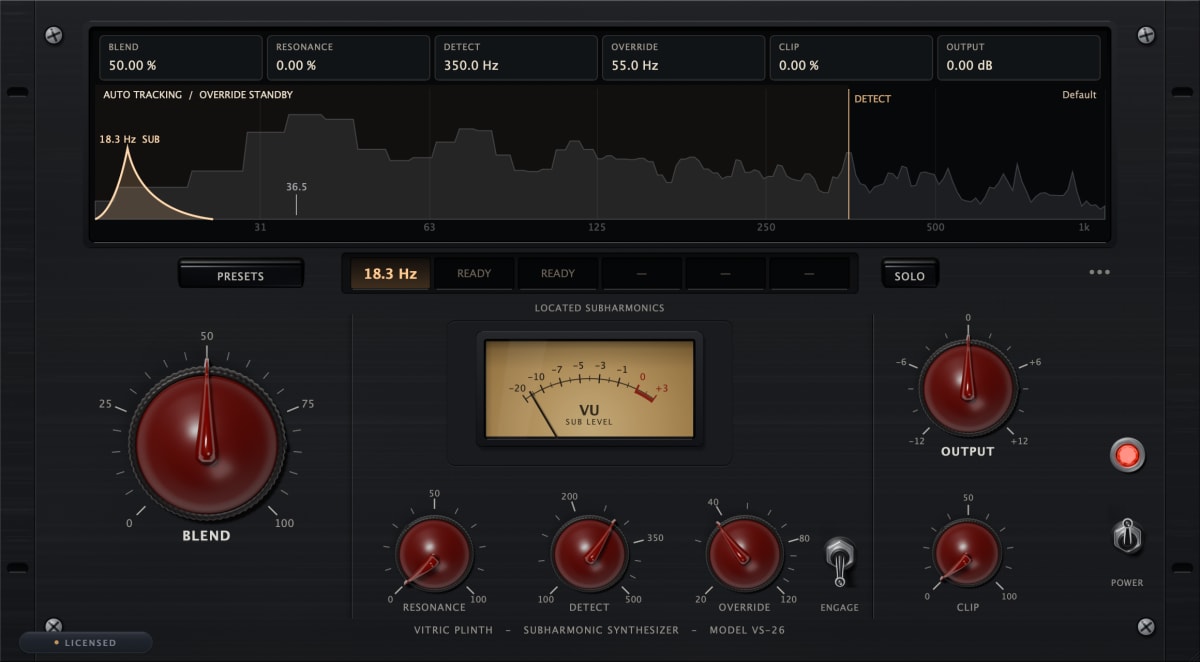
- Plinth Subharmonic Synthesizer adds a mono sub one octave beneath the fundamentals of a bass that lacks weight, with Blend to set its level.
Questions
What frequency should I boost on bass?
For weight, 1 to 3 dB around 60 to 100 Hz. For definition on small speakers, a small boost around 800 Hz to 1.5 kHz.
Should I high-pass the bass?
Only below its lowest wanted note, and only if there is rumble or unwanted energy there. A fixed 40 Hz high-pass can cut into the low notes you want.
How do I stop the bass and kick clashing?
Give each its own lane with small opposite EQ moves, then try level, note length or sidechain ducking.