Human hearing range: 20 Hz to 20 kHz, and what it means for a mix
People hear roughly 20 Hz to 20 kHz, most sharply between 2 and 5 kHz, and the top of the range fades with age. Here is the range, why bass needs far more level to sound as loud, and what that changes when you mix.
The human hearing range is usually given as 20 Hz to 20 kHz. That is a young listener's range, and it is not flat: the ear is most sensitive between 2 and 5 kHz, the top of the range fades with age, and the lowest notes need far more level than the middle to sound as loud. All three change how a mix sounds.
What is the human hearing range?
20 to 20,000 Hz is the range the textbooks give. In ideal lab conditions people have heard tones as low as 12 Hz and as high as 28 kHz, but the threshold climbs steeply above about 15 kHz in adults, and the upper limit starts to fall from around the age of eight. By comparison, dogs hear from about 67 Hz to 45 kHz, cats from 55 Hz to 79 kHz, and some bats up to 200 kHz.
The quietest sound you can hear also depends on frequency. Under ISO 226 (the 2003 edition; the 2023 revision moves these figures by under 1 dB), a young listener hears a 1 kHz tone at about 2 dB SPL and a 3.15 kHz tone below 0 dB, while a 20 Hz tone has to reach about 78 dB before it is heard at all.
Why doesn't every frequency sound equally loud?
Because the ear is not a flat microphone. Equal-loudness contours, first measured by Harvey Fletcher and Wilden Munson in 1933 and now standardized as ISO 226, show how loud each frequency has to be to sound as loud as a 1 kHz tone. Each curve is one loudness level, measured in phon.
Read across one curve. At 40 phon, a quiet listening level, a 1 kHz tone at 40 dB sounds as loud as 100 Hz at about 64 dB and 50 Hz at about 78 dB. At 80 phon, a loud level, 50 Hz needs about 102 dB against 80 dB at 1 kHz. The gap at 50 Hz shrinks from about 38 dB to about 22 dB as you turn up: the bass gets relatively louder.
What does it mean for a mix?
- Listening level changes the balance. A mix balanced loud sounds thin when played quietly, and one balanced quietly can boom when played loud, because the ear's bass sensitivity moves with level. Pick a moderate level for most of the work and check at a quiet and a loud one before you finish.
- 2 to 5 kHz is where the ear is most sensitive. Sound here reads as presence at a lower level than anywhere else, and too much turns harsh and tiring, so boost in small steps and check it at more than one listening level.
- The top end may be past your ears. Many adults hear little above 15 kHz, so hiss, noise and over-bright shelves up there can slip through. Check that range on a spectrum analyzer as well as by ear; the guide to reading one shows what to look for.
- Below 20 Hz costs headroom. Energy down there is barely heard but still pushes the meters and the limiter. High-pass the tracks that have no reason to be there.
- Small speakers need harmonics. Phone and laptop speakers often cannot play the lowest notes, but the ear rebuilds a missing fundamental from its harmonics: hear 200, 300 and 400 Hz together and you can still hear a 100 Hz pitch. Saturation and a little level around 1 kHz help a bass or an 808 read on small speakers. See what a saturator does and how to tune an 808.
The audio frequency spectrum, band by band
These are the working ranges from the EQ frequency chart, where you can play each band and see the instruments that live in it. They are places to start listening, not hard borders, and neighbors overlap.
| Band | Range | What it sounds like |
|---|---|---|
| Sub | 20 Hz to 60 Hz | Felt as much as heard. The fundamentals of kicks, 808s and the lowest bass notes. Too much eats headroom and makes a limiter pump; too little and the track feels small on a system with a subwoofer. |
| Low end | 60 Hz to 250 Hz | Weight and punch: bass notes, kick body, the low half of guitars and piano and the chest of a male voice. Warmth when balanced, boom when overloaded. |
| Mud | 200 Hz to 500 Hz | Where mixes turn cloudy. Many instruments stack their low harmonics here, so a mix can sound thick, dull and indistinct even though no single track is wrong. |
| Boxiness | 300 Hz to 700 Hz | A hollow, cardboard sound, common on close-miked drums, vocals recorded in small rooms and some cheap microphones. |
| Honk | 800 Hz to 1.5 kHz | Nasal, telephone-like and honky. Horns, some guitar tones and nasal voices push hard here. |
| Harshness | 2 kHz to 5 kHz | The ear is most sensitive in this region. A little brings clarity and presence; too much is harsh, brittle and tiring at high volume. |
| Sibilance | 5 kHz to 10 kHz | The s, t and sh sounds of a voice, plus hi-hat and cymbal splash. It gets exaggerated by bright microphones, compression and high shelf boosts. |
| Air | 10 kHz to 20 kHz | Openness, breath and sheen. Gentle lifts sound expensive; overdone, a mix turns brittle and noisy. Hearing up here fades with age, so check it on a spectrum analyzer as well as by ear. |
Seeing what you can't hear
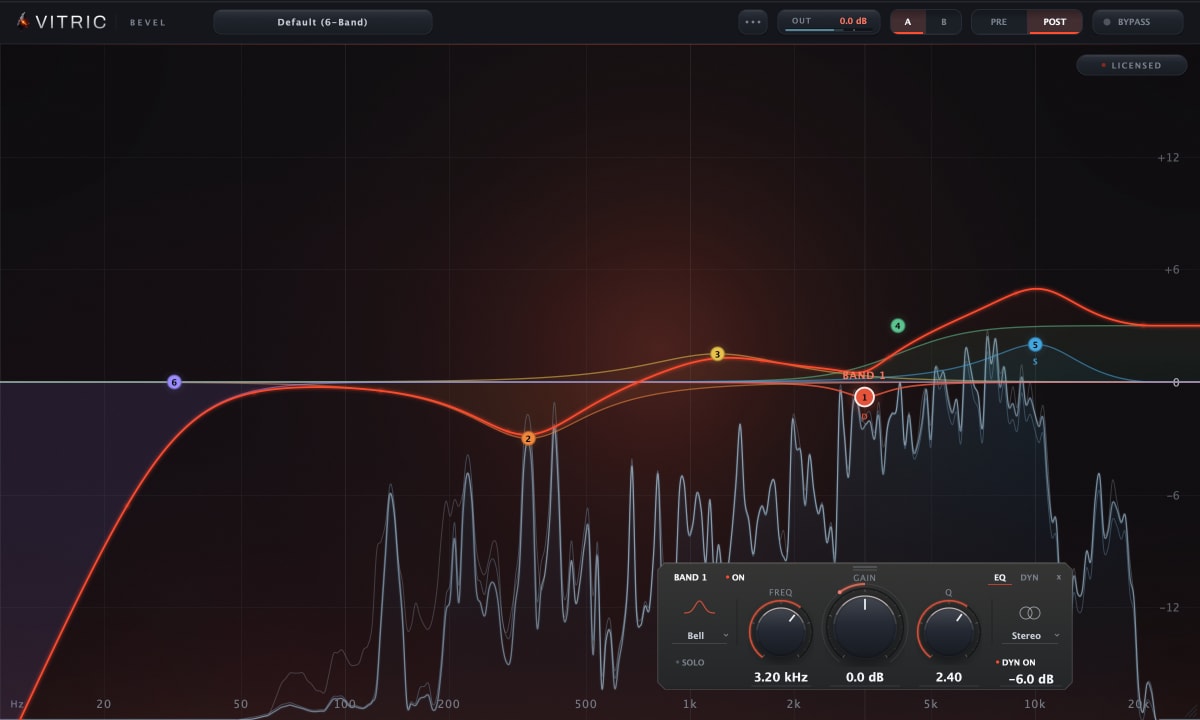
Bevel EQ draws the spectrum before and after the EQ, with both traces together when you turn that on in Options, so a resonance, a rumble or a hiss you can barely hear still shows on screen while you work on it.
Questions
What is the human hearing range in Hz?
About 20 to 20,000 Hz for a young listener. The top end usually falls with age.
Which frequencies are humans most sensitive to?
Between 2 and 5 kHz. In the ISO 226:2003 contours the ear is most sensitive around 3 to 4 kHz.
Can people hear above 20 kHz?
In ideal lab conditions, tones up to about 28 kHz have been heard, but most adults' hearing falls off steeply above about 15 kHz.
Why can I hear the bass on my phone if its speaker can't play it?
The ear works out the pitch of a missing fundamental from its harmonics. You hear the bass line's notes through its upper harmonics, even though the fundamentals themselves never leave the speaker.
Is an online hearing test accurate?
Test tones played through your own speakers or headphones measure the playback as much as your ears. An audiologist's hearing test is the real measure.