What is a Pultec EQ? The EQP-1A and the low-end trick
The Pultec EQP-1A is a passive tube program EQ from the 1950s and 60s, famous for broad, gentle curves and the low-end trick: boosting and cutting the bass at once. Here is how its controls work and how to use the trick.
A Pultec is a passive equalizer made by Pulse Techniques, a company founded in 1953 in Teaneck, New Jersey; the name is short for the company's. The EQP-1 followed in the 1950s (Sound On Sound dates it to 1953, other histories to 1956), and the updated EQP-1A around 1960 to 1961. Its passive circuit leaves the signal about 20 dB quieter when set flat, so a tube amplifier stage after it brings the level back to unity. Production stopped in 1981; a new company, Pulse Techniques LLC, resumed it around 2010, and the design has been emulated by various plugins. It is known for gentle curves and for one move in particular: the low-end trick.
The controls
| Section | What it does | Settings on the EQP-1A |
|---|---|---|
| Low frequency | A Boost knob and an Atten knob that share one frequency | 20, 30, 60 or 100 Hz |
| High-frequency boost | A boost with a Bandwidth control, from sharp to broad | From 3 to 16 kHz |
| High-frequency atten | A separate cut of the top end | 5, 10 or 20 kHz |
The frequencies are stepped choices, not a sweep. The Bandwidth control matters for level as well as shape: Sound On Sound notes that the maximum boost is 9 dB greater at the narrow setting than at the broad one.
The low-end trick
The original manual said the low Boost and Atten should not be used together. Engineers did it anyway, and today they are usually used that way. The boost and the cut act on slightly different ranges of low frequencies, so they do not cancel. In Sound On Sound's words, "typically, the result is a low-frequency boost with a cut about an octave higher". Its reviewer found that 60 Hz, with both knobs at 2, "really helped to fill out the low end of a mix without making it muddy".
To try it: pick the frequency, raise Boost until the low end is a little heavier than you want, then raise Atten until the boom clears and the weight stays. Compare with the EQ bypassed at the same level.
The high end
The high-frequency boost is broad at its wide setting, which suits a gentle lift of the top of a mix. In the same review, a boost of 3 at 10 or 12 kHz "brought out a lovely high-end gloss".
A Pultec-style curve in a parametric EQ
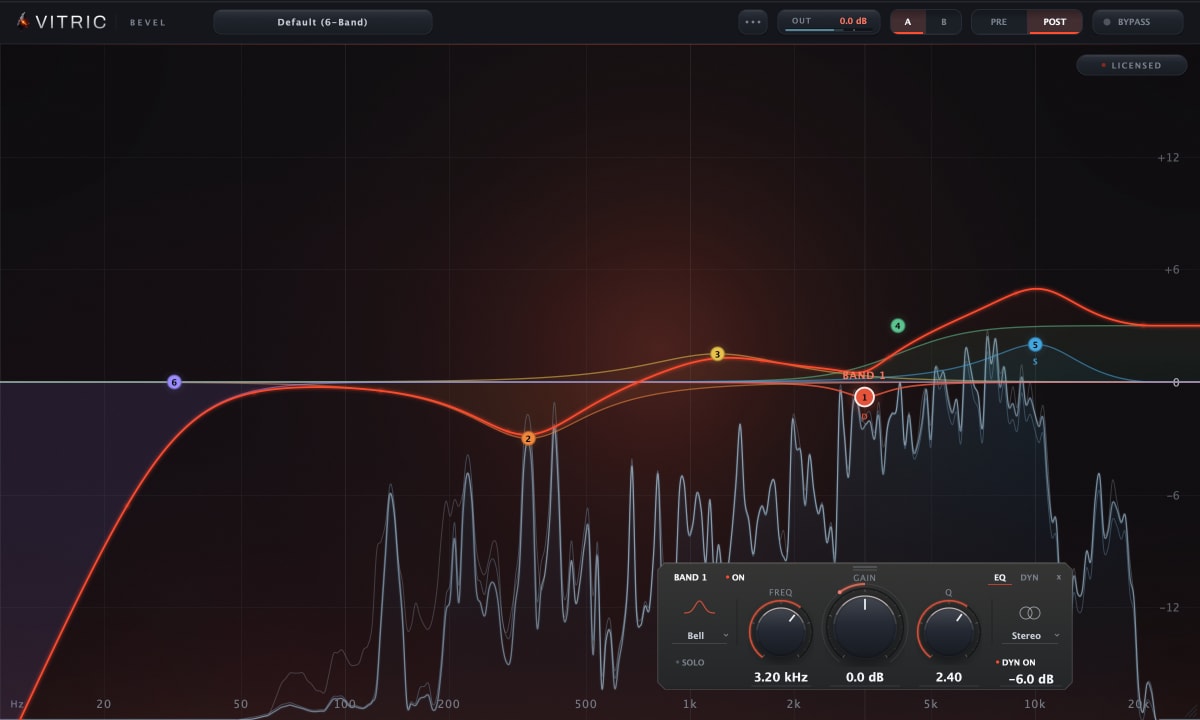
The illustration above is drawn the way you can build a similar shape in any parametric EQ: a low shelf boost, plus a gentle bell cut a little over an octave above the shelf's corner. Bevel EQ has bells and shelves on up to 24 bands, and each band can work in stereo, left, right, mid or side. For how the curves themselves work, see what a parametric EQ is.
Questions
What does Pultec stand for?
Pulse Techniques, the company that made it.
What is the difference between the EQP-1 and the EQP-1A?
The EQP-1A added frequency options, including a 20 Hz low setting and a 16 kHz high-boost setting, plus 5 and 20 kHz settings for the high attenuation, which on the EQP-1 was fixed at 10 kHz.
Why boost and cut at the same frequency?
On a Pultec the cut starts roughly half an octave above the boost, so turning both up gives more low end with a dip above it that reduces muddiness.