
Plinth Subharmonic Synthesizer plugin
Add a mono sub one octave beneath your kick or bass.
Plugin for Mac & Windows.
Try it free on your computer.
Hear the demo. Loudness matched.
Use headphones or monitors. Phone and laptop speakers can’t play this low.
About this demo
Blend at 50%, detector at 350 Hz, resonance and clip at zero.
Rendered through Plinth Subharmonic Synthesizer 0.1.3 on macOS. Input and processed excerpts are matched in loudness. Switching keeps your place.
Open input audio ↗Open processed audio ↗A subharmonic synthesizer plugin that generates a mono sub one octave beneath the fundamentals in your audio. See the detected source and added sub together, then set its level with Blend.
Sale price
Pay by card, PayPal, Apple Pay or Google Pay.
By buying, you agree to the EULA and Terms of Service.
Try free for 3 daysOne-time purchase · 3 computers at a time · 14-day money-back guarantee
Instant download: your license key arrives by email right after payment.
Or get all 12 with Vitric Access, $20 a month
Secure checkout by Paddle. No card required for the trial.
Mac & Windows · VST3, AU and AAX · version 0.2.10
Prices in US dollars. Checkout charges in your local currency where available. US and Canadian sales tax is added at checkout. In the EU, UK, Japan and Australia, tax is already included.
The trial uses the full plugin. Install it in your DAW, then start the 3-day trial from its license screen. No card required.
Read the Plinth manualTHE LISTENING ROOM
Listen to Plinth.
One performance. Two perspectives. Loudness matched.
Use headphones or monitors. Phone and laptop speakers can’t play this low.
Blend at 50%, detector at 350 Hz, resonance and clip at zero.
About this demo
Rendered through Plinth Subharmonic Synthesizer 0.1.3 on macOS. Input and processed excerpts are matched in loudness. Switching keeps your place.
Open input audio ↗Open processed audio ↗IN MOTION
Plinth, running.
IN YOUR SESSION
See what your low end is doing.
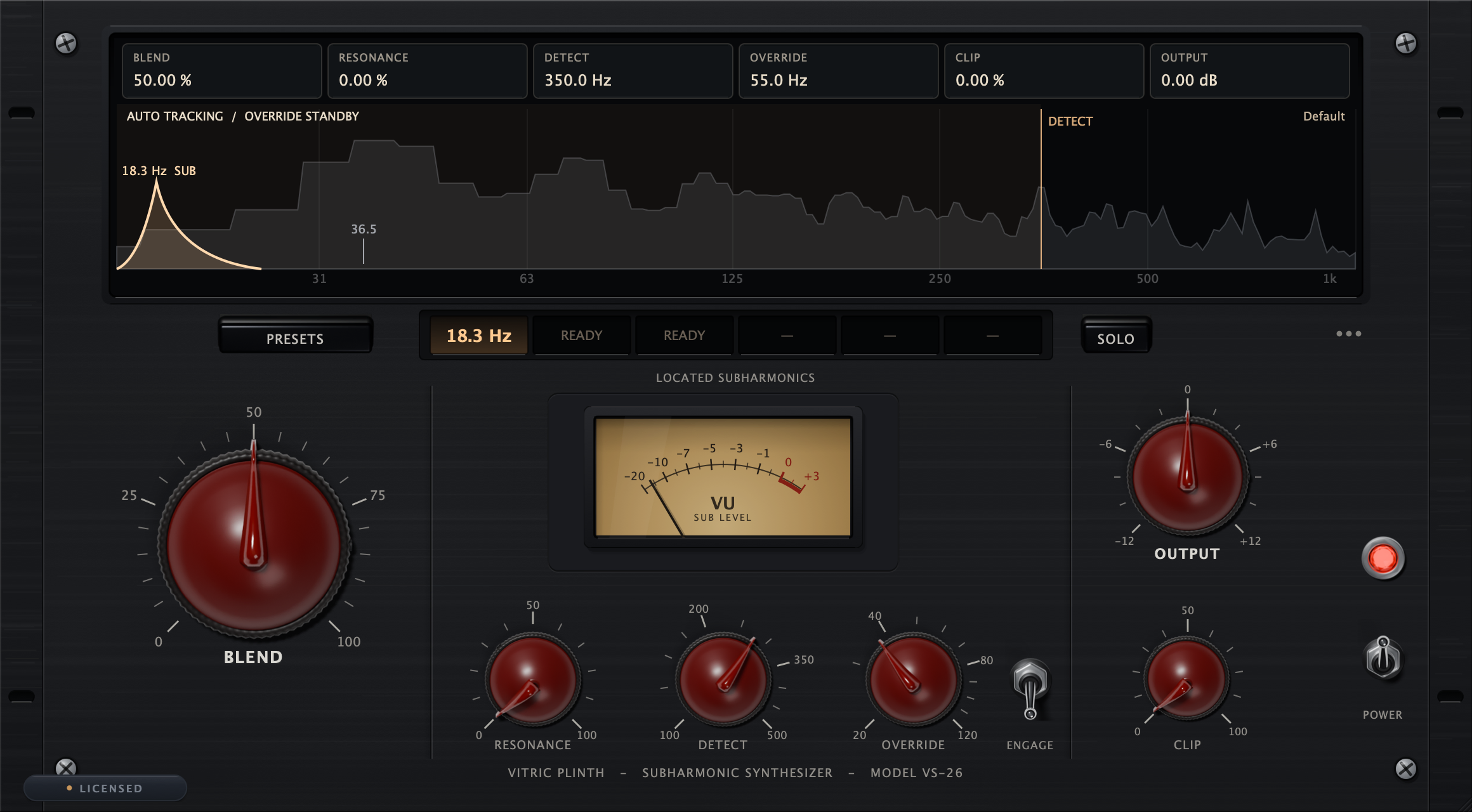
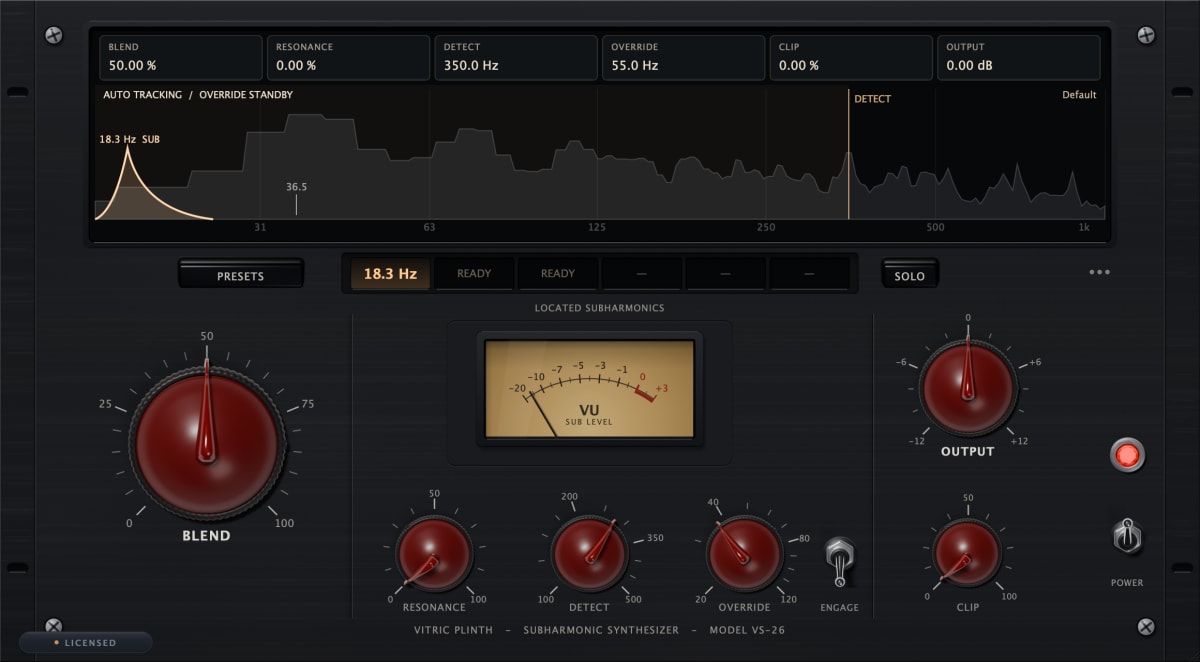
A filtered mono detector follows the fundamentals in your source, with up to three generated voices one octave below. The analyzer separates the source from the added sub, and frequency chips let you mute individual voices. Blend adds the sub to your dry signal; Resonance changes its bloom, and optional Clip controls the summed peaks.
A CLOSER LOOK
Inside Plinth.

The sub it made
The analyzer separates the detected 36.5 Hz fundamental from the generated 18.3 Hz sub.
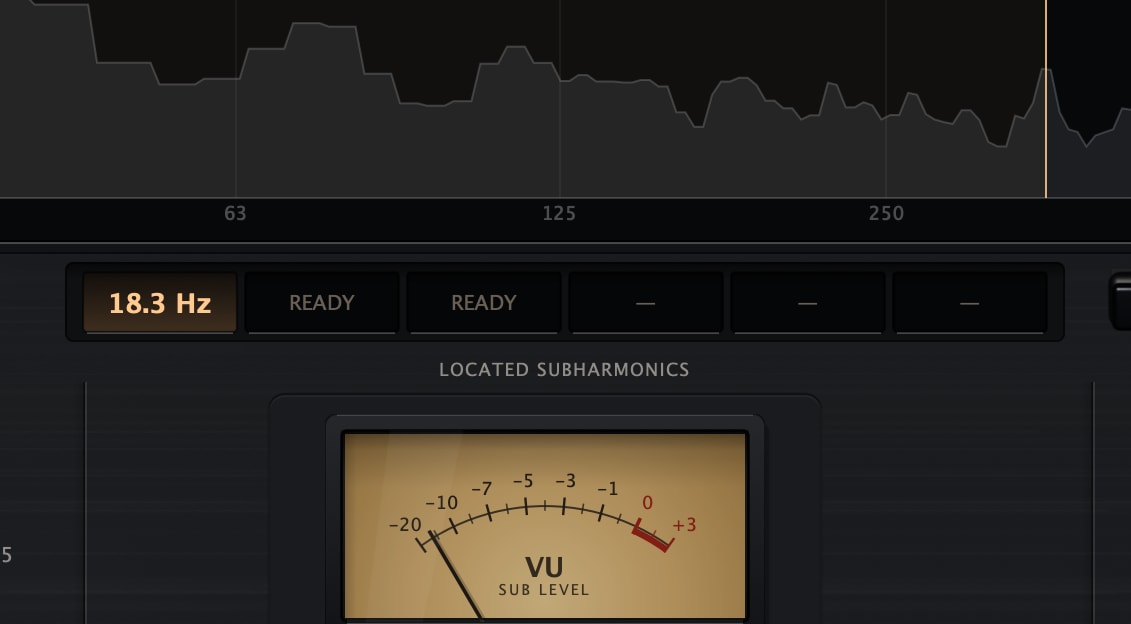
Three voices, one chip each
The first three chips show up to three generated voices at once; click one to mute or restore its voice. The last three tiles in the row are reserved and stay dark.
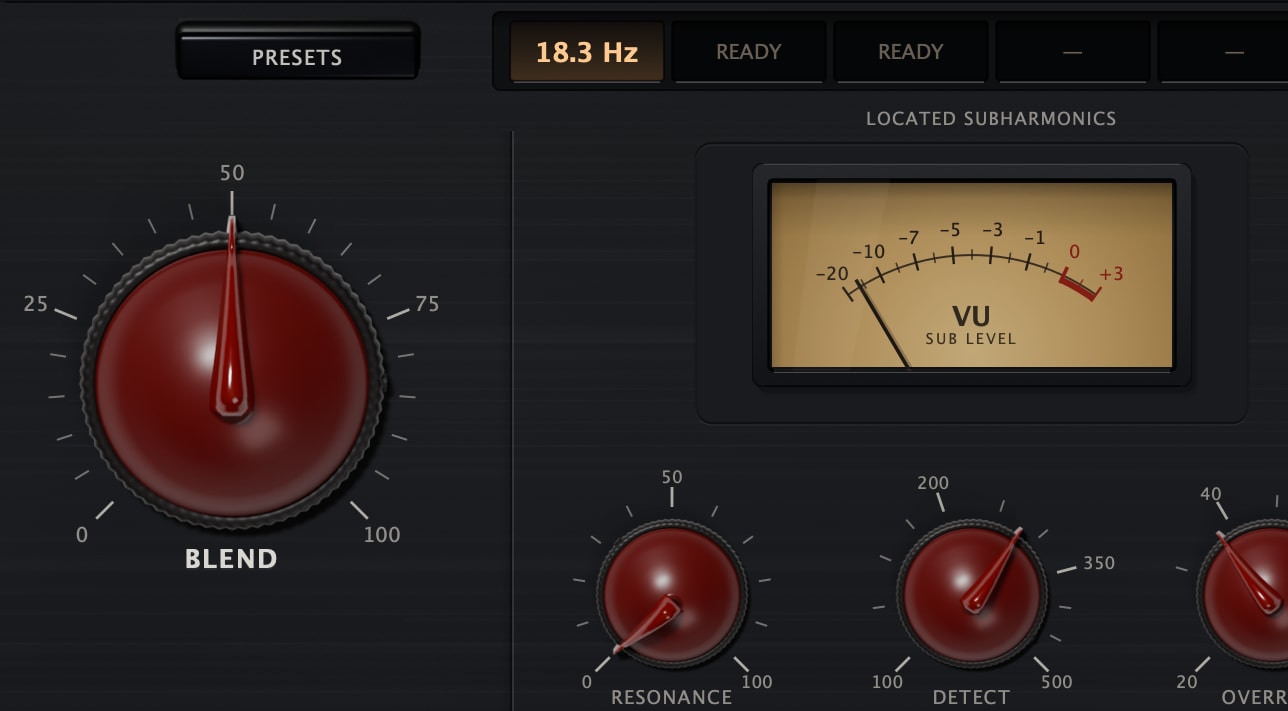
Blend is a volume sum
BLEND is engraved 0 to 100 with the SUB LEVEL VU beside it. At 100 the sub sits at level with the dry low band, by volume.
All features & controls
- Filtered mono detection sidechain; the dry path is never processed by the detector
- Up to three generated subharmonic voices on one mono bus, dead center
- Generated sub phase-locked to the source: plus or minus 0.000 degrees of drift over 60 seconds against an 80 Hz reference
- Phase correction is bounded at 10 degrees per cycle when locked
- Blend to 100 puts the sub at level with the dry low band by volume: no compressor, ducker or auto-makeup
- The recorded pink-noise test renders exact silence on the sub bus
- Confidence smoothed for about 30 ms before a voice can open
- Octave hysteresis: zero flips on the octave-trap battery
- Decorrelated stereo program yields bit-identical left and right sub contributions
- Override with Engage: pin the fundamental by hand, bypassing detection
- Optional first-order ADAA soft clip; recorded worst non-harmonic spur minus 104 dBFS on a clipped 35 Hz sine at full clip
- Zero reported latency, the clip stage included
- Display: located-subharmonic chips with Hz readouts plus the generated sub on the spectrum
- Designed from a hand-drawn sketch; three notes on it set the rules the DSP follows
- AU, VST3 and AAX on macOS; VST3 and AAX on Windows
The detector, 100 to 500 Hz
DETECT sets the low-pass cutoff of the mono detection sidechain, from 100 to 500 Hz. Plinth follows fundamentals up to about 385 Hz; a higher note is read an octave low. Drag its line on the analyzer to adjust the detection region.
Pin the frequency by hand
ENGAGE replaces automatic tracking with the fundamental set by OVERRIDE. The generated sub is one octave below that setting.
Soft clip, still no latency
CLIP soft-clips the summed dry signal and generated sub. It is shown at 80%, with zero reported latency.
Put it to work.
Kick drums
A phase-locked sub under the kick's fundamental, at level with the low end by volume, with the clip stage catching the peaks when you want it to.
Bass guitar and synth bass
The detector follows the played fundamental, and the chips show the generated sub frequencies.
808s and sparse low end
Blend brings the generated sub up to the dry low band by volume, with no compressor or ducker reshaping the groove underneath it.
Sound design
Override pins the frequency by hand, Resonance shapes the voice, and the display keeps showing what the box is doing while you push it.
THE DETAILS
Fits your setup.
- Sub voices
- Up to 3 · one mono bus, dead center
- Detection
- Filtered mono sidechain · dry path untouched · fundamentals up to about 385 Hz
- Phase lock
- Plus or minus 0.000 degrees over 60 s vs 80 Hz
- Pink-noise test
- Exact silence on the sub bus
- Clip
- First-order ADAA soft clip
- Controls
- Blend · Resonance · Detect · Override · Engage · Clip · Output · Solo · Power
- Latency
- 0 samples, clip stage included
- Formats
- VST3 and AAX on macOS and Windows · AU on macOS
- Platforms
- Windows 10+ (64-bit) · macOS 10.15+ Intel / 11+ Apple Silicon
- Made in
- USA
- Windows
- Windows 10 or later, 64-bit. VST3, AAX, Standalone.
- macOS
- macOS 10.15 or later on Intel; macOS 11 or later on Apple Silicon. AU, VST3, AAX.
- Hosts
- A 64-bit host supporting your platform’s plugin format. Your DAW may require a newer operating system.
Use it in Pro Tools, Logic Pro, Ableton Live, Cubase, Studio One, FL Studio, REAPER, Bitwig Studio, and other compatible hosts.
Find the right format for your DAWQuestions about Plinth.
Does the generated sub drift against the source?
Recorded drift against an 80 Hz reference is plus or minus 0.000 degrees over 60 seconds, against a 5 degree test threshold. Phase correction is bounded at 10 degrees per cycle when locked.
What happens on noise or unpitched material?
The sub bus renders exact digital silence in the recorded pink-noise test. Confidence is smoothed for about 30 ms before a voice can open.
Is the sub stereo?
No. The sub is mono and dead center: decorrelated stereo program yields bit-identical left and right contributions.
Does it add latency?
No. Reported delay compensation is always 0, the clip stage included. Sub onset is tracking physics, about 7 cycles to 90 percent, not plugin latency.
Which formats and platforms?
AU, VST3 and AAX on macOS; VST3 and AAX on Windows. Check the system requirements and your DAW’s supported formats.
Is there a free trial?
Yes. Every released Vitric plugin has a free 3 day trial with every feature available during the trial window. Trials need a live internet connection; the plugin checks in every few minutes. Purchased perpetual licenses work offline. Get the installer from the downloads page and request your machine-bound trial license on the trial page. At the signed expiry the plugin’s output goes silent until you install a purchased license or a valid subscription grant. The plugin can still load, so projects and saved settings are not deleted.
Own Plinth Subharmonic Synthesizer? Leave a verified review from your account.
FREE STUDIO TOOLS
Work out the next move.
Measure a mix or find a starting point. These tools run in your browser, with no account required.
GUIDES & JOURNAL
The technique behind Plinth.
Practical explanations, build stories and examples to try in your own session.
PART OF THE COLLECTION
Plinth, in a bundle.
Plinth is included in these bundles. Compare their contents and current offers.
Find its next partner.
Explore all plugins
Hear it in your own session.
Plinth. $29, or try it free for 3 days.
By buying, you agree to the EULA and Terms of Service.
Try free for 3 daysOne-time purchase · 3 computers at a time · 14-day money-back guarantee
Instant download: your license key arrives by email right after payment.
Or get all 12 with Vitric Access, $20 a month