Dynamic EQ vs multiband compression: which should you use?
Choose dynamic EQ for a focused tonal problem and multiband compression for movement across a wider region. Compare the controls with two repeatable mixing exercises.
Dynamic EQ changes an EQ filter's gain over time. A conventional multiband compressor splits the signal into frequency bands, compresses each band and recombines them. Both can turn down a harsh region only when it gets loud. The difference is the shape of the change and the controls you use to make it.
What changes when the processor turns down?
| Decision | Dynamic EQ | Multiband compressor |
|---|---|---|
| Shape | A bell, shelf or another supported filter | A frequency band bounded by crossover regions |
| Width | Frequency and Q, or a shelf transition | Low and high crossover points and their slopes |
| Typical job | A resonance, harsh note or changing tonal tilt | Low-end consistency or independent dynamics across a mix |
| First check | Is the filter affecting more tone than necessary? | Are the crossover boundaries and timing changing the groove? |
These are common architectures, not universal rules. Some multiband processors use different phase strategies, and a dynamic shelf can act over a wide region. Read the processor's actual mode and detector behavior rather than assuming all plugins work alike.
Exercise 1: a vocal gets harsh on a few words
This is an illustrative workflow, not a preset measured on your voice. Loop a phrase containing both the harsh word and a comfortable one.
- Find the region by ear. Sweep a bell or audition a band at a modest listening level. Use the frequency chart as a map, not a fixed prescription for every voice.
- Try a small static cut. If the good words become dull, return static gain toward zero and enable dynamic processing.
- Limit the cut. Use a restrained negative range and lower the threshold until the harsh words trigger it. Start with the smallest movement that helps.
- Set the recovery. The cut should arrive in time for the problem and release before it changes the next good word.
- Check the complete phrase in the mix. Level-match the output and bypass. A flatter display is not a better vocal.
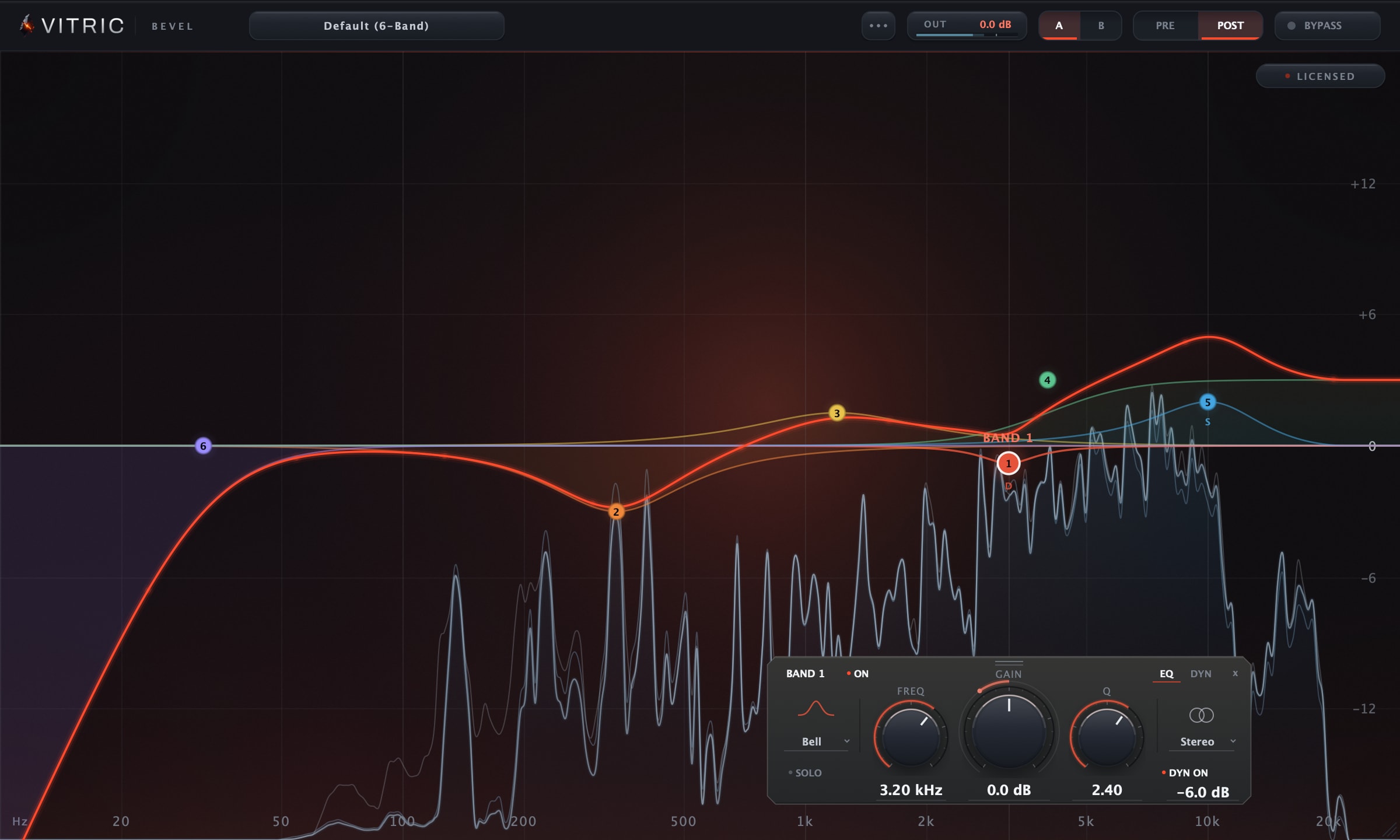
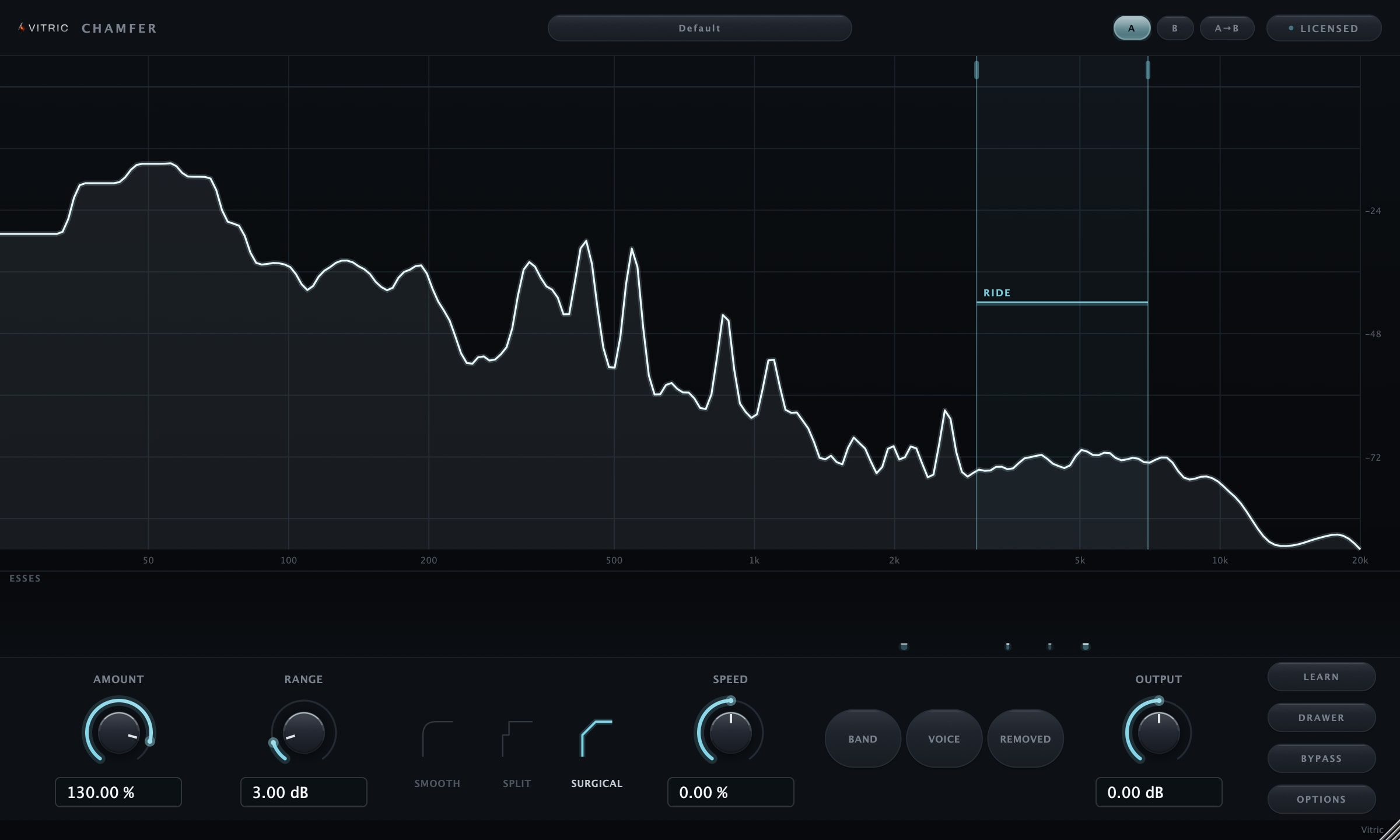
Bevel EQ supports dynamic bells and shelves with threshold, signed range, attack and release. Its notch and pass filters stay static. If the problem is specifically esses rather than a general resonance, Chamfer adds a vocal-oriented detector and a way to audition what is removed.
Exercise 2: the whole bass region changes level
Suppose a bass part is balanced on short notes but overwhelms the mix when a long note arrives. A narrow EQ cut may miss the changing pitch. A compressor band spanning the affected low region can follow its level.
- Check the source. Uneven MIDI velocity, note length or a badly tuned sample may be better fixed before processing.
- Choose crossover boundaries. Include the energy you want controlled without needlessly pulling the bass attack into the same band. Audition that region, then return to the full mix.
- Set modest compression. Reduce only the notes that need it. Adjust attack to preserve their beginning and release to avoid flattening the next note.
- Keep the other bands neutral. Do not compress every region just because the controls are there.
- Level-match and check mono. Compare the groove, sustain and low-end balance, not only the reduction meter.
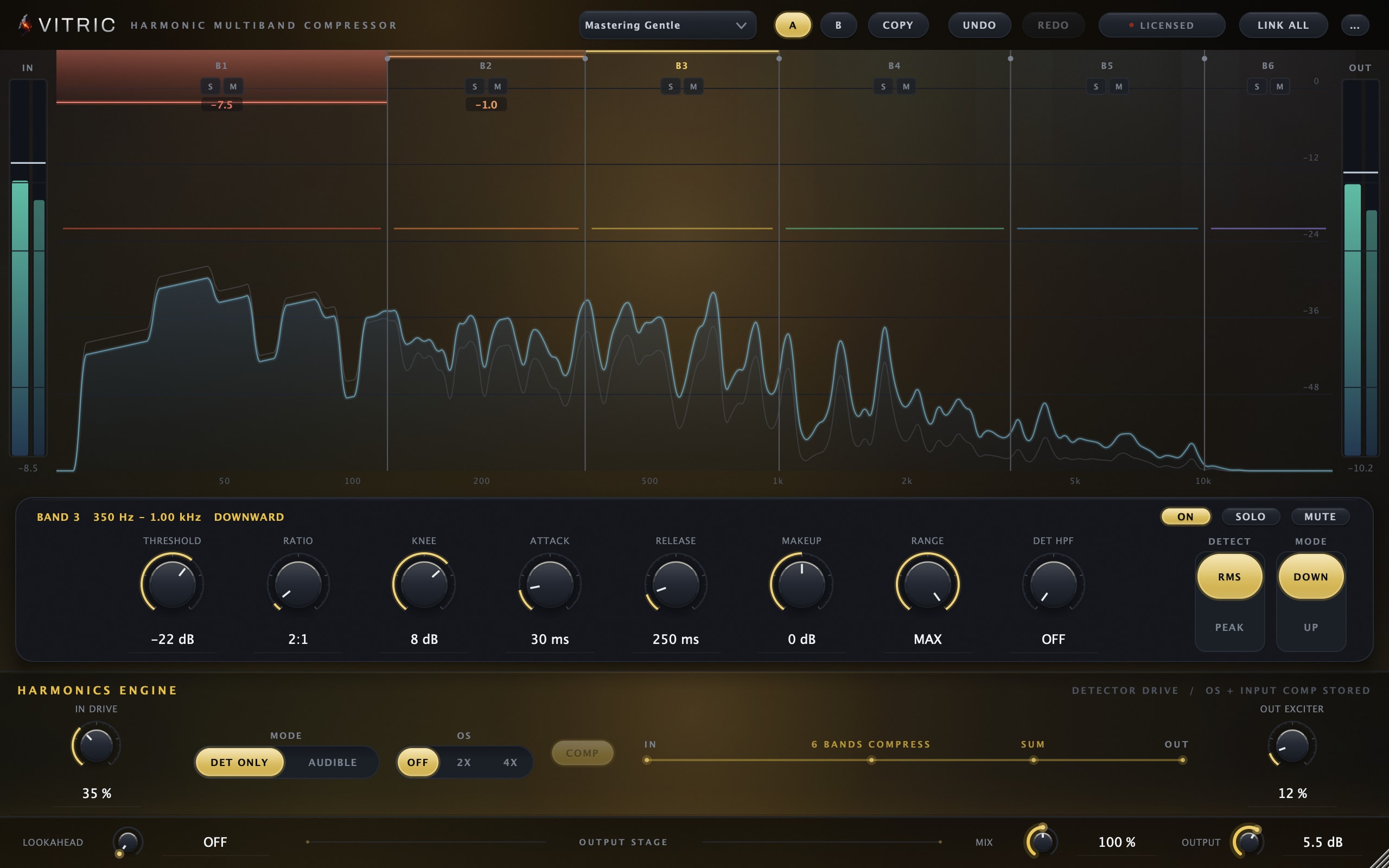
Harmonic Multiband provides six contiguous bands with independent timing and dynamics. Its input drive can affect the audio or only the detectors. Start with drive off when comparing basic dynamics, then introduce it as a separate decision.
Does dynamic EQ avoid phase changes?
No such guarantee follows from the name. A minimum-phase EQ changes phase with its response; a conventional crossover bank also has phase behavior. Linear-phase modes can introduce latency and pre-ringing. Different algorithms make different tradeoffs. FabFilter's Pro-MB, for example, offers Dynamic Phase as well as conventional phase modes, so the simple crossover explanation is not its only mode.
Read the Harmonic and Pro-MB comparison when those choices matter. Do not choose a processor from “zero phase” marketing shorthand.
Can you use both in one mix?
Yes. A dynamic bell can handle a particular resonance while a multiband compressor manages a broader region elsewhere. The useful question is whether each stage solves a different audible problem. Bypass both, then each individually. If you cannot explain what one stage improves at matched loudness, simplify the chain.
To compare the two approaches on your own material, use the Bevel EQ trial and Harmonic Multiband trial. Read their manuals for supported controls; this guide does not promise that either will repair a recording or arrangement problem.