How to EQ drums: kick, snare, toms and hi-hats, frequency by frequency
Where to EQ each drum: the kick's thump and click, the snare's body, crack and ring, the toms' tone, and the hats' shimmer. Frequency ranges, Q values and first moves, plus how to keep the kick and bass apart.
Drum EQ is easier when you know where each drum lives. The kick has a low thump and a click on top; the snare has body, crack and sometimes a ring; toms have a pitch; hi-hats are mostly high shimmer. The ranges below are where to listen first, not settings to copy: the right frequency depends on the drum, its tuning and the mix around it.
Before you EQ
Start flat, name what you want to change, and make one move while the rest of the mix plays. A drum that sounds great soloed, with huge lows and highs, can leave an awkward hole in the middle of the full mix. Check your moves in the busiest part of the song.
Kick drum
Listen to the kick and the bass together. For weight, find the kick's low thump, often around 50 to 80 Hz, and audition a 1 to 2 dB boost with a broad bell (Q 0.7 to 1.2). If the bass already fills that region, the boost can make both less clear; try lowering the bass or changing one of the sounds first.
A small cut around 250 to 500 Hz can reduce a boxy, cardboard tone. If the attack is hard to hear, try 1 to 3 dB around 2 to 5 kHz at Q 1 to 2. A soft hip-hop kick may need none of that click.
Kick and bass
The kick and the bass or 808 share the low end, so give them their own lanes: where one is boosted, cut the other a little at the same frequency. With an 808 the low note moves, so a fixed cut can hollow out some notes. If the 808 still covers every kick hit, level, note length or sidechain ducking may solve the overlap more directly than EQ.
Snare drum
For body, audition 150 to 250 Hz with a broad bell (Q 0.7 to 1.2) and 1 to 2 dB of boost. For crack, try 2 to 4 kHz at Q 1 to 2. These are separate jobs: more crack will not restore a thin snare's body, and more body can cloud a busy kick pattern. The wires and sizzle sit around 5 to 10 kHz.
To find a ring, listen to the tail between hits. Start around 400 Hz to 1 kHz and move beyond it if needed, with a narrow bell (Q 4 to 8) and a 2 to 4 dB cut. Keep the cut shallow enough that the snare keeps its pitch and character: a ringing drum is not automatically a bad drum.
Toms
Each tom has a pitch, from about 60 Hz on a floor tom to about 300 Hz on a small rack tom. Ring and boxiness sit around 300 to 700 Hz, where shells often ring: sweep a narrow boost to find the ring, then cut 2 to 5 dB at that spot. Stick attack is around 3 to 5 kHz.
Hi-hats and cymbals
Hats and cymbals have no single fundamental. The stick and bell sound runs from about 300 Hz to 1 kHz, and most of the energy is shimmer from about 3 to 15 kHz. High-pass the lows they do not need, set by ear. The 5 to 10 kHz region is also where vocal s and t sounds live, so harsh hats and a bright vocal can pile up there; a little boost can add bite to hats, but bright mics and compression exaggerate this range.
Drum EQ at a glance
| Drum | Where to listen | First move |
|---|---|---|
| Kick | Thump 50 to 80 Hz; boxy 250 to 500 Hz; click 2 to 5 kHz | 1 to 2 dB on the thump; 1 to 3 dB on box or click |
| Snare | Body 150 to 250 Hz; ring 400 Hz to 1 kHz; crack 2 to 4 kHz | Cut a ring 2 to 4 dB at Q 4 to 8 |
| Toms | Tone 60 to 300 Hz; ring 300 to 700 Hz; attack 3 to 5 kHz | Find the ring, cut 2 to 5 dB |
| Hats | Stick 300 Hz to 1 kHz; shimmer 3 to 15 kHz | High-pass by ear |
Drum EQ with Bevel EQ
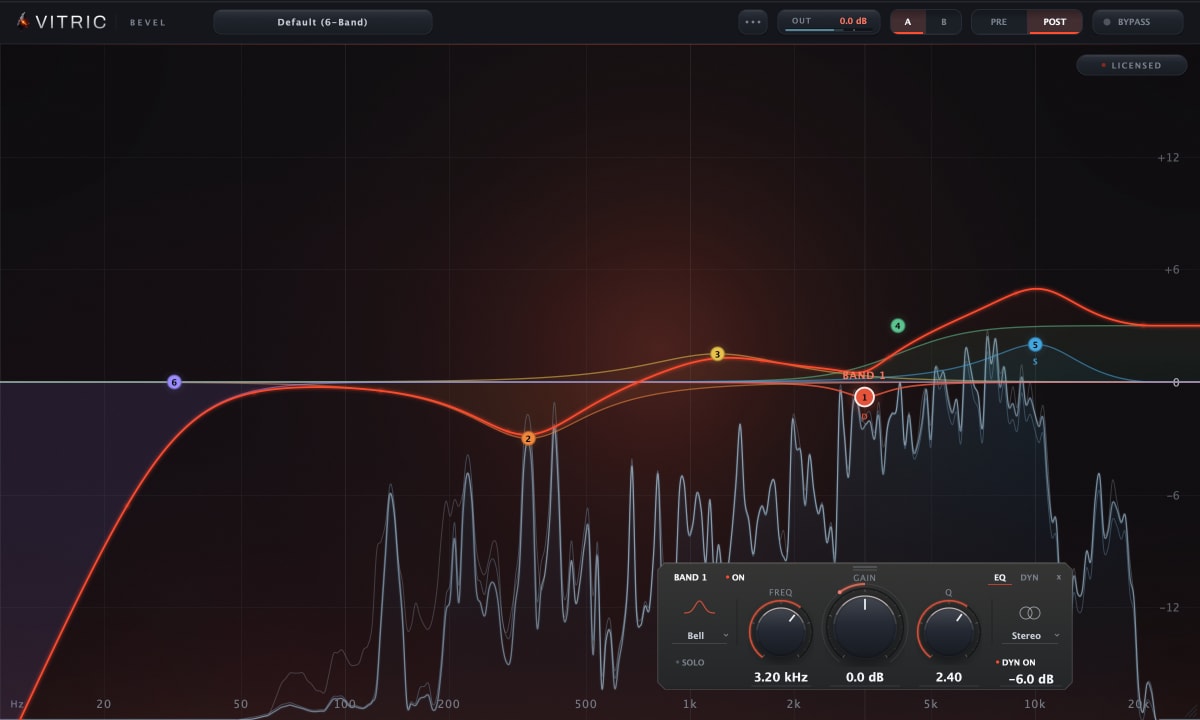
Bevel EQ is a 24-band dynamic EQ for resonances that come and go, so a ring that only appears on hard hits can be cut only when that band crosses the threshold you set. Its analyzer can show the spectrum before and after the EQ together (turn on Show pre and post together in Options). For more starting points across the mix, see EQ settings: where to start and the EQ frequency chart.
Questions
What frequency is a kick drum?
Its fundamental is usually about 40 to 100 Hz, with the weight you feel often around 50 to 80 Hz and the beater click around 2 to 5 kHz.
Should I EQ drums in solo?
Find a problem in solo if it helps, but judge the move in the full mix: drums that sound huge alone can leave a hole in the middle of the track.
How do I make a snare crack?
Try a small boost around 2 to 4 kHz at Q 1 to 2. If the snare still sounds thin, the body at 150 to 250 Hz is the other half of the sound.