
Stoke Saturator Saturation plugin
Add harmonic density and blend it with the dry track.
Plugin for Mac & Windows.
Try it free on your computer.
Hear the demo. Loudness matched.
About this demo
Drive at 100% with the input calibrated 6 dB hotter, blended 75% with the dry signal.
Rendered through Stoke Saturator 0.2.10 on macOS. Input and processed excerpts are matched in loudness. Switching keeps your place.
Open input audio ↗Open processed audio ↗An analog-style saturation plugin with four controls: Drive, Tone, Mix and Output. Add harmonic distortion for density, blend it with the dry track and use Auto to compensate as Drive changes.
Sale price
Pay by card, PayPal, Apple Pay or Google Pay.
By buying, you agree to the EULA and Terms of Service.
Try free for 3 daysOne-time purchase · 3 computers at a time · 14-day money-back guarantee
Instant download: your license key arrives by email right after payment.
Or get all 12 with Vitric Access, $20 a month
Secure checkout by Paddle. No card required for the trial.
Mac & Windows · VST3, AU and AAX · version 0.2.10
Prices in US dollars. Checkout charges in your local currency where available. US and Canadian sales tax is added at checkout. In the EU, UK, Japan and Australia, tax is already included.
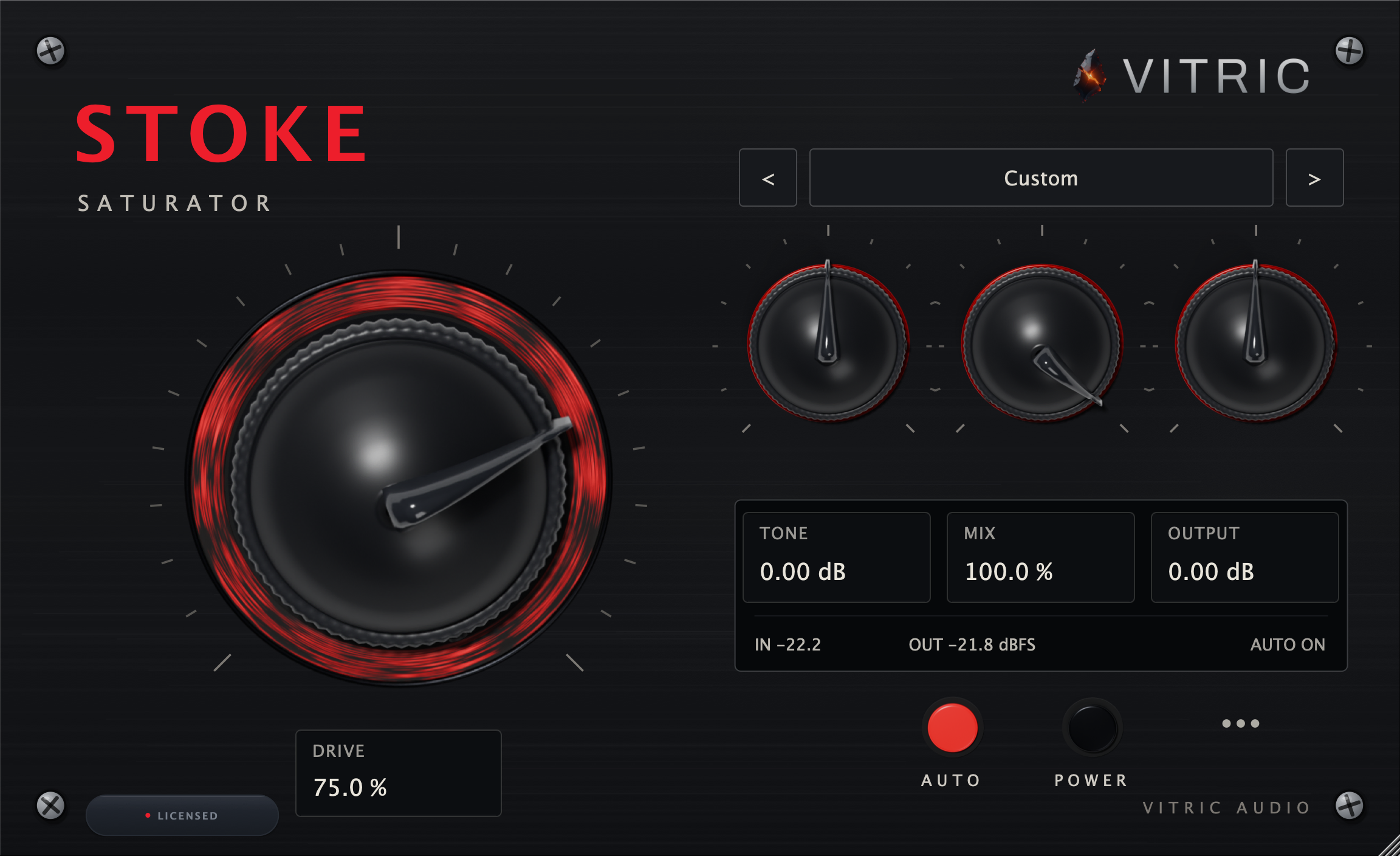
The trial uses the full plugin. Install it in your DAW, then start the 3-day trial from its license screen. No card required.
Read the Stoke manualTHE LISTENING ROOM
Listen to Stoke.
One performance. Two perspectives. Loudness matched.
Drive at 100% with the input calibrated 6 dB hotter, blended 75% with the dry signal.
About this demo
Rendered through Stoke Saturator 0.2.10 on macOS. Input and processed excerpts are matched in loudness. Switching keeps your place.
Open input audio ↗Open processed audio ↗IN MOTION
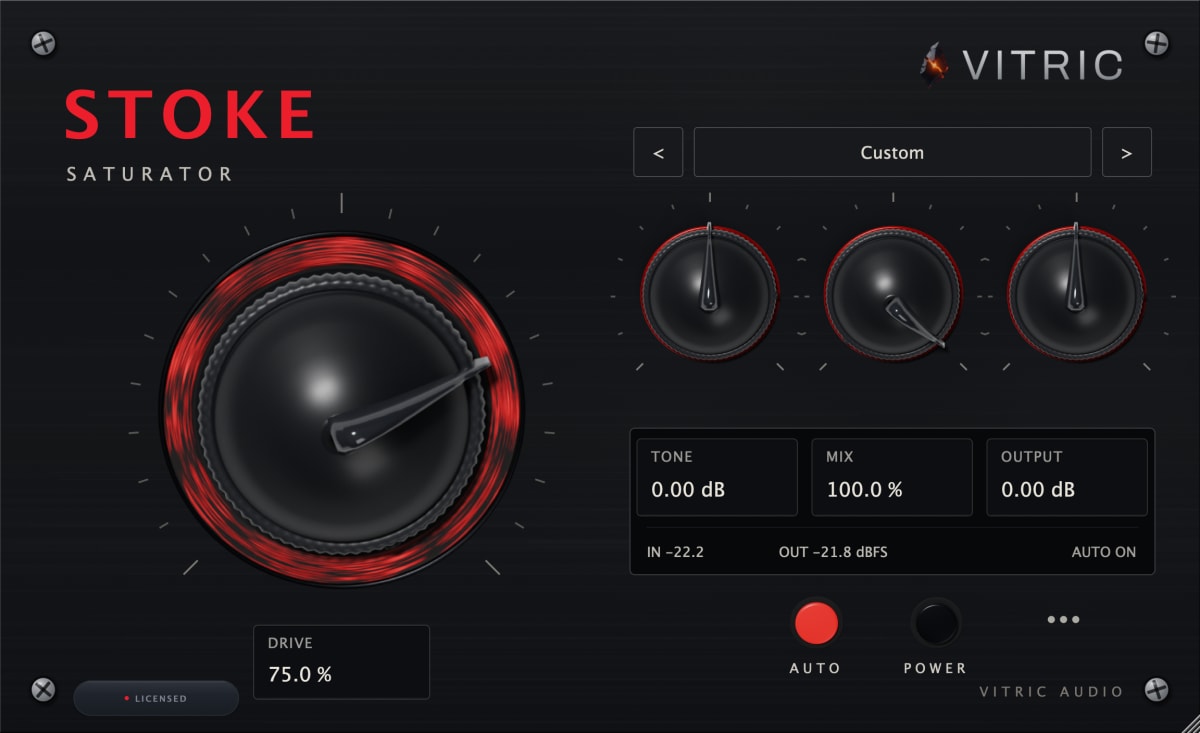
Stoke, running.
IN YOUR SESSION
Drive the tone, then compare the level.
Stoke keeps an aligned dry path and generates saturation in a separate harmonic contribution. Drive changes the character continuously; Tone tilts the processed signal, Mix sets its contribution and Output sets the final level. Auto uses a calibrated curve to limit the level change as Drive rises. Input calibration adjusts the circuit’s operating point to the source.
A CLOSER LOOK
Inside Stoke.
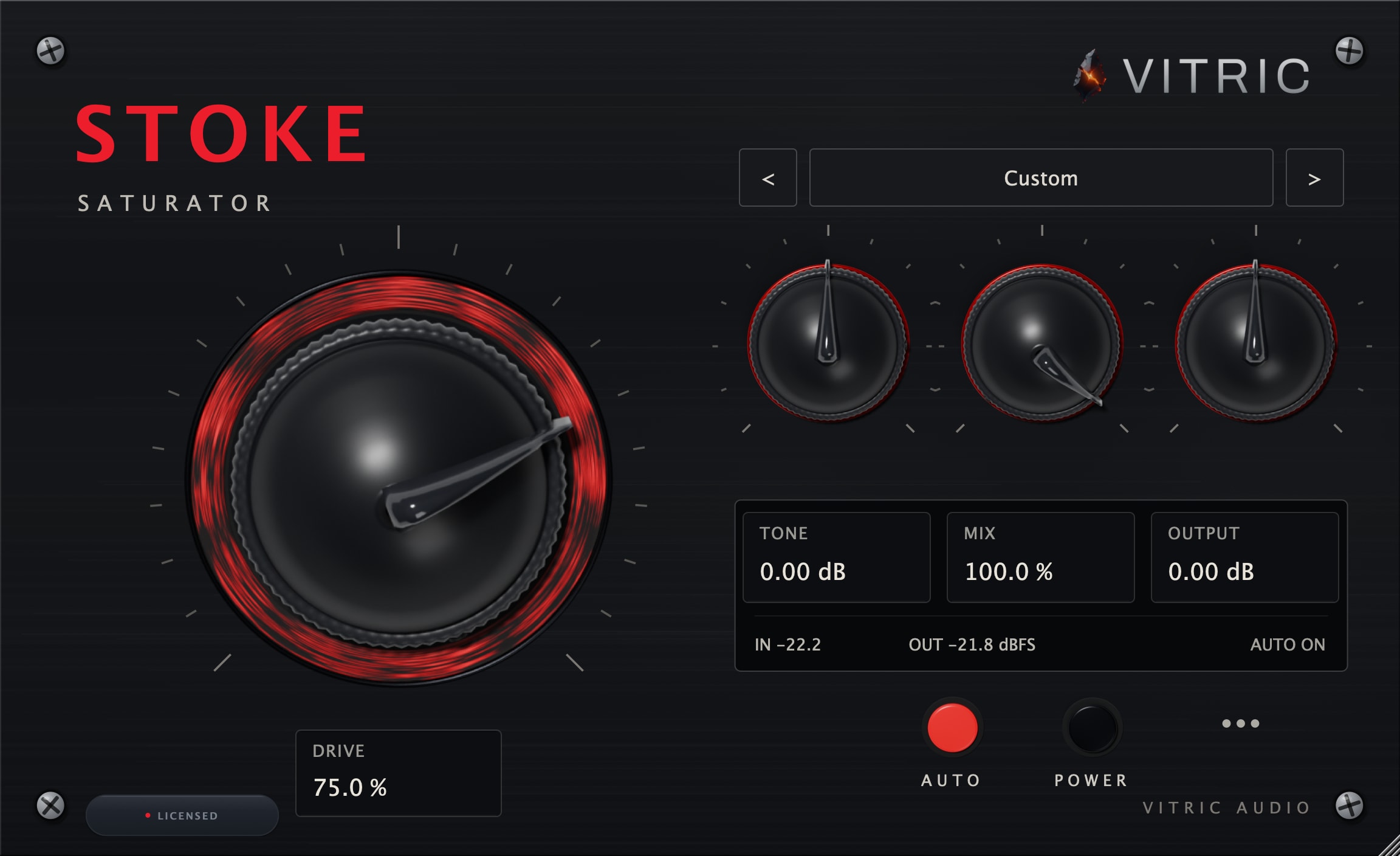
Four knobs, one row
Drive on the left under its coal, Tone, Mix and Output on the right, AUTO and POWER beneath them. Seven parameters in all.
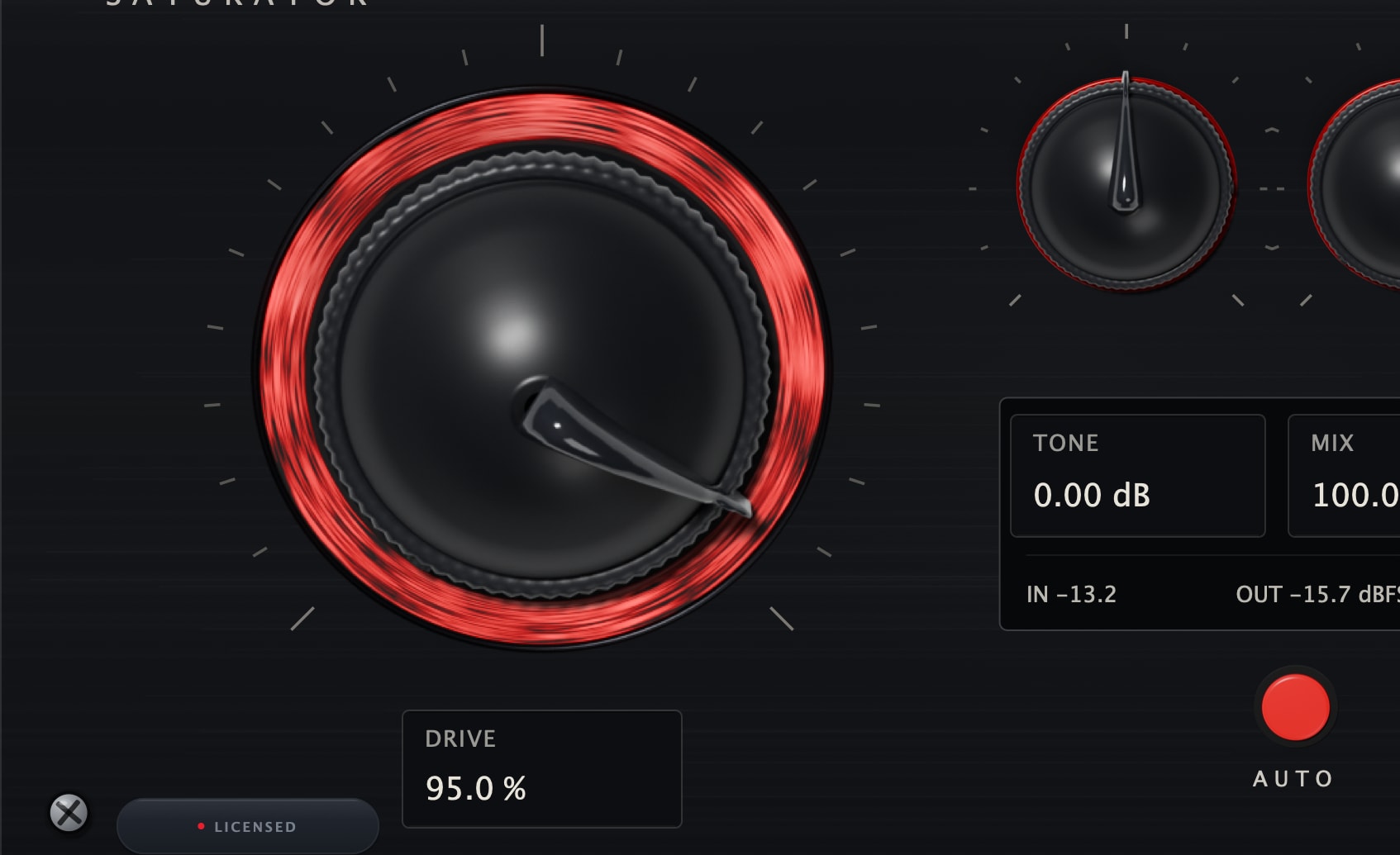
The coal is measured
The ring responds to measured added-harmonic energy. This capture shows DRIVE at 95%.
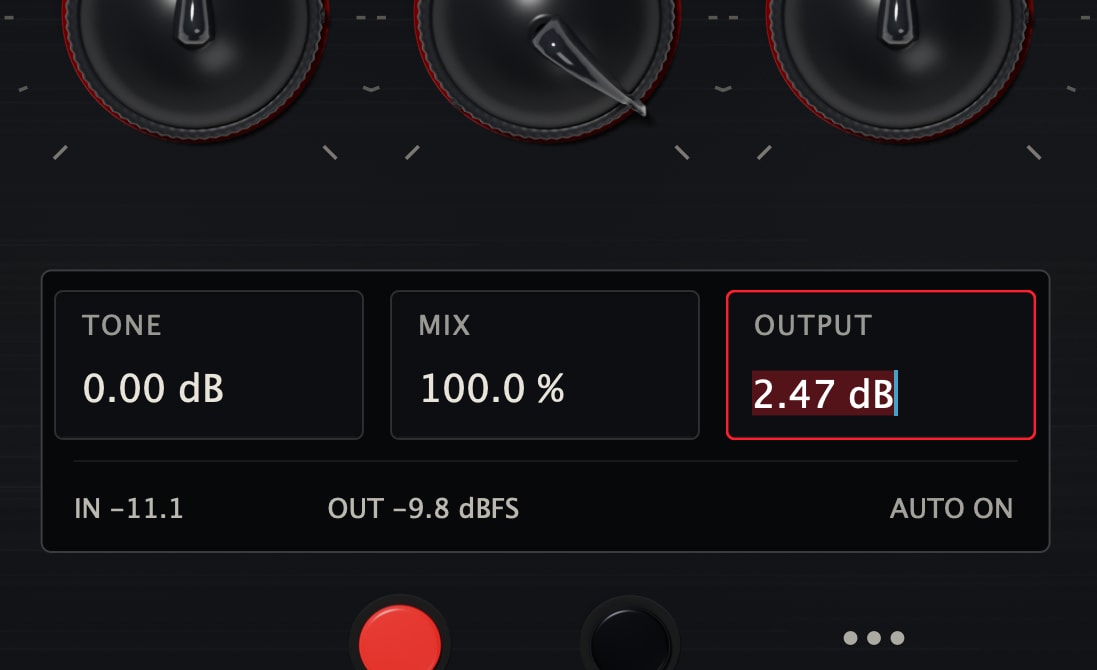
Type the exact value
Click any readout and type. Return commits as one host gesture, Escape writes nothing. Tone in dB, Mix in percent, Output in dB.
All features & controls
- One deeply tuned analog-style voice; Drive morphs it continuously
- Four knobs: Drive, Tone, Mix, Output; Auto and Power; seven parameters in all
- Dry path is a bit-exact delay line; every harmonic lives in a separately generated residual
- Synthesized 808, kick and bassline test signals keep 20–120 Hz energy within ±0.5 dB at Drive 50% with neutral Tone and Output
- Synthesized kick and snare test signals keep crest reduction within 1 dB at Drive 50% and 4 dB at Drive 100%
- Recorded aliasing result: −131 dBFS at full Drive with a 10 kHz sine
- With AUTO on, synthesized program and bassline test signals stay within ±0.5 LU at Drive 20%, 60% and 100%
- AUTO is tested at three input scales spanning approximately 24 dB
- Input calibration tracks program loudness with BS.1770 weighting and normalizes the drive operating point
- Program-dependent bias gives sustained material a slight bloom
- Transient-aware ease protects the first milliseconds of sharp hits
- Power off passes aligned dry. At Output 0 dB, Mix 0 nulls against aligned dry; Drive 0 also nulls with Tone 0 dB
- 6 samples at 44.1 and 48 kHz (0.125 ms at 48 kHz), fewer at higher rates, reported to the host for delay compensation
- 12 source-named starting points, plus presets you save yourself
- AU, VST3 and AAX on macOS; VST3 and AAX on Windows
Compare with Auto
AUTO uses a calibrated static compensation curve. Compare the level in your session as you adjust Drive.
Twelve starting points
The strip across the top steps through twelve source-named starting points. It reads Custom whenever the knobs match none of them or the defaults, and each one sets the four sound knobs and re-arms Auto and Power. Click the name to save your own presets beside them.
Power off is a null
The line says POWER OFF and both readings match. The input passes bit-exactly at the reported latency, 6 samples at 48 kHz.
Test-suite results and conditions
| Claim | Measured | The test |
|---|---|---|
| Low-frequency energy | 20–120 Hz within ±0.5 dB at Drive 50%, neutral Tone and Output; synthesized 808, kick and bassline test signals | ContractTests low-end |
| Transient crest | Crest reduction on synthesized kick and snare signals within 1 dB at Drive 50% and 4 dB at Drive 100% | ContractTests transient |
| Measured aliasing | Recorded −131 dBFS at full Drive with a 10 kHz sine; test limit below −90 dBFS | ContractTests alias |
| Loudness compensation | With Auto: ±0.5 LU on program and bassline tests at Drive 20%, 60% and 100%, at three input scales spanning approximately 24 dB | ContractTests equal-loudness grid |
| Honest bypass | Power off passes aligned dry. At Output 0 dB, Mix 0 nulls against aligned dry; Drive 0 also nulls with Tone 0 dB | EngineTests null family |
| Tiny latency, reported exactly | 6 samples, 0.125 ms at 48 kHz, verified by impulse cross-correlation | EngineTests latency |
Put it to work.
Drums and drum buses
Synthesized kick and snare test signals keep crest reduction within 1 dB at Drive 50% and 4 dB at Drive 100%.
808s, kick and bass
Synthesized 808, kick and bassline test signals keep 20–120 Hz energy within ±0.5 dB at Drive 50% with neutral Tone and Output.
Vocals, keys and guitars
Push Drive for density, keep AUTO on to compensate the level change, then compare with POWER.
Everywhere at once
One voice and seven parameters, with input calibration to adapt the drive circuit to your source.
THE DETAILS
Fits your setup.
- Controls
- Drive · Tone · Mix · Output · Auto · Power
- Parameters
- 7
- Starting points
- 12, named for sources; save your own
- Low end
- Synthesized 808, kick and bassline test signals: 20–120 Hz within ±0.5 dB at Drive 50%, neutral Tone and Output
- Aliasing floor
- Recorded −131 dBFS at full Drive with a 10 kHz sine
- Loudness
- Synthesized program and bassline test signals: ±0.5 LU with Auto, Drive 20%/60%/100%, three input scales spanning approximately 24 dB
- Bypass
- Power off passes aligned dry. At Output 0 dB, Mix 0 nulls; Drive 0 also nulls with Tone 0 dB
- Latency
- 6 samples at 44.1/48 kHz (0.125 ms at 48 kHz), fewer at higher rates; reported exactly
- Formats
- VST3 and AAX on macOS and Windows · AU on macOS
- Platforms
- Windows 10+ (64-bit) · macOS 10.15+ Intel / 11+ Apple Silicon
- Made in
- USA
- Windows
- Windows 10 or later, 64-bit. VST3, AAX, Standalone.
- macOS
- macOS 10.15 or later on Intel; macOS 11 or later on Apple Silicon. AU, VST3, AAX.
- Hosts
- A 64-bit host supporting your platform’s plugin format. Your DAW may require a newer operating system.
Use it in Pro Tools, Logic Pro, Ableton Live, Cubase, Studio One, FL Studio, REAPER, Bitwig Studio, and other compatible hosts.
Find the right format for your DAWQuestions about Stoke.
Does Drive change the low end?
Synthesized 808, kick and bassline test signals keep 20–120 Hz energy within ±0.5 dB at Drive 50% with neutral Tone and Output. Tone and Output can intentionally change the balance and level.
Does it get louder as I push it?
With AUTO on, synthesized program and bassline test signals stay within ±0.5 LU at Drive 20%, 60% and 100%, across three input scales spanning approximately 24 dB. Compare the level in your own session as you adjust the controls.
How much latency does it add?
6 samples at 44.1 and 48 kHz, or 0.125 ms at 48 kHz, and fewer at higher sample rates, reported to the host for delay compensation.
Are there modes or styles to choose?
No. Drive morphs one continuous voice: mostly second-order warmth low on the dial, controlled upper harmonics arriving as you push, with a spectral ceiling that darkens slightly as drive rises.
Which formats and platforms?
AU, VST3 and AAX on macOS; VST3 and AAX on Windows. Check the system requirements and your DAW’s supported formats.
Is there a free trial?
Yes. Every released Vitric plugin has a free 3 day trial with every feature available during the trial window. Trials need a live internet connection; the plugin checks in every few minutes. Purchased perpetual licenses work offline. Get the installer from the downloads page and request your machine-bound trial license on the trial page. At the signed expiry the plugin’s output goes silent until you install a purchased license or a valid subscription grant. The plugin can still load, so projects and saved settings are not deleted.
Own Stoke Saturator? Leave a verified review from your account.
FREE STUDIO TOOLS
Work out the next move.
Measure a mix or find a starting point. These tools run in your browser, with no account required.
GUIDES & JOURNAL
The technique behind Stoke.
Practical explanations, build stories and examples to try in your own session.
PART OF THE COLLECTION
Stoke, in a bundle.
Stoke is included in these bundles. Compare their contents and current offers.
Find its next partner.
Explore all plugins
Hear it in your own session.
Stoke. $9, or try it free for 3 days.
By buying, you agree to the EULA and Terms of Service.
Try free for 3 daysOne-time purchase · 3 computers at a time · 14-day money-back guarantee
Instant download: your license key arrives by email right after payment.
Or get all 12 with Vitric Access, $20 a month