Plinth Subharmonic Synthesizer: the manual
Learn Plinth installation, activation, detection, generated subharmonics, Blend, manual override, clipping, presets and exact control entry.
Plinth adds a generated subharmonic to an audio signal. It listens below the DETECT crossover, follows the pitched components it finds, and generates content one octave lower. BLEND adds that sub to the original signal. It does not turn down the dry signal as you turn it up.
This guide covers the Plinth 0.2.0 interface.
Installation and activation
Get the current Plinth Subharmonic Synthesizer installer for your computer. Save your session and close your DAW, run the Windows .exe or macOS .pkg, then reopen the DAW. Rescan plugins if necessary.
Insert Plinth Subharmonic Synthesizer on an audio track or bus. Use AU in Logic Pro, AAX in Pro Tools, or VST3 in a compatible host. AU is available on macOS; both platforms include VST3 and AAX.
Windows builds require Windows 10 or later, 64-bit. Mac builds require macOS 10.15 or later on Intel, or macOS 11 or later on Apple Silicon. Your DAW may require a newer operating system.
Start a three-day trial
- Open the plugin’s license panel and choose Start free trial. This opens the trial page for Plinth Subharmonic Synthesizer with your product and machine code filled in.
- Sign in using the link sent to your email. Check the product and machine code, then choose Email my trial.
- Save the attached license file from your email. On the same computer, choose Load file in the plugin’s license panel.
Install first: the three days begin when the trial license is issued. Every feature is available during that window. Keep the computer connected for periodic internet verification. There is one trial per product, person and machine, with no payment details or automatic charge. At expiry, processing locks while the plugin keeps its saved project settings.
Activate a full perpetual license
Paste the VT-... key from your purchase email or account into the license panel and choose Apply license. Full perpetual licenses work offline after activation.
For an offline studio computer, use the license portal on an online device. Enter your key and the studio computer’s VTM1-... machine code, download the bound file, transfer it to the studio computer and choose Load file. The portal can also resend your active full-license keys.
A full license allows three machine bindings over its lifetime. Deactivation does not restore a binding because permanent offline files cannot be remotely erased. Contact support for a legitimate hardware replacement after using the allowance. A trial is bound to its issuing computer.
Find the plugin after installation
Open the plugin from your DAW’s plugin browser. Check that its supported format was installed, restart the DAW, and inspect its rescan or failed-plugin list if the plugin is missing. The Mac package installs plugins, not a standalone application. Windows may also offer a standalone app under C:\Program Files\Vitric Audio.
Standard installation folders
| Format | macOS | Windows |
|---|---|---|
| AU | /Library/Audio/Plug-Ins/Components | Not available |
| VST3 | /Library/Audio/Plug-Ins/VST3 | C:\Program Files\Common Files\VST3 |
| AAX | /Library/Application Support/Avid/Audio/Plug-Ins | C:\Program Files\Common Files\Avid\Audio\Plug-Ins |
If installation or activation still fails, send support the product version, operating system, DAW version, plugin format and exact error.
Make your first move
- Play a passage with a clear bass part or kick. Start with POWER on, SOLO off and ENGAGE off.
- Leave DETECT at its 350 Hz default initially. Watch the screen for located frequencies and the generated sub trace.
- Lower BLEND, then raise it until the extra weight fits the part. BLEND changes the amount added; it is not a dry/wet crossfade.
- Press SOLO to hear the generated contribution by itself. Turn SOLO off before judging the whole mix.
- Adjust DETECT if higher material is confusing the tracking. Try RESONANCE for more bloom and upper partials.
- Watch the track's output level. Added sub can raise peaks. Use OUTPUT to trim the result and CLIP only when you want soft clipping on the combined signal.
For a gentle full-mix starting point, choose Gentle Ground under PRESETS. For an isolated bass part, Studio Floor is another useful starting point. Presets are starting settings, so adjust BLEND in context.
Read the screen
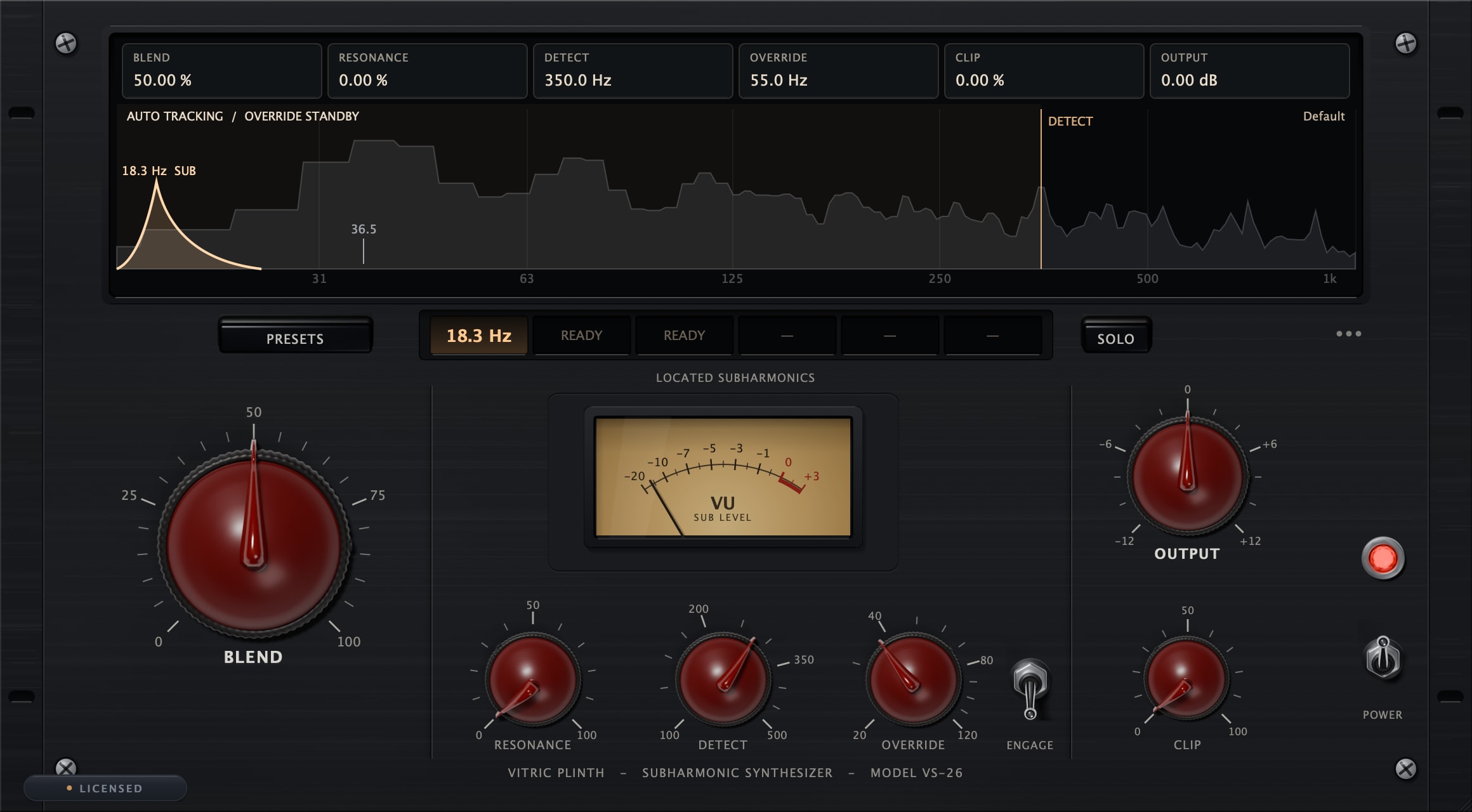
The spectrum shows the input, located fundamentals and generated sub activity. DETECT's vertical line sets the top of the region used for detection. The LOCATED SUBHARMONICS row shows generated frequencies; click a lit chip to mute or restore its slot. The row has six positions, while the engine can generate up to three sub voices at once.
The six values along the top correspond to BLEND, RESONANCE, DETECT, OVERRIDE, CLIP and OUTPUT. Click one, or focus it and press Enter, to type an exact value. Enter applies a valid value; Escape cancels. Incorrect units or values outside the control's range leave the sound unchanged and show an error in the field.
The status identifies automatic tracking, manual override, sub solo or power off. The VU meter shows the contribution being added, rather than the entire mix.
Control reference
| Control | Range and default | What it changes |
|---|---|---|
| BLEND | 0–100%; 50% | Amount of generated sub added to the dry signal. At 100%, its level target follows the dry low band. |
| DETECT | 100–500 Hz; 350 Hz | Upper boundary of the detection region. Lower settings focus the tracker on lower material. |
| RESONANCE | 0–100%; 0% | Resonant bloom on the generated sub. Upper settings add gentle upper partials. |
| OVERRIDE | 20–120 Hz; 55 Hz | Fundamental used when ENGAGE is on. This is the source fundamental, not the generated sub frequency. |
| ENGAGE | Off by default | Enables manual override in place of automatic detection. |
| CLIP | 0–100%; 0% | Soft clipping after the dry and sub are summed. Zero bypasses the clip stage. |
| OUTPUT | −12 to +12 dB; 0 dB | Final output trim. |
| SOLO | Off by default | Auditions only the generated contribution, at its current BLEND amount. |
| POWER | On by default | Enables processing or bypasses it. |
An OVERRIDE value of 80 Hz aims the generator at a 40 Hz sub. ENGAGE uses one generator and still follows the input's envelope and level gate; it does not turn Plinth into a free-running test oscillator.
Adjust controls precisely
Drag knobs to adjust them. Shift-drag gives finer movement; wheel and arrow keys use each control's adjustment grid, with Shift for fine steps. Double-click resets a knob to its default. In Pro Tools, the fine-drag modifier follows the host's Command/Ctrl convention.
The DETECT line can be dragged directly without jumping to the initial click. Shift makes this movement finer. Wheel or arrows step by a semitone, or ten cents with Shift. Double-click the line to return to 350 Hz.
With the plugin focused, P opens presets, S toggles SOLO, E toggles ENGAGE, and [ / ] steps through presets. ? opens the shortcut sheet and Esc closes it. Shortcuts do not run while you are typing into a value field.
Presets and session recall
PRESETS contains 32 factory starting points grouped by source, including 808, Bass DI, Synth Bass, Kick and Mix Bus. Loading one changes BLEND, DETECT, RESONANCE, CLIP and OUTPUT and unmutes all chips. It preserves POWER, SOLO, ENGAGE and the manual frequency, so check those utility settings if a preset sounds unexpected.
The displayed name follows the current sound values. It reads Custom when they no longer match a factory starting point. Save your own settings in the DAW session or the DAW's preset system; this version does not provide a separate user-preset browser.
Common questions
Why is there no sub on a noisy sound? Plinth needs useful pitch evidence. Unpitched or very short material may not open a generator. Check POWER, BLEND, chip mutes and the detection region before increasing the level.
Why does a sub arrive after the beginning of a note? The tracker needs cycles of a new fundamental before it can follow it confidently. Plinth reports zero samples of added host latency; that does not make pitch detection instantaneous.
Does it make the entire track mono? The generated sub contribution is mono. The original dry signal keeps its existing channels.
Why did the output get louder? BLEND adds signal. Use the full mix and level meters to set OUTPUT, rather than assuming that more sub keeps the same peak level.