FET vs opto vs tube: which compressor behavior and when
The names describe circuits, but what you hear is detection and release behavior. What FET grab, opto memory, tube knee and clean math do, and where each earns its insert.
Ask which compressor to put on a vocal and you get answers by catalog number: an 1176 for this, an LA-2A for that. The names are shorthand, and shorthand hides the mechanism. What separates these units is how the detector measures the signal, how fast the gain element can move, and what shape the release takes when it lets go. Those three behaviors are the whole personality.
This article walks the four behaviors that cover most compressors you will reach for: the FET grab, the opto release memory, the tube soft knee, and clean digital math. For each: the mechanism, what it does musically, and which session job it fits.
The three behaviors that matter
Every compressor is a detector, a gain computer, and ballistics. The detector draws an envelope over the signal. The gain computer turns that envelope into a gain-reduction amount through threshold, ratio and knee. The ballistics decide how fast the gain is allowed to move. The classic circuit families differ on all three, and each difference is audible.
One distinction does a lot of work here: feedforward versus feedback detection. A feedforward detector measures the raw input, so it reacts to exactly what arrives. A feedback detector listens at the output, so it hears peaks its own compression has already pulled down. That makes it self-smoothing by construction: the harder it compresses, the less extreme the signal it measures. Most of the vintage units people call musical are feedback designs, and that is a large part of why.
FET: the microsecond grab
The 1176 family uses a field-effect transistor as the gain element, and a FET changes resistance almost instantly. That gives the design its defining trait: attack times measured in microseconds, fast enough to catch the leading edge of a snare hit rather than the decay after it. The classic control set is ratio buttons, 4:1 up to 20:1, plus the all-buttons-in trick where engaging every ratio at once pushes the curve into an aggressive, program-dependent overdrive of its own.
The release is program-dependent: short bursts recover fast, sustained level recovers slower. Combined with feedback detection, the result is a compressor that grabs transients hard and then breathes with the material instead of pumping mechanically.
Musically, FET behavior is exciting rather than polite. Because it clamps the transient itself, it can make a drum room explode: the hit is controlled, so everything after the hit comes up. On a rock or rap vocal it adds forwardness and grit, especially driven hard in parallel. The cost is subtlety. At a fast attack it will dull material that lives on its transients, and it does not do gentle.
Opto: release with memory
The LA-2A family runs the audio through a light-dependent resistor. The signal drives a light source; the light falls on a photocell; the photocell's resistance sets the gain. The musical fingerprint comes from the cell's physics: it does not respond instantly, and it does not forget instantly either. The attack is slow by FET standards, and the release happens in two stages, a quick initial recovery followed by a long tail whose length depends on how hard and how long the cell was just driven.
That release memory is the whole reason engineers still reach for opto on vocals. A phrase that pushed the compressor hard leaves the cell partially charged, so the next phrase is met with gain reduction already leaning in the right direction. The compressor rides the performance the way a hand on a fader would, smoothing level over seconds rather than reacting syllable by syllable. Bass gets the same benefit: notes sustain evenly without the release chatter a fast compressor produces on low frequencies.
The trade is transient control. An opto compressor lets the front of the hit through, which makes it the wrong tool on drums unless that is exactly what you want.
Tube: the wide soft knee
The behavior associated with tube units like the Tube-Tech CL 1B is less about speed and more about the knee. A hard-knee compressor does nothing below threshold and compresses at full ratio above it: a corner. A wide soft knee spreads that corner across many decibels, so compression fades in gradually as level rises. Material near the threshold gets a little; material well over it gets the full ratio. There is no audible moment where the compressor switches on.
Add the gentle harmonic thickening of tube gain stages and you get the sound people call glue: the sense that a bus was mixed together rather than merely summed. Because the knee engages progressively, the whole mix leans into the compressor as it gets louder, and quiet passages pass nearly untouched. On a lead vocal it reads as expensive and unforced, which is why this behavior owns so many ballad vocals.
Clean: exact math
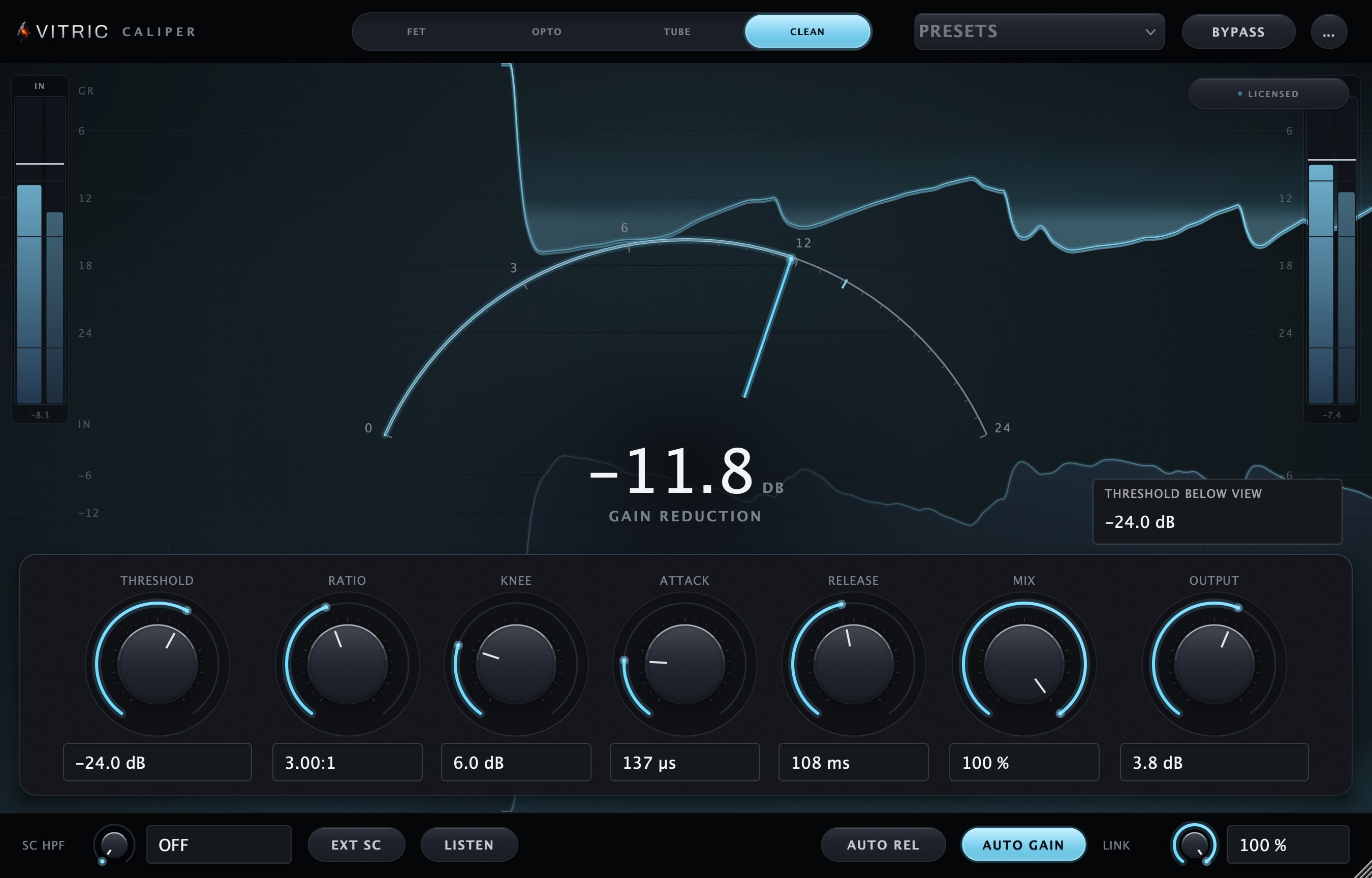
The fourth behavior is the one hardware could never do: feedforward detection, an exact knee computed rather than approximated, auto release, and no harmonic contribution at all. Gain reduction is precisely what the numbers say it is.
This is not the boring option. It is the right option whenever coloration is a liability: a mastering lid where the client signed off on the tone, dialogue, classical and jazz, or any chain that already has enough character stages. It is also the honest way to learn the controls, because nothing program-dependent is second-guessing your attack and release settings.
Matching behavior to the session
| Job | Behavior | Why |
|---|---|---|
| Drum bus, aggression | FET | Microsecond attack clamps the hit, program-dependent release brings up the room behind it |
| Lead vocal, level riding | Opto | Two-stage release with memory smooths phrase to phrase instead of syllable to syllable |
| Mix bus glue | Tube | Wide soft knee engages progressively, so the mix leans in with no audible switch-on |
| Mastering lid, dialogue | Clean | Feedforward exact math, zero added color, gain reduction you can trust literally |
Treat the table as defaults, not law. Plenty of records run FET on a vocal for attitude or opto on a mix bus for slow glue. Choose by mechanism: does the job need the transient caught or let through, should the release remember the last phrase, and is color a feature here or a contaminant.
A few gotchas that apply across all four:
- Level-match before judging. Character compressors add gain and harmonics, and louder reads as better. Match output level to bypass or you are rating volume, not behavior.
- Watch the low end on fast releases. A release shorter than a bass note's cycle modulates the waveform itself and reads as distortion. This is where opto and auto-release behaviors quietly save you.
- Use the sidechain high pass. On full-range material the kick dominates any detector. A high pass in the sidechain stops the whole mix ducking to the kick drum, in every one of these behaviors.
- Stack behaviors instead of pushing one. A few dB of FET into a few dB of opto often beats either doing all the work. Serial compression at low depth is a classic vocal chain.
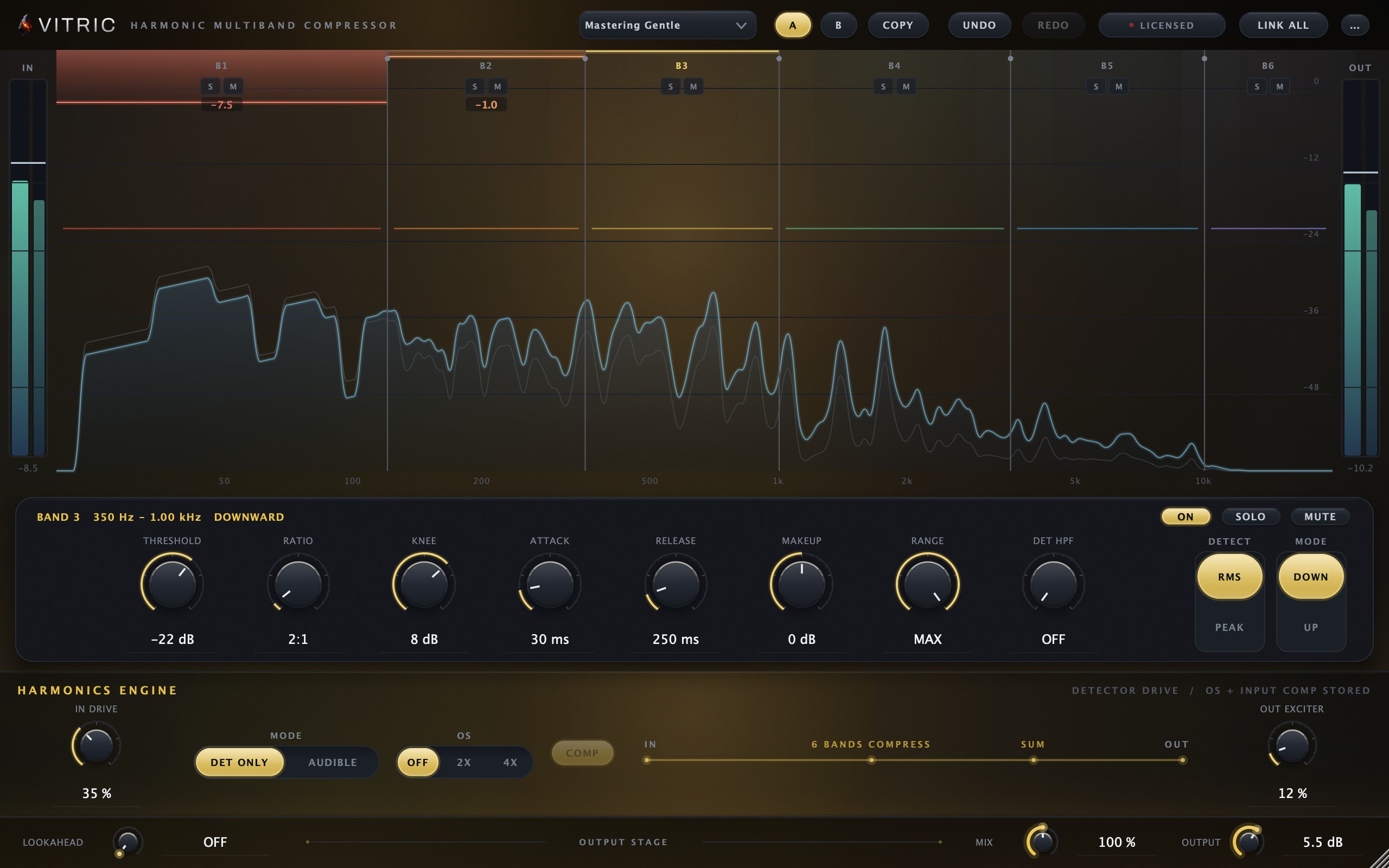
One caveat on scope: everything above is single-band thinking, one detector judging the whole spectrum. When the real problem is one region misbehaving, low mids blooming or an ess spiking, the fix is a band-split detector, which is a different tool entirely.
Emulation versus behavior
A last distinction worth having. Some plugins model one specific hardware unit, component by component, and are judged on fidelity to it, quirks included. Others implement the behavior class: the detection topology, the release shape, the knee, without claiming to be a photograph of one serial number. Neither approach is superior. If a mix was built around one unit's sound, emulate that unit. If what you need is the behavior, fast feedback grab or two-stage optical release, then the behavior is the spec that matters, and switching between behaviors quickly beats fidelity to any single box.