Harmonic Multiband Compressor: the manual
Install, activate, and run the Harmonic Multiband Compressor: the Harmonics Engine, the six-band foundation, session recipes, and the full reference.
The Harmonic Multiband Compressor is a six-band multiband compressor built around the Harmonics Engine, a dual-stage saturation system wired into the signal path. The engine can drive the detectors, saturate the bands audibly, or excite the summed mix, so the saturator-into-compressor chain engineers build from separate plugins lives in one insert. Under it sits a six-band compressor on an allpass-compensated Linkwitz-Riley LR4 crossover tree that sums flat within half a dB.
This manual covers Harmonic Multiband Compressor 2.1.0: installation, activation, the interface, session workflows and the reference controls. It was updated on 11 September 2026. For more techniques, visit the guides index.
Installation and activation
Get the current Harmonic Multiband Compressor installer for your computer. Save your session and close your DAW, run the Windows .exe or macOS .pkg, then reopen the DAW. Rescan plugins if necessary.
Insert Harmonic Multiband Compressor on an audio track or bus. Use AU in Logic Pro, AAX in Pro Tools, or VST3 in a compatible host. AU is available on macOS; both platforms include VST3 and AAX.
Windows builds require Windows 10 or later, 64-bit. Mac builds require macOS 10.15 or later on Intel, or macOS 11 or later on Apple Silicon. Your DAW may require a newer operating system.
Start a three-day trial
- Open the plugin’s license panel and choose Start free trial. This opens the trial page for Harmonic Multiband Compressor with your product and machine code filled in.
- Sign in using the link sent to your email. Check the product and machine code, then choose Email my trial.
- Save the attached license file from your email. On the same computer, choose Load file in the plugin’s license panel.
Install first: the three days begin when the trial license is issued. Every feature is available during that window. Keep the computer connected for periodic internet verification. There is one trial per product, person and machine, with no payment details or automatic charge. At expiry, processing locks while the plugin keeps its saved project settings.
Activate a full perpetual license
Paste the VT-... key from your purchase email or account into the license panel and choose Apply license. Full perpetual licenses work offline after activation.
For an offline studio computer, use the license portal on an online device. Enter your key and the studio computer’s VTM1-... machine code, download the bound file, transfer it to the studio computer and choose Load file. The portal can also resend your active full-license keys.
A full license allows three machine bindings over its lifetime. Deactivation does not restore a binding because permanent offline files cannot be remotely erased. Contact support for a legitimate hardware replacement after using the allowance. A trial is bound to its issuing computer.
Find the plugin after installation
Open the plugin from your DAW’s plugin browser. Check that its supported format was installed, restart the DAW, and inspect its rescan or failed-plugin list if the plugin is missing. The Mac package installs plugins, not a standalone application. Windows may also offer a standalone app under C:\Program Files\Vitric Audio.
Standard installation folders
| Format | macOS | Windows |
|---|---|---|
| AU | /Library/Audio/Plug-Ins/Components | Not available |
| VST3 | /Library/Audio/Plug-Ins/VST3 | C:\Program Files\Common Files\VST3 |
| AAX | /Library/Application Support/Avid/Audio/Plug-Ins | C:\Program Files\Common Files\Avid\Audio\Plug-Ins |
If installation or activation still fails, send support the product version, operating system, DAW version, plugin format and exact error.
Interface tour
The display
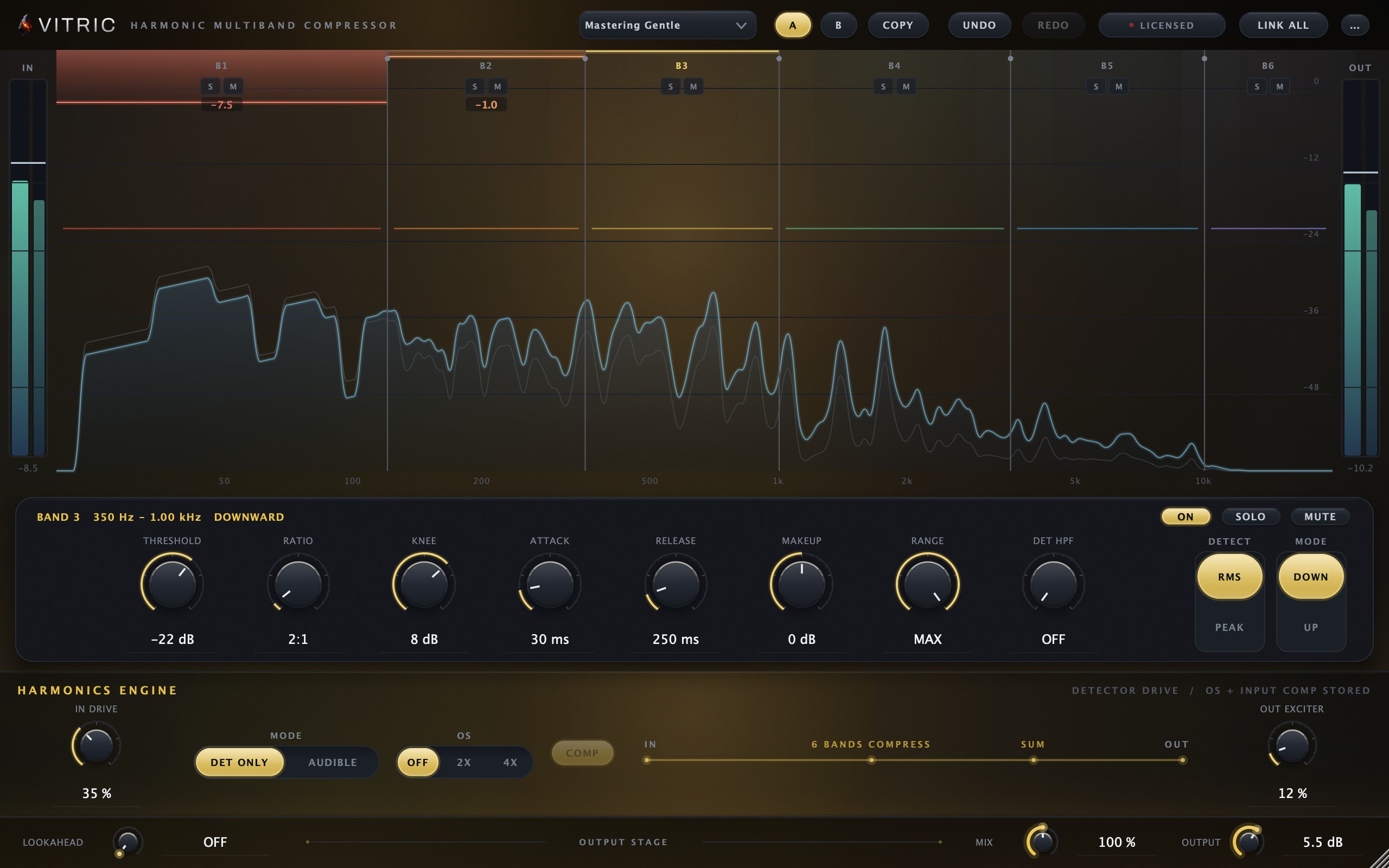
The top of the window is a live spectrum you mix on: a pre and post analyzer running a 4096-point FFT with a 4.5 dB per octave display tilt. Crossovers and thresholds are draggable directly on the spectrum, and each band draws a gain reduction curtain in its own hue, so you see where the compressor is working and by how much without reading meters.
The Harmonics Engine
The engine has two stages. Harmonics IN uses global IN DRIVE and DET ONLY/AUDIBLE controls, then processes each band after the crossover split and before compression. IN DRIVE sets the tanh saturation amount from 0 to 100 percent for all six bands. Selecting a band changes its compressor controls, not a separate drive amount or harmonic mode for that band.
- DET ONLY. The drive saturates only the sidechain feeding that band's detector. The rounded peaks make the compressor ignore micro-transients and squeeze the body of the sound, the way slower vintage optical and tube units behave, while the audio you hear stays completely clean.
- AUDIBLE. The drive hits the audio path itself, per band, before compression, so the compressor reacts to and squashes the saturated signal. Audible saturation offers Off, 2x or 4x oversampling, with a delay-compensated dry path. COMP applies input-drive level compensation in this mode.
Harmonics OUT is the exciter on the summed mix. It isolates added harmonics, filters them from about 18 kHz at low drive toward about 2 kHz at high drive, then blends them back in. The output exciter has its own automatic level matching, independent of COMP. COMP controls audible input pre-saturation compensation only.
The per-band compressor
Each band has threshold, ratio, knee, attack, release, makeup and a range control stored from 0 to 60 dB. Down mode applies downward compression; Up mode applies upward compression capped at the smaller of Range and 30 dB. Each band also has an RMS/Peak detector choice and its own detector high-pass. The smoothed transition between RMS and Peak does not create a separate continuous blend control.
Global controls
- Lookahead. Up to 10 ms, with the latency reported to the host automatically so everything stays aligned.
- Mix. 0 to 100 percent blends dry and wet. Above 100 percent the control adds wet gain, up to 200 percent.
- A/B, Copy, Link All. Two full states with Copy between them, Link All for moving every band together, and undo and redo.
With oversampling and lookahead both off, the plugin runs at zero added latency. Engage either and the latency is reported to your DAW.
Exact editing and effective status
Click a control's value to enter it exactly; Return applies and Escape cancels. Double-click a crossover, or focus it and press Enter, to enter its frequency. Crossovers stay ordered with 5 percent neighbor spacing. The selected-band header shows its frequency span and whether compression is active, off, muted or excluded by another solo. Upward gain appears as a positive LIFT readout.
COMP OFF disables that band's compressor; audible input saturation and the output exciter can still process the signal. DET ONLY keeps input COMP and oversampling settings stored but inactive. Low Latency disables input oversampling, but lookahead remains active and can still add latency. Output-exciter level matching is independent of input COMP.
Workflows
Drum bus density
Choose DET ONLY and raise the global IN DRIVE gradually. Then select the bands carrying the kick, snare body and upper transients and adjust their thresholds, ratios and timing independently. Watch the gain reduction or lift display to judge which regions are working.
Bass that reads small
On a bass track, choose AUDIBLE and introduce a small amount of global IN DRIVE. Choose 2x or 4x oversampling with Low Latency off if desired. Use the individual bands' thresholds and timing to manage the fundamental and harmonics separately. COMP compensates input drive; compare at similar output levels.
Mastering control
Use the individual bands to tighten a wandering low end. The allpass-compensated crossover tree recombines with a flat magnitude response within half a dB; this is not a linear-phase mode. When using audible input saturation, COMP compensates that input drive. The output exciter has separate automatic matching. Compare with A/B and bypass at a similar level.
Air without EQ
A touch of OUT EXCITER at low drive works like a high-frequency exciter: the smart filter sits open near 18 kHz, so the isolated harmonics blend in behind the mix as air rather than as an EQ boost of what is already there.
Reference
| Stage | Where it works | What you hear |
|---|---|---|
| IN, Detector Only | The sidechain only, per band | Smoother, deeper compression with zero added harmonics; vintage opto and tube behaviour |
| IN, Audible Pre-Sat | Each band's audio, using global drive; optional 2x/4x oversampling | Saturation the compressor then squeezes; dense, aggressive walls of sound |
| OUT, Exciter | The summed mix, harmonics isolated and smart-filtered | Air at low drive, console-thick warmth at high drive, level auto-matched |
| Spec | Value |
|---|---|
| Bands | 6, LR4 allpass-compensated, flat sum within 0.5 dB |
| Per band | Threshold, ratio, knee, attack, release, makeup, range 0 to 60 dB with upward lift capped at 30 dB, Down/Up mode, RMS/Peak choice, detector high pass |
| Exciter filter | Dynamic low pass, about 18 kHz to about 2 kHz with drive |
| Lookahead | 0 to 10 ms, host-compensated |
| Analyzer | Pre and post, 4096-point FFT, 4.5 dB/oct tilt |
| Oversampling | Off / 2x / 4x, delay-compensated dry path |
| Mix | 0 to 200 percent |
| Formats | VST3/AAX on Windows and macOS; AU on macOS. Windows 10+ (64-bit); macOS 10.15+ Intel / 11+ Apple Silicon |
FAQ
What is the Harmonics Engine?
A dual-stage saturation and excitation system integrated into the compressor's signal path. Harmonics IN saturates each band before compression, either the detector sidechain only or the audible signal. Harmonics OUT excites the summed mix through a smart-filtered exciter. It replaces the saturator plugins engineers chain around their compressors.
Why put saturation before a compressor?
Because the compressor hears it. Harmonics round the transient peaks the detector reacts to, so the compressor ignores micro-transients and squeezes the body of the sound, behaving like slower vintage optical and tube units. DET ONLY mode gives you exactly that response change with zero audible distortion.
How do the crossover bands recombine?
Harmonic applies allpass compensation across its LR4 crossover tree, so the bands recombine with a flat magnitude response within half a dB. Flat magnitude does not mean zero phase shift; the plugin does not offer a linear-phase mode.
Is it good for mastering?
Yes. The crossover bands recombine flat, and the dry path is delay-compensated when oversampling is used. COMP compensates audible input drive; the output exciter auto-matches independently. Compare at a similar level when deciding how much processing a master needs.
Does it add latency?
Only when per-band oversampling or lookahead is engaged, and that latency is reported to your DAW automatically so everything stays aligned. With both off it runs at zero added latency.
Support
Anything unclear, broken, or missing from this manual: write to support@vitricaudio.com. Every purchase carries a 14 day money back guarantee, so if the plugin does not earn its insert, ask within 14 days and get a refund. More technique articles live in the guides index.