Kiln Synthesizer: the manual
Learn Kiln installation, presets, oscillators, Glass filters, modulation, effects, Field and Anneal, with exact entry and keyboard shortcuts.
Kiln is a software instrument with three oscillator slots, two filters, modulation, an arpeggiator and nine effects. The Glass filter adds resonant body to a source. Anneal takes an audio reference and searches for editable patches with a related tone and envelope.
This guide covers the Kiln 0.2.0 interface.
Installation and activation
Get the current Kiln Synthesizer installer for your computer. Save your session and close your DAW, run the Windows .exe or macOS .pkg, then reopen the DAW. Rescan plugins if necessary.
Create an instrument or MIDI track and load Kiln Synthesizer. It generates audio from notes; it is not an insert effect for an audio track. Use AU in Logic Pro, AAX in Pro Tools, or VST3 in a compatible host. AU is available on macOS; both platforms include VST3 and AAX.
Windows builds require Windows 10 or later, 64-bit. Mac builds require macOS 10.15 or later on Intel, or macOS 11 or later on Apple Silicon. Your DAW may require a newer operating system.
Start a three-day trial
- Open the plugin’s license panel and choose Start free trial. This opens the trial page for Kiln Synthesizer with your product and machine code filled in.
- Sign in using the link sent to your email. Check the product and machine code, then choose Email my trial.
- Save the attached license file from your email. On the same computer, choose Load file in the plugin’s license panel.
Install first: the three days begin when the trial license is issued. Every feature is available during that window. Keep the computer connected for periodic internet verification. There is one trial per product, person and machine, with no payment details or automatic charge. At expiry, processing locks while the plugin keeps its saved project settings.
Activate a full perpetual license
Paste the VT-... key from your purchase email or account into the license panel and choose Apply license. Full perpetual licenses work offline after activation.
For an offline studio computer, use the license portal on an online device. Enter your key and the studio computer’s VTM1-... machine code, download the bound file, transfer it to the studio computer and choose Load file. The portal can also resend your active full-license keys.
A full license allows three machine bindings over its lifetime. Deactivation does not restore a binding because permanent offline files cannot be remotely erased. Contact support for a legitimate hardware replacement after using the allowance. A trial is bound to its issuing computer.
Find the plugin after installation
Open the plugin from your DAW’s plugin browser. Check that its supported format was installed, restart the DAW, and inspect its rescan or failed-plugin list if the plugin is missing. The Mac package installs plugins, not a standalone application. Windows may also offer a standalone app under C:\Program Files\Vitric Audio.
Standard installation folders
| Format | macOS | Windows |
|---|---|---|
| AU | /Library/Audio/Plug-Ins/Components | Not available |
| VST3 | /Library/Audio/Plug-Ins/VST3 | C:\Program Files\Common Files\VST3 |
| AAX | /Library/Application Support/Avid/Audio/Plug-Ins | C:\Program Files\Common Files\Avid\Audio\Plug-Ins |
If installation or activation still fails, send support the product version, operating system, DAW version, plugin format and exact error.
Find a starting sound
- Click LIBRARY or the preset name in the top strip.
- Choose FACTORY in the scope selector and use a category such as BASS, PAD, KEYS, PLUCK or GLASS. Search narrows the list by name.
- Load a patch, close the library and play a phrase. The previous/next buttons step through patches; [ / ] does the same from the keyboard.
- Open MASTER to adjust the four macros and the OUT level. Their effect depends on the patch's modulation routes.
- Save the DAW project before experimenting further, or create a named USER patch in the library.
Kiln includes 554 factory presets and 80 in-house wavetables. The GLASS category is a useful place to hear the resonator before building a patch around it.
Navigate the instrument
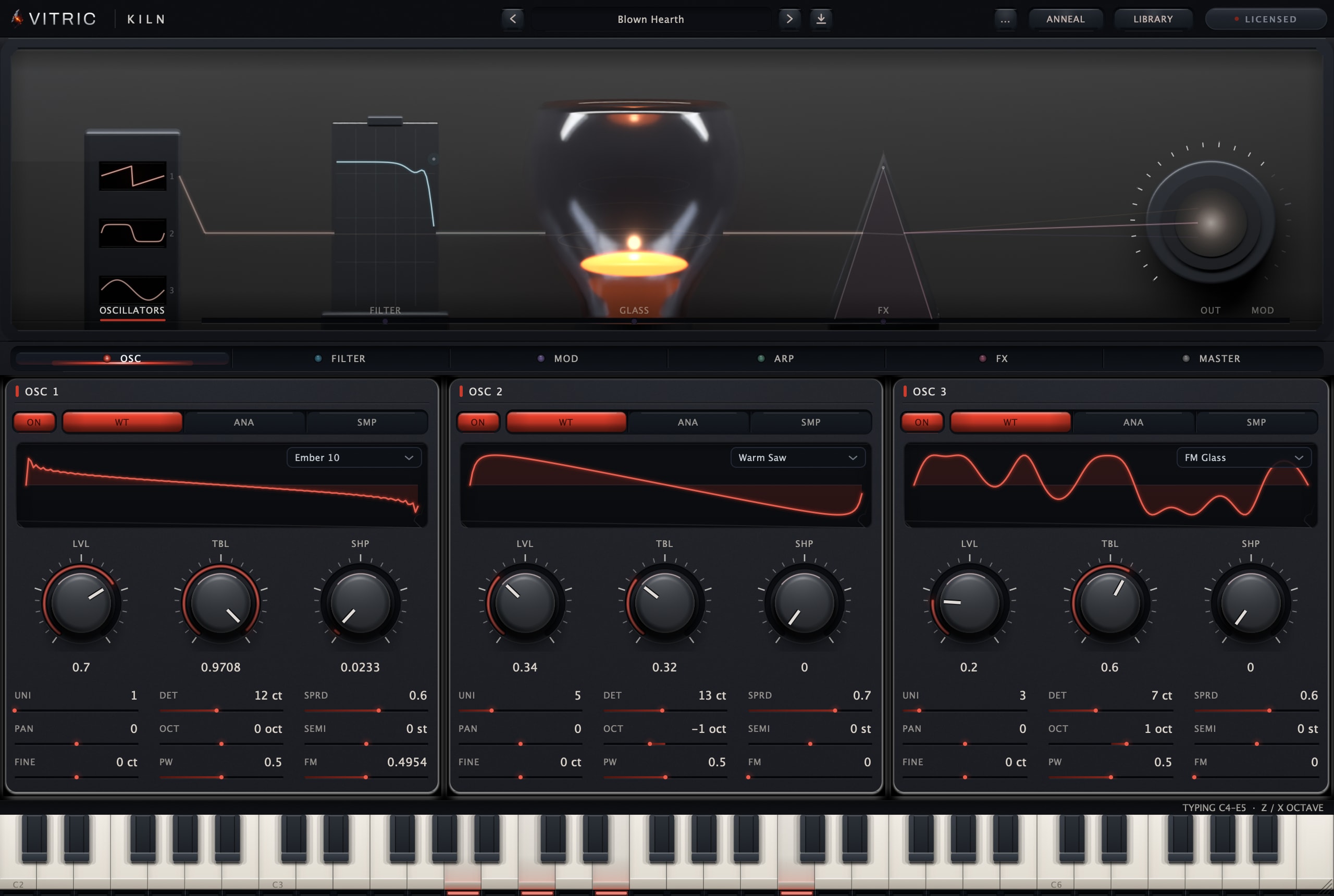
The section rail opens OSC, FILTER, MOD, ARP, FX and MASTER. Keys 1–6 select the same sections. The Stage above the rail reflects activity and provides another way to select sections.
Most plain value fields accept exact entry. Click one or focus it and press Enter, type in its displayed unit, then press Enter to apply or Escape to cancel. Units such as Hz, kHz, ms, s, ct and % are supported where appropriate. An invalid value remains in the editor with a range or unit explanation and does not change the sound.
Drag controls for continuous changes, use Shift for fine movement, and double-click to reset. Wheels and arrow keys follow the control's adjustment grid. Pro Tools uses Command/Ctrl for fine knob dragging. The … menu opens tooltips and the shortcut guide.
OSC: choose and shape a source
Each of the three oscillator slots has an ON switch and an engine selector:
| Label | Engine | Useful controls |
|---|---|---|
| WT | Wavetable | Pick a table in the wave window; TBL scans its frames. |
| ANA | Analog morph | SHP moves through sine, triangle, saw and pulse; PW adjusts pulse width in the pulse region. |
| SMP | Sample playback | Selects the slot's sample engine. |
LVL sets the slot's level. The lower value grid holds UNI, DET and SPRD for unison, detune and stereo spread; PAN, OCT and SEMI for placement and pitch; and FINE, PW and FM for fine tuning, pulse width and phase-modulation amount. UNI runs from one to sixteen voices per note, so raising it can increase CPU demand substantially.
For an initial edit, keep the loaded patch's routing, move TBL or SHP slowly, and adjust LVL before adding more unison. Dedicated SUB and NOISE sources live in MASTER.
FILTER: shape the spectrum and add Glass
The two filter slots offer SVF, LDR, CMB, FRM and GLS: state-variable morph, ladder, comb, formant and Glass. Each slot has ON, CUTOFF, RESO, MRPH, DRV, KEY and MIX.
CUTOFF sets frequency and RESO adds emphasis. MRPH changes the SVF response or formant vowel position; DRV adds input drive for the ladder. KEY controls keytracking and MIX sets the filter contribution. A control's effect depends on the selected model.
Select GLS to reveal its four visible body controls:
| Label | Control | Purpose |
|---|---|---|
| MAT | Material | Moves the modal relationships from glass toward metal and wood. |
| SIZE | Size | Changes the resonator's body scale. |
| POS | Position | Changes the strike point and which modes are excited. |
| DMP | Damp | Shapes how the modal ring decays. |
A practical starting point is a GLASS factory patch. Change MAT and POS first, then adjust DMP to shorten or lengthen the ring. Use MIX to control how strongly the resonator shapes the source.
MOD: add movement
MOD contains envelopes, LFOs and the modulation matrix. The matrix has 48 routes presented in pages of eight. Each route selects a source, a destination and a bipolar DEPTH.
Choose a source and target, start DEPTH near zero, and raise it while holding a note. A positive and negative depth move the destination in opposite directions. Four envelopes, four LFOs, macros and performance sources provide movement; inspect the loaded patch's routes before replacing one.
ARP: turn held notes into a pattern
Turn ARP on, hold a chord and choose UP, DN, UD, PLY, RND or CHD for up, down, up-down, as-played, random or chord behavior. RATE follows host tempo. OCT sets a one-to-four-octave span, GATE controls note length, SWING offsets alternate steps and PROB changes the chance of a step sounding.
LATCH keeps the phrase running after you release the keys; a new phrase replaces it. Turn LATCH off when you want release to stop the pattern. Random and probability behavior uses seeded decisions for repeatable rendering.
FX: finish the patch
The FX tabs are EQ, CMP, SAT, CHO, PHS, FLG, DLY, REV and UTL. Each processor has an ON control. CMP offers COMP and OTT; SAT offers TAPE, TUBE, FOLD and CRUSH. Chorus, phaser and flanger add modulation; delay and reverb add space; Utility provides DC blocking, width, pan and gain.
The EQ uses LOW, MID and HIGH nodes. LOW and HIGH move in gain; MID moves in frequency and gain. Shift gives fine movement. The exact fields along the bottom provide direct entry. TILT changes the overall lean. Double-click a node to reset its gain.
On DLY, SYNC on makes DIV L and DIV R control the repeat times; the millisecond TIME fields become inactive. SYNC off enables TIME L and TIME R instead. FDBK controls repeats, PING crossfeed, WOW pitch wander, DIFF diffusion and MIX the delay amount.
MASTER: level and quality
MASTER contains OUT, the dedicated SUB and NOISE sources, DRIFT, four macros, master CLIP and quality controls. OUT spans −60 to +12 dB. ECO, STD and ULTRA trade processing cost against quality. AUTO enables the governor, which reduces processing demands under load.
When the host tells Kiln it is rendering offline, Kiln uses Ultra and disables governor reductions. If your host performs a real-time export, it may not identify that export as offline. Do not assume every export uses a different quality path from playback.
Save a patch and use Field
Open LIBRARY, enter a new name, choose a tag, then click SAVE NEW. The browser confirms success or shows a duplicate-name or write error. Factory presets remain unchanged. Use the FACTORY/USER scope selector to find your saved patches.
FIELD maps saved USER patches by timbre. It is not a map of the entire factory bank. Save a few user patches first, then choose FIELD and click a dot to load one. LIST returns to the searchable browser.
Anneal: start from a reference
- Open ANNEAL and use OPEN AUDIO or drop one audio file into the target area.
- Choose a short, isolated sound when possible. Kiln accepts non-empty mono or stereo material at 8–384 kHz and analyzes at most the first four seconds.
- Press ANNEAL and wait for the search to complete.
- Compare the four returned candidates using APPLY, then close the panel and edit the selected patch with the ordinary controls.
- Save a new USER patch when you have a result worth keeping.
CANCEL stops the current search, keeps the target and discards partial results. Closing the panel cancels active work too. The percentage is a feature-match score, not a promise that the patch reproduces the reference exactly. Analysis and search run locally; the plugin's license requirements remain separate.
Keyboard and troubleshooting
The typing row a w s e d f t g y h u j k o l p ; plays notes. Z/X changes octave; the keyboard strip shows the current typing range. ? opens shortcuts and Esc closes overlays or cancels entry. Text entry and overlays temporarily suspend musical typing and release held typed notes.
No sound: check the instrument track's MIDI input and monitoring, the license state, oscillator ON and LVL, and MASTER OUT. If a sequence continues after key release, check ARP LATCH.
A control seems inactive: verify the engine or model it belongs to. For example, TBL scans wavetable frames and the DLY millisecond fields are inactive when SYNC is on.
Field is empty: it maps saved user patches, so create a USER patch first.
Anneal differs from the reference: this is expected. It searches for a related editable patch rather than performing exact resynthesis.