The best Pro-Q alternatives in 2026, including free ones
An honest look at Pro-Q 4 alternatives as of July 2026: TDR Nova and Nova GE, Kirchhoff-EQ, the EQ already in your DAW, and where our own Bevel EQ fits.
Ask any producer forum which EQ to buy and the answer arrives before the question is finished: FabFilter Pro-Q. It earned that reputation. But the recommendation has hardened into a reflex, and a reflex does not check your session, your DAW, or what you already own. The honest question is not whether Pro-Q 4 is good. It is whether you need what it does, and whether something cheaper or free covers your actual work.
This roundup places the realistic alternatives as of July 2026: TDR Nova and Nova GE, Kirchhoff-EQ, the stock EQ in your DAW, and our own Bevel EQ. Full disclosure on that last one: we build it at Studio 4 in Cleveland, and this page lives on our site. We have tried to place it honestly, including the cases where a competitor is the better pick.
What you are actually paying Pro-Q for
Pro-Q 4 costs $179 direct from FabFilter as of July 2026, and around $199 at some retailers. That buys up to 24 bands, dynamic EQ on any band, and spectral dynamics, which moves individual frequencies inside a band's range instead of riding the whole band at once. It also buys zero latency, natural phase and linear phase modes, and per-band mid/side or left/right processing.
The less-quoted half of the value is workflow. The analyzer, the drag-anywhere band creation, the way a session-long habit forms in a week: that is what people are describing when they say it is worth the money. Also worth saying plainly: most sessions use a fraction of the feature list. That is not an argument against buying it. It is an argument for knowing which fraction you use before you spend.
TDR Nova: the free one to try first
TDR Nova is a free parallel dynamic EQ from Tokyo Dawn Labs: four parametric bands plus dedicated high pass and low pass filters. Each band carries a threshold, ratio, attack and release, so a band can sit at 0 dB and only cut when the signal in its range crosses threshold. That covers a large share of the jobs people buy dynamic EQ for: ducking vocal harshness only on the loud phrases, taming one boomy note on an acoustic guitar, controlling sibilance without a dedicated de-esser.
The limits are real but narrow. Four bands run out on dense surgical work, and the filter shapes on offer are a shorter list than any paid EQ here. But if you have not spent money on an EQ yet, start here. A remarkable number of "I need Pro-Q" problems are one-band or two-band problems, and Nova solves those for free.
TDR Nova GE: the cheap upgrade
Nova GE, the paid version, lists at about $60 as of July 2026, and Tokyo Dawn discounts it regularly. It extends the same engine to six bands and adds deeper dynamics control, including frequency dependent ratio and equal loudness workflows for level-matched judgement. If Nova fits your hands but you keep hitting the band count, this is the smallest possible spend that removes the wall.
Kirchhoff-EQ: the maximalist option
Kirchhoff-EQ by Three-Body Technology lists at $299 as of July 2026 and is discounted often, regularly landing under $200 at retailers. It is the spec-sheet heavyweight of this list: 32 bands, dynamic processing available on every band, 15 filter types with continuously variable shape, and a library of vintage EQ curve models built in.
Where it honestly beats Pro-Q: raw band count, and analog-style curves living in the same plugin as the surgical ones, so you do not chain a second EQ for color moves. The cost is density. The interface exposes nearly everything, which working engineers tend to either love or route around. If you demo it and the layout fights you, that feeling does not improve at week three.
The EQ already in your DAW
Logic's Channel EQ, Ableton's EQ Eight, Cubase's Frequency, Pro Tools' EQ III: you have already paid for one of these. The mechanism argument matters here. A clean digital bell filter at moderate Q in the middle of the spectrum is solved math, and two competent implementations are indistinguishable there. Cutting 3 dB at 300 Hz does not sound different because the plugin cost more.
Real differences between clean EQs live at the edges: how bells behave near the top of the spectrum, whether linear phase and other phase modes exist, whether bands can be dynamic (Cubase's Frequency: yes; EQ Eight: no), analyzer quality, and how fast the workflow moves under deadline. If your stock EQ has the bands and the analyzer you need, no purchase will fix a mix problem it caused, because it did not cause one.
Bevel EQ, placed honestly
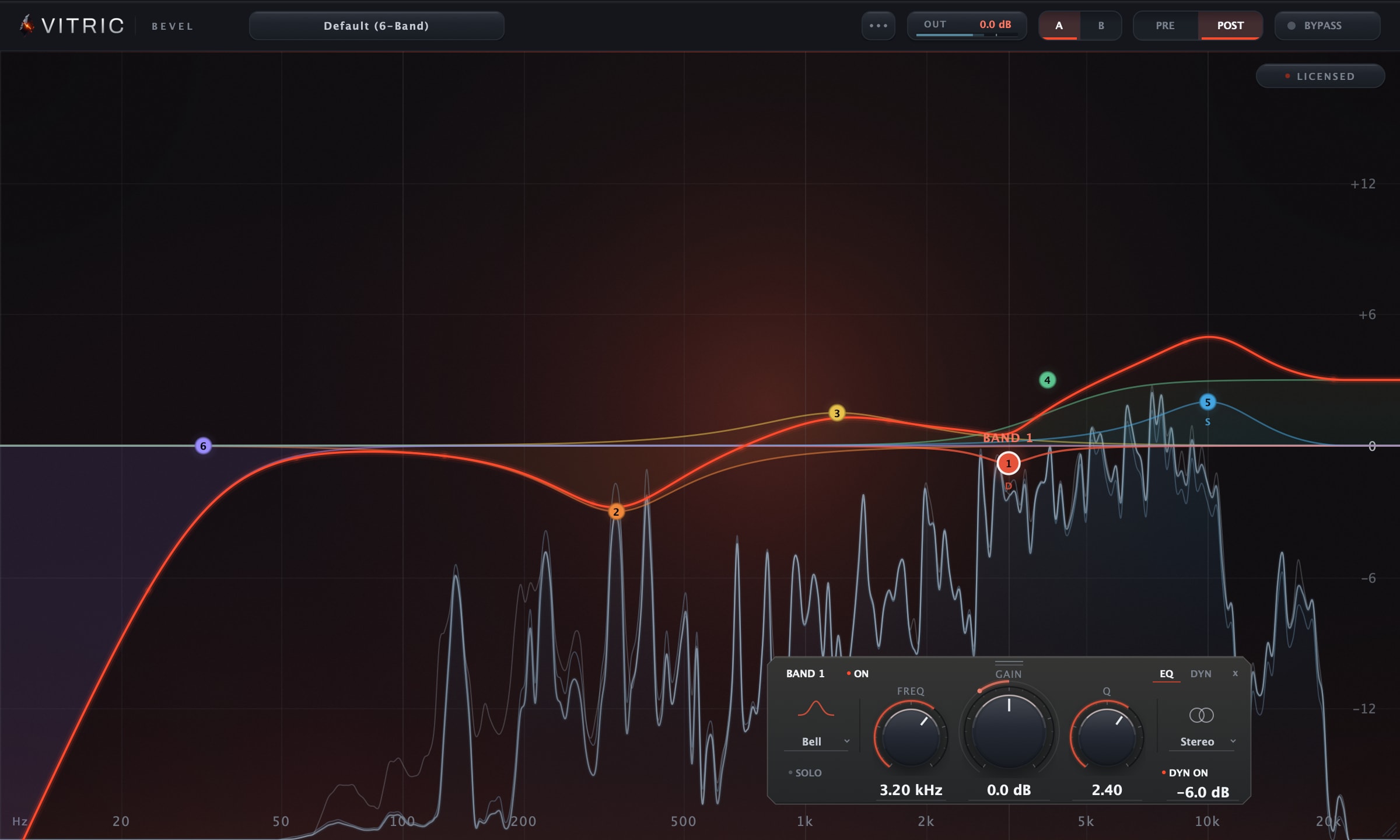
Bevel EQ is ours, so calibrate accordingly. It is a 24-band parametric EQ where every band slot is freeform: any slot can be a bell, shelf, notch, high pass or low pass, with filter slopes from 12 to 96 dB/oct. The real-time pre and post spectrum analyzer draws under the summed curve, and it runs on the UI thread rather than in the audio path, so the metering adds no work to the signal chain. Per-band solo, typeable frequency, gain and Q, A/B states, and click-free bypass, edits and preset recall round out the workflow. VST3, AU and AAX on Windows 10 and up and macOS, Intel and Apple Silicon, with a 3-day full-function trial.
Version 1.1.0 closed the gap this section used to lead with: bands can now be dynamic. Any bell or shelf takes a threshold, a range that is signed so the band can duck or lift, and its own attack and release. The detector is filtered to that band's frequency region, so a dynamic band reacts to its own content rather than to overall programme level. Every band also carries a stereo placement, stereo, left, right, mid or side, so a lift in the sides and a cut in the mid can live in one instance.
The honest gaps that remain: one phase mode only, so no linear phase and no natural phase option. Stereo only, with no surround and no Atmos. No EQ match, no spectrum grab for drawing a curve off a reference, and no collision view between instances. Those are specs, not modesty: if linear phase is part of your print chain, Pro-Q 4 has it and Bevel does not, and if you want the plugin to draw curves off a reference for you, buy the one that does. Where Bevel earns its slot is steep filter work (96 dB/oct covers cleanup and effect filters most EQs cannot reach), resonance hunting with per-band solo, and mid/side placement on any band, with dynamics on the bells and shelves, without budgeting band types against fixed roles. The store is open. Bevel's current price is Free ($30 regular); see the product page for availability and the current offer.
Side by side
| EQ | Bands | Dynamic EQ | Stands out for | Price (dates below) |
|---|---|---|---|---|
| FabFilter Pro-Q 4 | 24 | Yes, plus spectral dynamics | Workflow speed, phase modes | $179 direct |
| TDR Nova | 4 plus HP/LP | Yes | Being free and genuinely good | Free |
| TDR Nova GE | 6 plus HP/LP | Yes, deeper control | Cheapest paid upgrade path | About $60 list |
| Kirchhoff-EQ | 32 | Yes, on every band | Band count, vintage curve models | $299 list, often discounted |
| Stock DAW EQ | Varies | Varies by DAW | Already installed and paid for | Included |
| Bevel EQ (ours) | 24 freeform | Yes, on bells and shelves | Slopes to 96 dB/oct, freeform bands | Free ($30 regular) |
Competitor prices are list or direct prices checked in July 2026; check their stores for current offers. Bevel's price follows this store's current offer, including any active launch discount.
How to choose without wasting money
- Start with Nova. It is free, and it will either solve your problem or teach you exactly which feature you are missing. Both outcomes are worth more than a review.
- Buy for the wall you actually hit. Ran out of bands: Nova GE or Kirchhoff. Need spectral or per-frequency dynamics: Pro-Q 4. Need very steep filters and a fast analyzer workflow: that is the case Bevel EQ is built for. If you cannot name the missing feature, you have not hit a wall yet.
- Demo inside your own session. An EQ that feels fast on a tutorial screen can feel slow on your 60-track mix, and only your own session tells you. Trial before purchase, always.
- Level-match before judging. An EQ move that adds level reads as better on first listen regardless of the plugin. Match output levels in the A/B or you are rating volume, not the equalizer.
The uncomfortable summary: for clean parametric work, the free and stock options are closer to the paid ones than the forum consensus admits, and the paid ones earn their money at specific edges. Find your edge first, then pay for exactly that.