EQ settings: where to start on vocals, kick, 808, snare and the mix bus
Find EQ starting points for vocals, kick, 808, snare and the mix bus. Learn useful frequency and Q ranges, when to cut, and when to use dynamic EQ.
Good EQ settings solve a specific balance problem in a specific recording. A frequency chart can tell you where to listen, but it cannot know the singer, drum tuning or arrangement. Start flat, name what you want to change, and make one move while the rest of the mix plays.
What is the best equalizer setup?
The best equalizer setup is the simplest one that makes the part fit. Before reaching for a band, adjust the track fader. A vocal that seems dull may just be too quiet; an 808 that masks the kick may need a shorter tail. EQ changes the balance of frequencies within a sound, so it cannot replace every level or timing edit.
Frequency chooses where the band acts, gain sets the boost or cut, and Q sets its width. Higher Q means a narrower bell. The guide to parametric EQ, frequency, gain and Q explains the shapes and bandwidths. Q values do not translate exactly between every filter design, so compare the audible width as well as the number.
Why try a cut before a boost?
A low-mid buildup can hide a vocal's consonants. Reducing that buildup may reveal enough clarity without adding treble. A boost in the same situation can leave the mud in place while making breaths, noise and esses louder. Finding the excess first helps you avoid stacking bands that fight each other.
This is a listening order, not a rule that cuts are inherently cleaner. Boost when something useful is missing, and skip a cut when nothing is wrong. Either move can change peaks and phase; even a cut does not guarantee more peak headroom. Trim the output for a fair bypass comparison and check for clipping downstream.
Use the EQ frequency chart to locate likely regions. If you need visual help, the spectrum analyzer can show where energy collects. A tall peak might be the note you want to keep. Do not flatten the display just because it looks uneven.
EQ starting points at a glance
| Source and problem | Region to audition | Bell Q | First move |
|---|---|---|---|
| Vocal sounds muddy | 200 to 400 Hz | 1 to 2 | Cut 1 to 3 dB; keep the chest tone |
| Kick sounds boxy | 250 to 500 Hz | 1 to 2 | Cut 1 to 3 dB; check against the bass |
| 808 crowds the low mids | 150 to 300 Hz | 1 to 2 | Cut 1 to 2 dB only if those harmonics are excessive |
| Snare has an unwanted ring | Often 400 Hz to 1 kHz; locate the actual ring | 4 to 8 | Cut 2 to 4 dB; keep some drum tone |
| Mix bus feels thick | 200 to 400 Hz | 0.5 to 1 | Cut 0.5 to 1 dB; compare the vocal body |
These rows describe separate problems. Do not apply all of them by default. The right frequency moves with the performance, and a track may need no EQ at all.
Where should you start on vocals?
For rumble, audition a high-pass around 60 to 100 Hz with a 12 dB/oct slope. Raise the corner until the voice begins to lose weight, then back it down. A low voice may need a lower corner, and a clean recording may need no filter. A high-pass attenuates gradually; it is not a wall that leaves every frequency above the label untouched.
If the vocal is muddy, try the table's 200 to 400 Hz cut. For a nasal sound, listen around 800 Hz to 1.5 kHz with Q 2 to 4 and a small cut. Do not assume all energy there is a fault: removing too much takes away the vowel that makes the voice recognizable.
For intelligibility, try a broad 1 to 2 dB lift around 2 to 4 kHz at Q 0.7 to 1. For air, audition a high shelf around 10 to 14 kHz at similarly modest gain. Stop if breaths or esses take over. Harshness on only a few syllables calls for dynamic EQ or de-essing before a permanent cut that darkens the whole take.
Where should you start on kick?
Listen to the kick and bass together. For a kick that needs weight, locate its low thump, often around 50 to 80 Hz, then audition a 1 to 2 dB boost at Q 0.7 to 1.2. If that region is already occupied by the bass, the boost may make both less clear. Try lowering the bass level or changing either sound first.
A small cut around 250 to 500 Hz can reduce cardboard-like tone. If the attack is hard to hear, try 1 to 3 dB around 2 to 5 kHz at Q 1 to 2. A soft hip-hop kick may need none of that click. Compare in the chorus: a soloed kick with huge lows and highs can leave an awkward hole in the middle of the mix.
Where should you start on an 808?
Check tuning and note lengths before EQ. An 808 is often the bass instrument, and its fundamental follows the notes. A fixed deep notch that clears the kick on one note can hollow out another. The 808 tuning guide is a better first stop if the line sounds wrong against the chords.
Play the whole bass phrase. If its upper bass crowds the vocal or keys, audition a 1 to 2 dB cut around 150 to 300 Hz at Q 1 to 2. Those harmonics also help an 808 remain audible on small speakers, so check there before keeping the cut. Boosting a nearly pure sub tone at 1 kHz will not create missing harmonics.
Filter below the lowest wanted note only when there is unwanted energy to remove. An automatic high-pass at 40 Hz can weaken the part you meant to keep. If a few notes boom, try clip gain or a dynamic band at the offending region. If every kick hit is masked, level, envelope length or sidechain ducking may solve the overlap more directly.
Where should you start on snare?
For body, audition 150 to 250 Hz with a broad Q 0.7 to 1.2 bell and 1 to 2 dB of boost. For crack, try 2 to 4 kHz at Q 1 to 2. These moves serve different jobs: extra crack does not restore a thin drum's body, and extra body can obscure a busy kick pattern.
Find an unwanted ring by listening to the tail between hits. Start around 400 Hz to 1 kHz, then move beyond that range if needed. Use Q 4 to 8 and a 2 to 4 dB cut as an audition. Keep the cut shallow enough that the snare still has a pitch and character. A ringing drum is not automatically a bad drum.
How much EQ belongs on the mix bus?
Begin smaller: a broad 0.5 to 1 dB bell at Q 0.5 to 1, or a gentle shelf. For excess warmth, audition 200 to 400 Hz. For a little air, try a high shelf around 10 to 12 kHz. Listen to the vocal, cymbals and snare together, because all three change when you move the top end.
If only one instrument is causing the problem, fix its channel first. A bus cut that clears a muddy synth also thins the singer. Recheck the loudest section and any limiter after changing bus EQ; a small tonal move can change what drives the next processor.
When should you use dynamic EQ instead?
Use a static cut for a problem that stays present. Use dynamic EQ when the region is right most of the time but jumps forward on certain notes or syllables. Start with no static gain change, a downward range of about 2 to 3 dB, and a threshold that catches the offending events.
For a low-mid swell, audition 10 to 30 ms attack and 100 to 200 ms release. For a sharp consonant, try a faster response. Shorten release if the following note stays dull; lengthen it if the tone chatters. The goal is recovery between events, not constant movement on the meter.
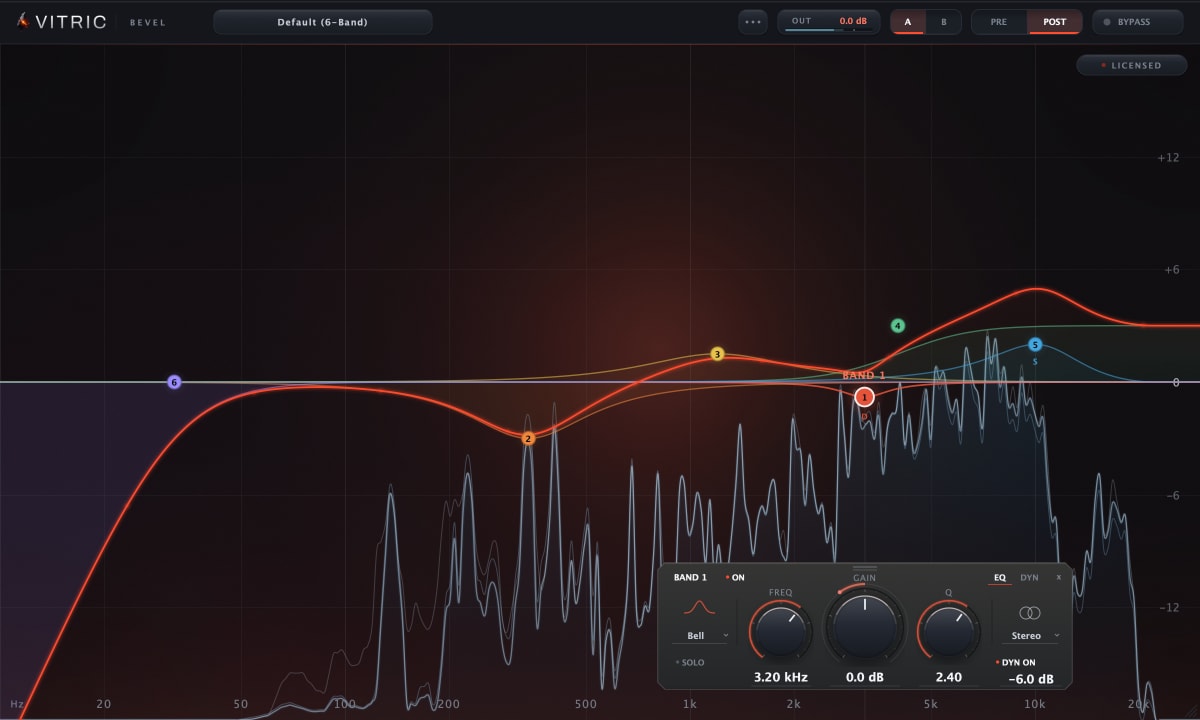
In Bevel EQ, bells and shelves have per-band dynamics with a detector filtered to the band's region. Select the band, open DYN, enable DYN ON and set a negative Range for downward movement. The Bevel EQ manual covers these controls. Compare the result at matched output level and keep only the bands that improve the mix.