How to EQ vocals: the frequencies that matter, and a starting chain
Vocal EQ is mostly small cuts: a high-pass for rumble, a little out of the mud at 200 to 400 Hz, a narrow dip for nasal tone, then a gentle lift for presence and air. Here is where each problem lives and the first move for each.
Most vocal EQ is a few small moves: a high-pass to clear rumble, a cut where the voice turns muddy or nasal, and a gentle lift for presence and air. The frequencies depend on the singer and the microphone, so treat every number below as a place to start listening, make the move in the mix rather than with the vocal soloed, and stop as soon as the problem is gone.
Where does a voice sit?
A male voice sings from about E2 to C5, roughly 82 to 523 Hz, with its chest around 100 to 250 Hz, a nasal honk near 1 kHz, presence around 3 to 5 kHz and sibilance around 5 to 9 kHz. A female voice sings from about F3 to C6, roughly 175 Hz to 1 kHz, with body around 200 to 400 Hz, presence around 3 to 6 kHz, sibilance around 6 to 10 kHz and air above 10 kHz.
Vocal EQ chart: problems and first moves
| If the vocal is | Look around | First move |
|---|---|---|
| Rumbly, thumpy | Below 60 to 100 Hz | High-pass, 12 dB/oct; raise until it thins, then back off |
| Muddy | 200 to 400 Hz | Cut 1 to 3 dB, Q 1 to 2; keep the chest tone |
| Boxy, cardboard | 300 to 700 Hz | Find the ring with a narrow boost, then cut 2 to 5 dB there |
| Nasal | 800 Hz to 1.5 kHz | Small cut, Q 2 to 4 |
| Harsh on some words | 2 to 5 kHz | Dynamic EQ band that cuts only when it happens |
| Too essy | 5 to 10 kHz | De-esser, not a static cut |
| Unclear, buried | 2 to 4 kHz | Lift 1 to 2 dB, Q 0.7 to 1 |
| Dull, closed | 10 to 14 kHz | Modest high shelf; stop if breaths jump out |
| Thin | 200 to 400 Hz | A little boost; a thin voice can take some here to sound fuller |
These are separate problems, not a preset. Most vocals need two or three of these moves, and a well recorded one may need none. Compare every change at matched loudness: a boost can sound better simply because it is louder.
How do you find the problem frequency?
Play the vocal in the mix, set a narrow bell with a few dB of boost and sweep it slowly through the range in the table. The problem jumps out where the boost makes it worst. Turn the boost into a cut, widen it a little, and lower the gain until the problem just goes. A spectrum analyzer helps confirm a resonance, but decide by ear: an uneven display is not a fault on its own.
Male and female vocals
A lower voice carries useful weight further down, so its high-pass corner may need to sit lower than 100 Hz, and its chest region overlaps the mud range. A higher voice has less below 200 Hz to lose, so its high-pass can often sit a little higher, and its presence and sibilance sit slightly higher too. Set the high-pass by ear every time: raise the corner until the voice starts to lose weight, then back it down.
Where does EQ go in the vocal chain?
Often in two places. Mike Senior in Sound On Sound says there are no hard and fast rules, but cutting low-frequency resonances or thumps before the compressor stops them driving it, and he does most tonal shaping after it. Pitch correction usually comes first; after it, as the vocal compression guide explains, come corrective EQ, compression, then de-essing, or de-essing before the compressor if strong esses trigger it. Tonal EQ follows, with reverb and delay on sends. See pitch correction, how to compress vocals and what sibilance is.
Vocal EQ in Vitric plugins
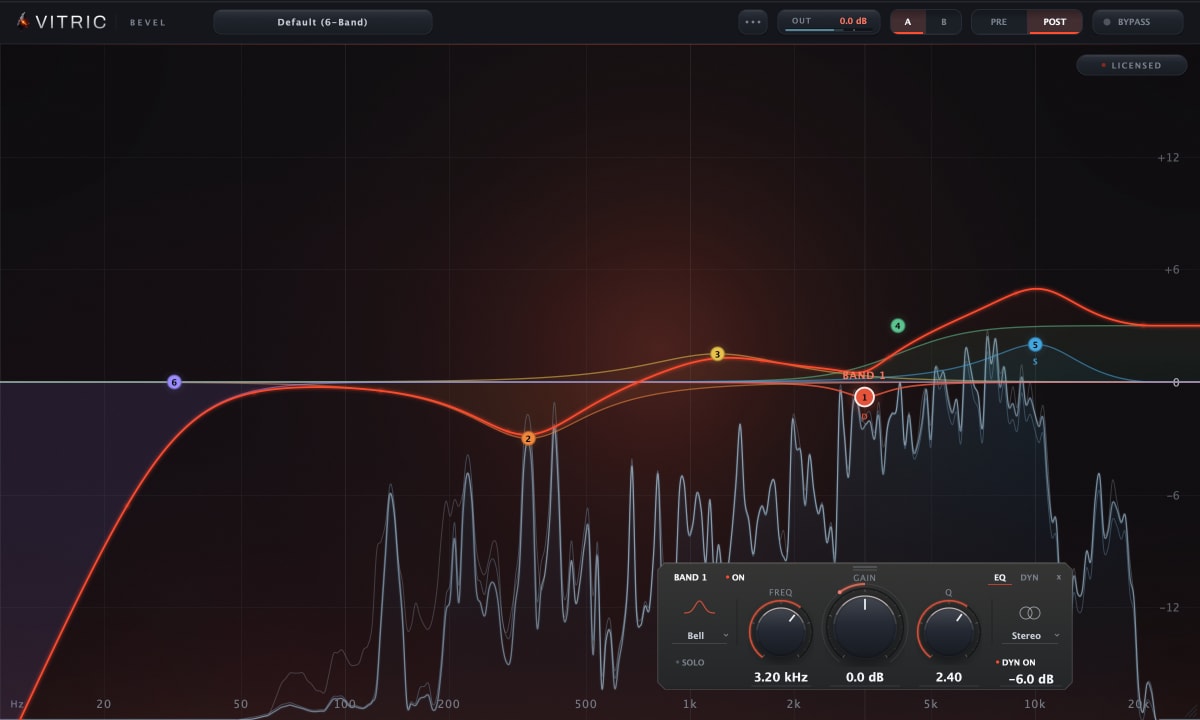
- Bevel EQ: when a harsh frequency comes and goes, a dynamic bell or shelf cuts it only when it appears, instead of a constant cut.
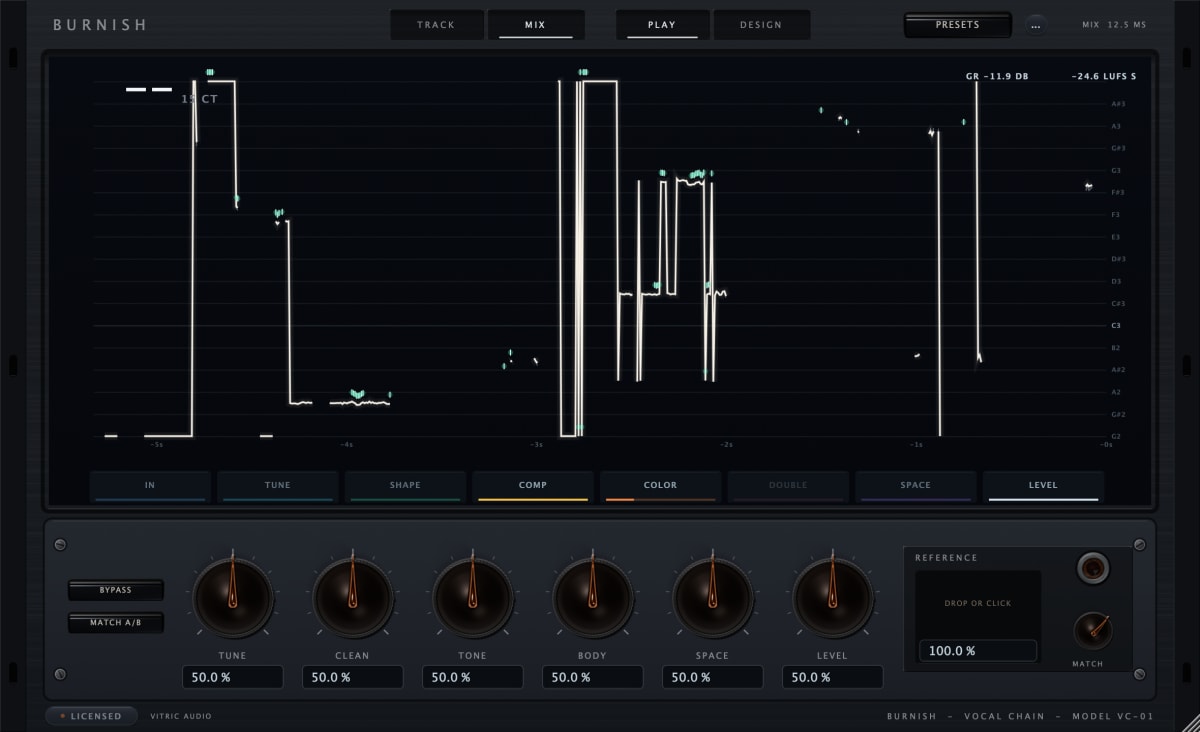
- Burnish Vocal Chain: its SHAPE station runs a five-band EQ, then de-harsh and de-ess, between tuning and compression.
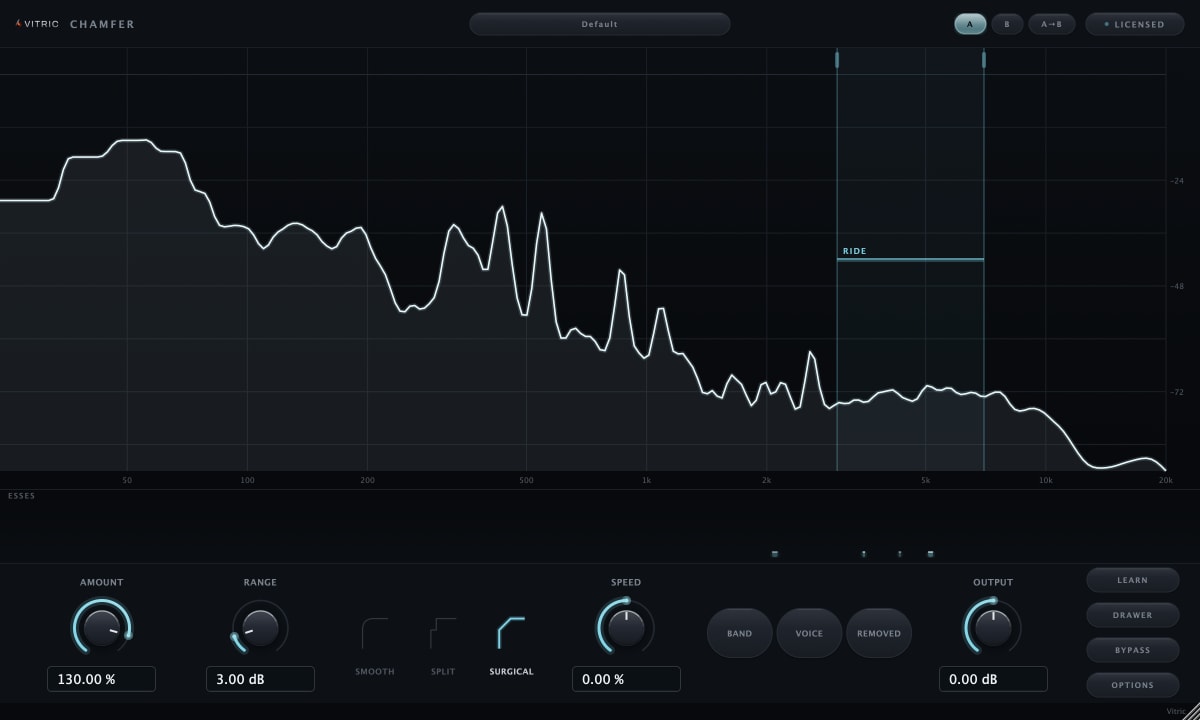
- Chamfer De-Esser: for harsh sibilance that changes with the vocal level. Learn a phrase, set Amount, and cap the reduction with Range.
Questions
What frequency should I cut on vocals?
Most often below 60 to 100 Hz with a high-pass, and 1 to 3 dB somewhere between 200 and 400 Hz if the voice is muddy. Only cut what you can hear as a problem.
How do I make vocals clearer?
Clear the mud first, then try a broad 1 to 2 dB lift around 2 to 4 kHz. If the vocal is still buried, the fix is usually its level or the parts competing with it, not more EQ.
Should I EQ vocals before or after compression?
Corrective cuts before, tonal EQ after, is the usual split. Subtle EQ works either way.
Should I boost or cut?
Both have a place. Cuts fix problems; small, broad boosts add character. Whichever you use, compare at the same loudness.