Room correction and room EQ: what it can fix, what it can't, and how to measure
A small room changes the bass you hear from your speakers. Room correction measures it and applies EQ, which helps with some problems and not others. Here is why rooms do this, what EQ can and can't fix, and how to measure with REW.
A small room changes what you hear from your speakers, most of all in the bass. Some low notes boom and others nearly vanish, and the effect changes as you move your head. Room correction measures the sound at your listening position with a microphone and applies EQ to even it out. It helps with some of these problems and not others.
Why rooms change the bass
Every room has resonances called room modes, mostly at low frequencies. The strongest are usually the axial modes, between one pair of opposite surfaces. Their frequencies follow from the room's size: the first mode along a dimension is the speed of sound divided by twice its length, and the rest are whole-number multiples. In a room 4 metres long that is about 43 Hz, then 86, 129 and 172 Hz.
A mode is not equally loud everywhere. At some spots it is strong, at others it nearly cancels, so the bass you hear depends on where you sit. Higher up, above what is called the Schroeder frequency (in typical rooms, the low hundreds of hertz), the modes overlap so densely that they no longer stand out as separate resonances.
What room EQ can fix
- Peaks. A mode that makes one bass note boom can be cut with EQ.
- Broad, shallow dips can be lifted a little.
- At one position. The correction is right only where you measured. For a realistic range of head movement, the REW documentation puts the useful range at a few hundred hertz and below.
What it cannot fix
- Deep, narrow dips. Where sound cancels, the dip is very sensitive to position, even at very low frequencies. Boosting it takes a lot of gain, which eats headroom and can clip, and a step to the side makes it worse.
- Reflections and dips. Room responses are mostly not minimum phase, so EQ cannot undo how the sound arrives over time. Cutting a mode's peak can shorten its ringing where you measured, but only treatment damps it across the room.
- Other seats. EQ that fixes one listening position can make others worse.
The REW documentation sums it up: EQ is a complement to acoustic treatment and only ever a small part of the solution. Bass traps damp the modes themselves. Porous ones must be very thick to work in the low bass; damped panels are another way to absorb it.
How to measure your room with REW
REW, Room EQ Wizard, is free room measurement software by John Mulcahy for Windows, macOS and Linux. The simplest setup is a calibrated USB measurement mic such as the UMIK-1; an analog measurement mic needs an audio interface with phantom power.
- Put the mic where your head goes when you mix.
- Measure each speaker, then both, and look at the bass below a few hundred hertz.
- Move the speakers or your seat a little and measure again. A small move can fill a dip that EQ cannot.
- Look at the decay as well as the response: REW's impulse and spectrogram views show modes that ring on.
- Only then, cut the worst peaks with an EQ in the playback chain to your speakers, not on your mix, and measure again.
Checking the low end of a mix
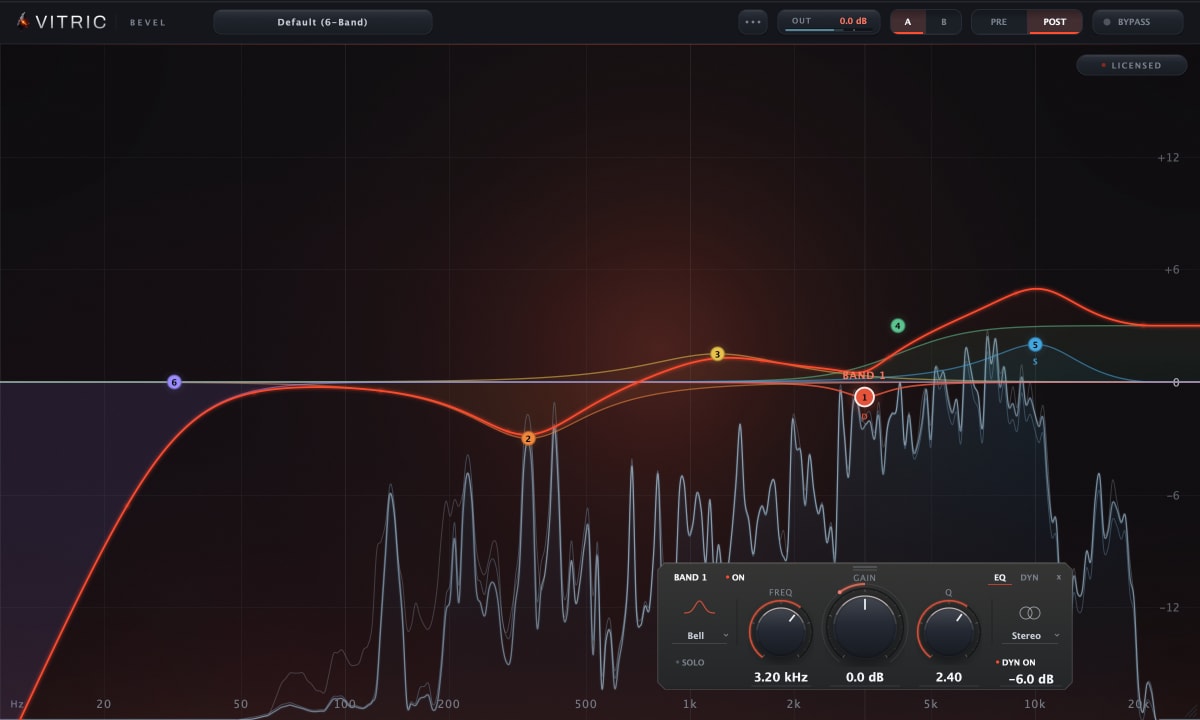
Until the room is right, do not trust it alone in the bass. A spectrum analyzer shows what is really there: see how to read a spectrum analyzer and the free spectrum analyzer. Bevel EQ can draw the spectrum before and after its EQ together, so you can see what a low-end move in your mix changed.
Questions
Does room correction replace acoustic treatment?
No. EQ can tame bass peaks at one position, but it cannot fill deep dips or remove reflections. Treatment and positioning do the heavy lifting; EQ refines what is left.
What is REW?
Room EQ Wizard, free software for measuring rooms, speakers and subwoofers and setting EQ to help with room problems.
Why does my mix sound different in another room?
Every room has its own modes, so the bass you heard was partly your room. Measuring, treating and checking with an analyzer help your mixes translate.