Types of delay: slapback, tape, ping-pong and more
Delay records a sound and plays it back later. Here is what makes slapback, tape, ping-pong and bucket-brigade delays sound the way they do, how to time them to the song, and how to keep a vocal delay out of the way.
A delay records what you feed it and plays it back a moment later. Three settings decide most of the sound: the time before the first repeat, the feedback that sends each repeat back in to make another, and the mix of wet repeats against the dry signal. The types below differ in where the repeats land and what happens to their tone on each pass.
What is delay in music?
In music, delay is the effect that turns one sound into a series of repeats. At a 250 ms time the first repeat arrives a quarter of a second after the note. Feedback at 0 percent gives exactly one repeat; 30 to 40 percent gives a handful, each quieter than the last. Near 100 percent the repeats stop fading, and past it they grow until something in the circuit limits them. That runaway is called self-oscillation.
On an insert, 10 to 25 percent wet is a normal start for an echo that sits behind the part. On an aux send the delay runs 100 percent wet and the send level sets the balance.
Delay vs echo vs reverb: what's the difference?
Delay is the process; an echo is a repeat that arrives late enough to stand apart from the original. Below roughly 40 ms on a voice, and much less on a drum hit, a single repeat fuses with the source, and you hear a thicker, wider or slightly hollow sound instead of a second event.
Reverb is the same physics taken further: so many reflections, so close together, that they blur into one fading tail. A delay gives you a few countable copies; a reverb gives you a space, and the reverb guide covers its decay and pre-delay. The two work well together. Feed the delay return into the vocal's reverb and the repeats sit in the room instead of floating in front of it.
What is a slapback delay?
Slapback is a single repeat about 70 to 150 ms after the original, with little or no feedback. It is too late to fuse with the source and too early to read as a rhythmic echo, so the part sounds as if it was played against a hard wall. It is the sound of 1950s rock and roll records, made by hearing the signal off a tape machine's playback head a fraction of a second after it was recorded.
Start at 90 ms, feedback at 0 to 10 percent, the slap 8 to 12 dB under the dry part, and a low-pass around 3 to 5 kHz so it reads as a reflection rather than a second singer. Slapback is rarely synced to the tempo. Set it by ear: shorter for fast songs, longer for slow ones.
What makes tape delay sound like tape?
A tape echo records onto a loop of tape and reads it back from a playback head further along. The delay time is the head spacing divided by the tape speed, so these machines change it with the motor speed, a movable head or a choice of heads. Feedback records the playback onto the tape again, and every trip costs something:
- Darker repeats. Tape loses high frequencies, more so at slower speeds, so each repeat comes back duller than the one before.
- Saturation. Tape rounds off peaks, so loud repeats get thicker rather than louder, and runaway feedback swells and distorts instead of climbing forever.
- Wow and flutter. Wow is slow speed drift, flutter a faster wobble. Both bend the pitch of the repeats slightly.
- Pitch glides. Change the time mid-phrase and the tape speeds up or slows down under the heads, so the echoes already on it slide in pitch.
A tape delay plugin earns the name by doing this inside the feedback loop, so later repeats are more worn than early ones. Try a quarter note or a dotted eighth, 30 to 45 percent feedback and a slightly worn setting on a vocal or a lead line.
What is a ping-pong delay?
A ping-pong delay sends its repeats left and right in turn, each one landing on the opposite side from the last. Each repeat is still a single point you can follow, so the part moves across the stereo field rather than just getting wider. It suits synth plucks, guitar fills and vocal throws at the end of a line. Under a lead that keeps singing it pulls attention from side to side, so keep it low there or save it for the gaps.
What are bucket-brigade, dub and modulated delays?
Bucket-brigade (analog) delay
Analog delay pedals use a bucket-brigade chip: a chain of tiny capacitors that pass samples of the signal from stage to stage on a clock. A slower clock gives a longer delay but samples the signal less often, so less high end gets through, and filters around the chip keep clock noise and aliasing out. So longer times tend to sound darker, and because every repeat runs back through those filters, each pass is darker than the last. Many designs add a compander against noise, which makes the repeats pump and bloom slightly.
Dub delay
Dub delay is a way of playing a delay more than a circuit, and it grew out of Jamaican dub mixing in the late 1960s and 1970s. The usual recipe is a tape-style echo, feedback high enough that the repeats nearly run on, a filter narrowing them toward the midrange, and the send pushed by hand on single words or snare hits. Letting the feedback run away for a bar, then pulling it back, is part of the style.
Modulated and clean digital delay
A modulated delay sweeps its time slightly with a slow LFO, so the repeats waver in pitch; chorus and flanging are very short modulated delays. A clean digital delay is the opposite: exact copies, which is right when the repeats are part of the rhythm and should stay as clear as the original.
How do you set delay time to the tempo?
One beat lasts 60,000 divided by the BPM, in milliseconds. Halve it for an eighth note, then multiply any value by 1.5 for its dotted version or by 2/3 for its triplet. At 90 BPM:
| Note | Straight | Dotted | Triplet |
|---|---|---|---|
| 1/4 | 666.67 ms | 1,000 ms | 444.44 ms |
| 1/8 | 333.33 ms | 500 ms | 222.22 ms |
| 1/16 | 166.67 ms | 250 ms | 111.11 ms |
Straight values thicken a part without changing its rhythm. A dotted eighth lands between the beats and weaves a second rhythm against the first. Triplets relax the feel. The delay calculator lists every value from a whole note to a 1/64 at any tempo, and the BPM tapper finds the tempo by tapping along.
Synced is a starting point, not a rule. Shortening a vocal delay by 5 to 15 ms pushes the feel; lengthening it lays the feel back. If a reverb follows the delay, the reverb calculator does the same math for pre-delay and decay.
How do you put delay on vocals without clutter?
A vocal delay should be heard in the gaps and felt under the words. A cluttered one is usually too bright, too long or too loud while the singer is singing.
- Use a send, not an insert. Put the delay on an aux return, 100 percent wet, fed post-fader so riding the vocal also rides the repeats. The return gets its own EQ and ducking, and backing vocals can share it. An insert at 10 to 20 percent mix is fine for a slapback.
- Filter the repeats. High-pass the return around 200 to 300 Hz and low-pass it around 4 to 6 kHz. The repeats lose their chest and their esses; the dry vocal keeps both. A filter inside the feedback loop darkens every pass, so later repeats drift back on their own.
- Duck them under the dry vocal. Key a compressor on the return from the dry vocal, or use the delay's own ducking, for 4 to 8 dB of reduction while the singer is singing. A fast attack and a 200 to 400 ms release let the repeats bloom as each line ends.
- Keep feedback low. 15 to 25 percent on a quarter note gives two or three audible repeats, enough to fill a gap without stacking under the next line.
- Throw single words. Automate a second send to a longer delay and open it only on the last word of a phrase.
How do you try each type in Colonnade?
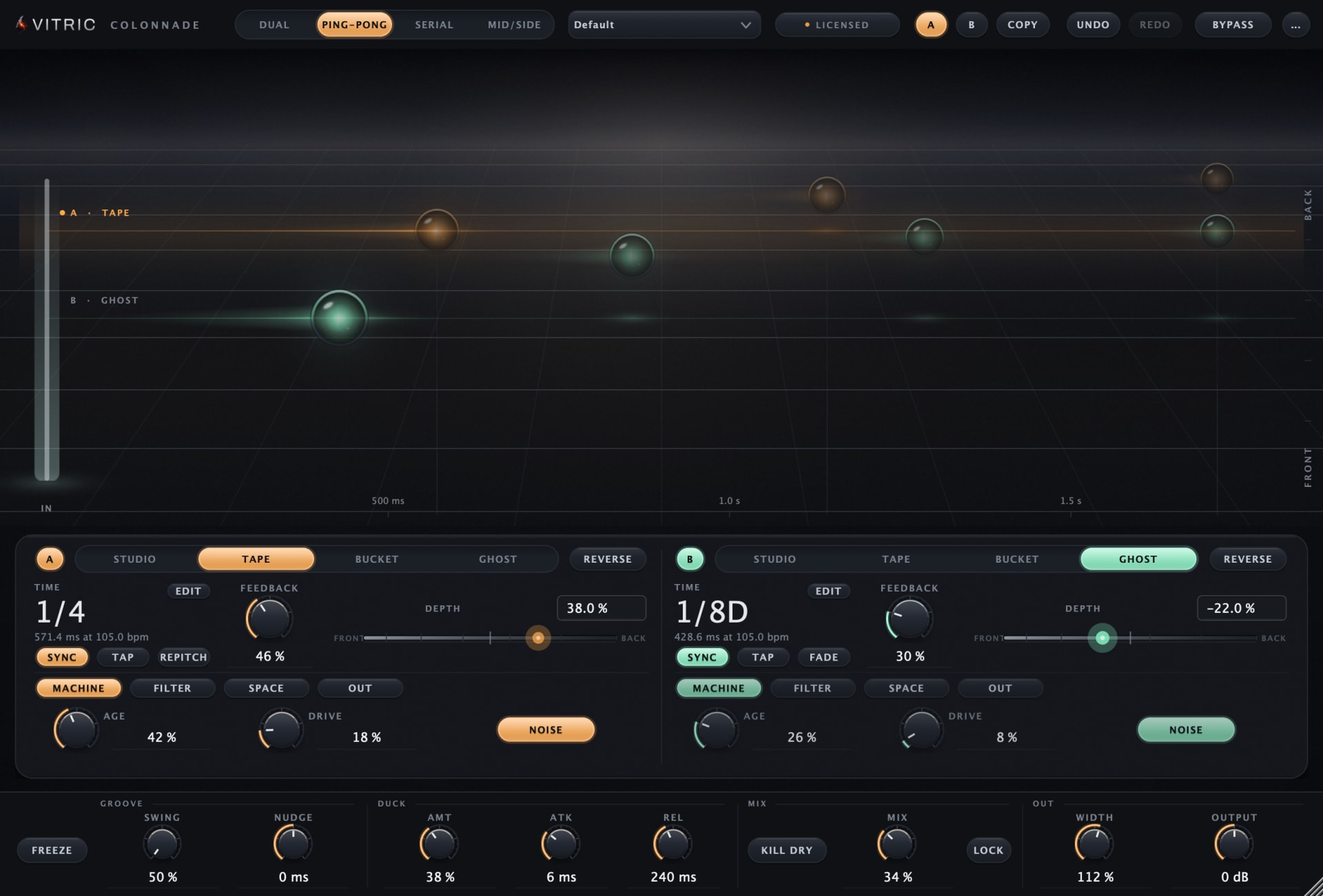
Colonnade Delay has two independent engines, A and B, each running one of four characters inside its feedback loop: Studio, Tape, Bucket or Ghost. Tone and wear build up as the repeats go on.
- Slapback. Engine A on Studio or Tape with sync off, TIME EDIT at 90 ms and feedback at 0. Switch B off from its lane's right-click menu.
- Tape echo. Tape on a synced quarter note, feedback around 35 percent, Age toward worn. It models saturation, head bump, high-frequency loss that tracks tape speed, and wow and flutter built from measured machine behavior. In Repitch a time change glides like a tape transport, with motor constants from a real echo machine; Fade crossfades at constant pitch instead.
- Ping-pong. The Ping-Pong routing puts the first repeat on the left, the second on the right, the third on the left. In a new instance both sides are fed from a mono sum of the input, so a centered vocal bounces too.
- Bucket-brigade. Bucket derives a virtual clock from 8,192 stages and filters at 0.4 times that clock, so repeats darken as the time gets longer, with compander pumping and bloom.
- Dub. A low-pass or band-pass FILTER in the loop shapes the first repeat and compounds on every pass. Feedback self-oscillates from 100 percent and stays bounded up to 120.
- Lo-fi. Ghost adds companded bit reduction, sample rate reduction and a deep, slow warble.
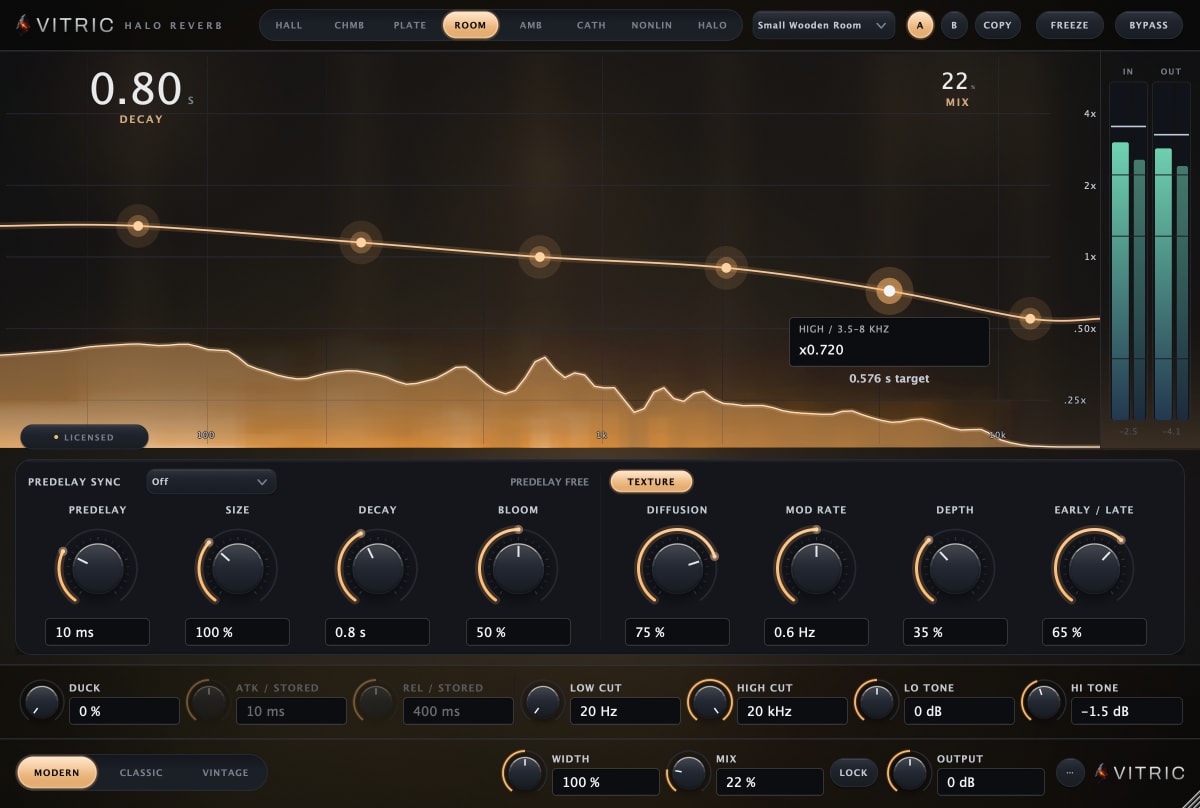
For vocals, the manual's slap and throw setup puts a clean Studio eighth on A at a slightly negative DEPTH and a worn Tape quarter on B pushed far back. DEPTH moves level, air absorption, smear, arrival time and width together, so the far repeats recede instead of just getting quieter, and ducking from the dry signal lets both bloom in the gaps. On a send, engage KILL DRY and lock the mix. The Colonnade Delay manual covers every control. For a room behind the repeats, send the delay return on to Halo Reverb, whose predelay can follow the host tempo.