Chorus vs flanger vs phaser: how each modulation effect works, and when to use which
Chorus and flanger mix in a delayed copy of the sound whose delay time an LFO sweeps, while a phaser sweeps notches made by all-pass filters. Here is how each one works, a sourced comparison, and starting settings for guitar, pads, vocals and bass.
Chorus and flanger both mix in a delayed copy of the sound whose delay time an LFO sweeps, chorus with longer times and flanger with very short ones plus feedback, while a phaser sweeps notches made by a chain of all-pass filters, not by a delay.
What is a chorus effect?
A chorus splits the signal, delays the copy, and uses an LFO to move that delay time up and down. While the delay is getting longer the copy plays slightly flat; while it is getting shorter, slightly sharp. Mixed with the dry sound, the copy reads as a second player a hair out of tune and out of time. Sound On Sound's Synth Secrets series puts the chorus delay anywhere from 10 to 50 ms: much longer and you hear a distinct echo, much shorter and it turns into flanging.
- Rate is the LFO speed. A fraction of 1 Hz gives a gentle chorus, around 3 Hz is a common general setting, and 5 to 7 Hz gives the shimmer of a synth string ensemble (Sound On Sound, 2003 and 2004).
- Depth is how far the delay swings, so how far the pitch wanders. Fast rates want shallow depth; slow rates can take more.
- Voices are extra delayed copies, each swept at a different LFO phase or rate, so the movement never lines up into one obvious wobble.
- Feedback stays at or near zero.
What is a flanger?
A flanger is the same circuit with a much shorter delay: typically under 20 ms, and often only a few (Sound On Sound, 2021; Smith, Physical Audio Signal Processing). At those times the copy no longer sounds like a second player. It cancels the dry signal at a row of evenly spaced frequencies, a comb filter. With the copy at the same polarity, the first notch sits at 500 divided by the delay in milliseconds, in hertz, and the rest at 3, 5, 7 times that, all the way up. At 1 ms that is 500 Hz, 1.5 kHz, 2.5 kHz and on every 1 kHz, about 20 notches across the audible band; at 5 ms the first notch drops to 100 Hz and the rest crowd together. Sweep the delay and the whole comb slides up and down: that is the whoosh.
Most flangers add feedback, also called regeneration or resonance, which turns the gaps between notches into ringing peaks. The notches are deepest with the dry and delayed signals at equal level, so 50 percent mix is the classic setting, and flipping the delayed copy's polarity gives negative flanging, which sounds more hollow. Sweeps are slow: in a tape-style walkthrough for Sound On Sound, Craig Anderton used 0.45 Hz and found 0 to 0.4 Hz effective.
The name comes from tape. Two machines played the same recording in sync, and an engineer slowed one by pressing on the flange of its reel, so it fell a few milliseconds behind and caught up again; studios have done it since at least the 1960s. Tape flanging used no feedback, and because one machine could also run slightly ahead, it could pass through zero delay, where the cancellation is deepest. Through-zero designs recreate that by delaying the dry path a little too.
What is a phaser?
A phaser gets its notches another way. An all-pass filter passes every frequency at the same level but shifts its phase, by an amount that changes with frequency. Chain several stages and mix the result with the dry signal: wherever the copy comes out exactly opposite in phase, the two cancel. An LFO sweeps the frequency the stages are tuned to, and the notches move with it.
Each notch takes two stages, so a four-stage phaser has two notches, and most phasers have between two and six (Sound On Sound, 2021). More stages give more notches and a stronger effect, and feedback sharpens the peaks between them. The notches are not evenly spaced. Four identical stages centered on 1 kHz notch at about 414 Hz and 2.4 kHz, nearly 6 to 1 apart, and nowhere else, where a flanger's comb keeps going right up the spectrum. That harmonic comb is why a flanger sounds pitched and metallic, and the phaser's few uneven notches are why it is the softer swirl.
Chorus vs flanger vs phaser at a glance
| Effect | Chorus | Flanger | Phaser |
|---|---|---|---|
| What moves | The delay time of a copy | The delay time of a copy | The tuning of a chain of all-pass stages |
| Delay | About 10 to 50 ms | Typically under 20 ms, often a few ms | No delay line |
| LFO rate | Under 1 Hz gentle, about 3 Hz typical, 5 to 7 Hz ensemble | Slow: 0 to 0.4 Hz in a tape-style example | Set by ear, from slow swirls to fast wobbles |
| Feedback | Little or none | Usually, often a lot | Optional; strengthens the sweep |
| Notches | Closely packed and moving; heard as a detuned double rather than a sweep | Evenly spaced comb: 1, 3, 5, 7 times the first notch | A few, usually two to six, unevenly spaced |
| Typical sources | Clean guitar, pads, backing vocals, bass with the lows dry | Guitars, drum loops, overheads, transitions | Electric piano, pads, guitar, synth leads |
The delay ranges overlap and published figures differ at the edges; below about 15 ms a delayed copy stops being heard as a separate event. Sources: Sound On Sound, More Creative Synthesis With Delays (2004); Sound On Sound, Using Your Plug-in Delay Effects (2003); Sound On Sound, Effects: All You Need To Know (2007); Sound On Sound, How Phasers Work (2021); Sound On Sound, What's the difference between phasing and flanging? (2006); Sound On Sound, Flanger Management (2012); Sound On Sound, Understanding & Emulating Vintage Effects (2001); Sound On Sound, Where To Use Processors & Why: Part 4 (1998); Julius O. Smith III, Physical Audio Signal Processing, Flanging.
Chorus, flanger and phaser settings to start with
Depth and mix are percentages of each control's range, and plug-ins scale depth differently, so judge depth by how far the pitch wanders. The chorus rates below sit under 1 Hz, the gentle end of the range above; push toward 3 Hz when the wobble should be obvious.
| Part | Effect | Rate | Depth | Feedback | Mix |
|---|---|---|---|---|---|
| Clean guitar | Chorus | 0.5 to 0.8 Hz | 30 to 50% | 0 | 30 to 50% |
| Guitar or drum loop, jet sweep | Flanger | 0.1 to 0.3 Hz, or one sweep per 2 or 4 bars | 50 to 70% | 40 to 60% | 50% |
| Synth pad | Chorus, or a phaser for movement | Chorus 0.3 Hz; phaser one sweep per 1 or 2 bars | 40 to 60% | 0 on chorus, 20 to 40% on phaser | 30 to 50% |
| Lead vocal | Chorus, subtle | 0.3 to 0.5 Hz | 10 to 20% | 0 | 10 to 20% |
| Backing vocals | Chorus | 0.5 to 0.8 Hz | 20 to 40% | 0 | 25 to 40% |
| Bass | Chorus with the lows dry | 0.5 Hz | 20 to 30% | 0 | 30 to 50%, above about 150 Hz only |
- Guitar. A flanger with feedback can take over a part, so it often works best automated on a fill or a transition.
- Pads. To sync a phaser sweep to the song, the delay calculator gives any note value in Hz at your tempo.
- Vocals. On a lead, keep chorus low enough that you notice it more when it is bypassed than when it is on. Backing vocals can take more, which helps a stack blend.
- Bass. Low notes that wobble lose weight, and a wide low end cancels in mono. Use a chorus with a low cut on its wet path, or duplicate the bass, high-pass the copy at about 150 Hz, chorus the copy, and leave the original dry and centered.
Why a wide chorus can thin out in mono
Many stereo choruses run a separate moving copy on each side, with the two LFOs offset in phase, and the width you hear is the difference between the sides. Summed to mono, whatever lived only in that difference cancels, and the moving copies comb filter against each other and the dry signal in one channel. The worst case is a chorus that widens by putting the wet signal in opposite polarity on each side: Sound On Sound warned that early stereo units built this way lose the effect completely in mono.
Check every stereo chorus in mono at your normal level; the mono vs stereo guide shows what to listen for. If the part drops away, lower the width or the mix. For width that survives, pan a mono chorus to one side and the dry part to the other: in stereo it spreads, and in mono it folds back into an ordinary chorus.
How they relate to vibrato, tremolo and modulated delay
Turn a chorus to 100 percent wet and you hear only the moving copy, a pitch wobble with nothing to beat against: vibrato. Tremolo moves the level instead, so it makes no notches and no pitch change; see tremolo, vibrato and autopan and what an LFO is. Lengthen the delay past the chorus range and you get a modulated echo, separate repeats that waver in pitch. Tape delays do this on their own, because wow and flutter move the delay time; the types of delay guide covers them. And since a phaser is a moving filter and a flanger a moving comb, the filter effects guide is the next step for other sweeps.
Modulated delay lines in Colonnade and Halo
Neither of these plug-ins is a chorus, flanger or phaser. They use the mechanism underneath all three, a delay whose time moves, for other jobs.
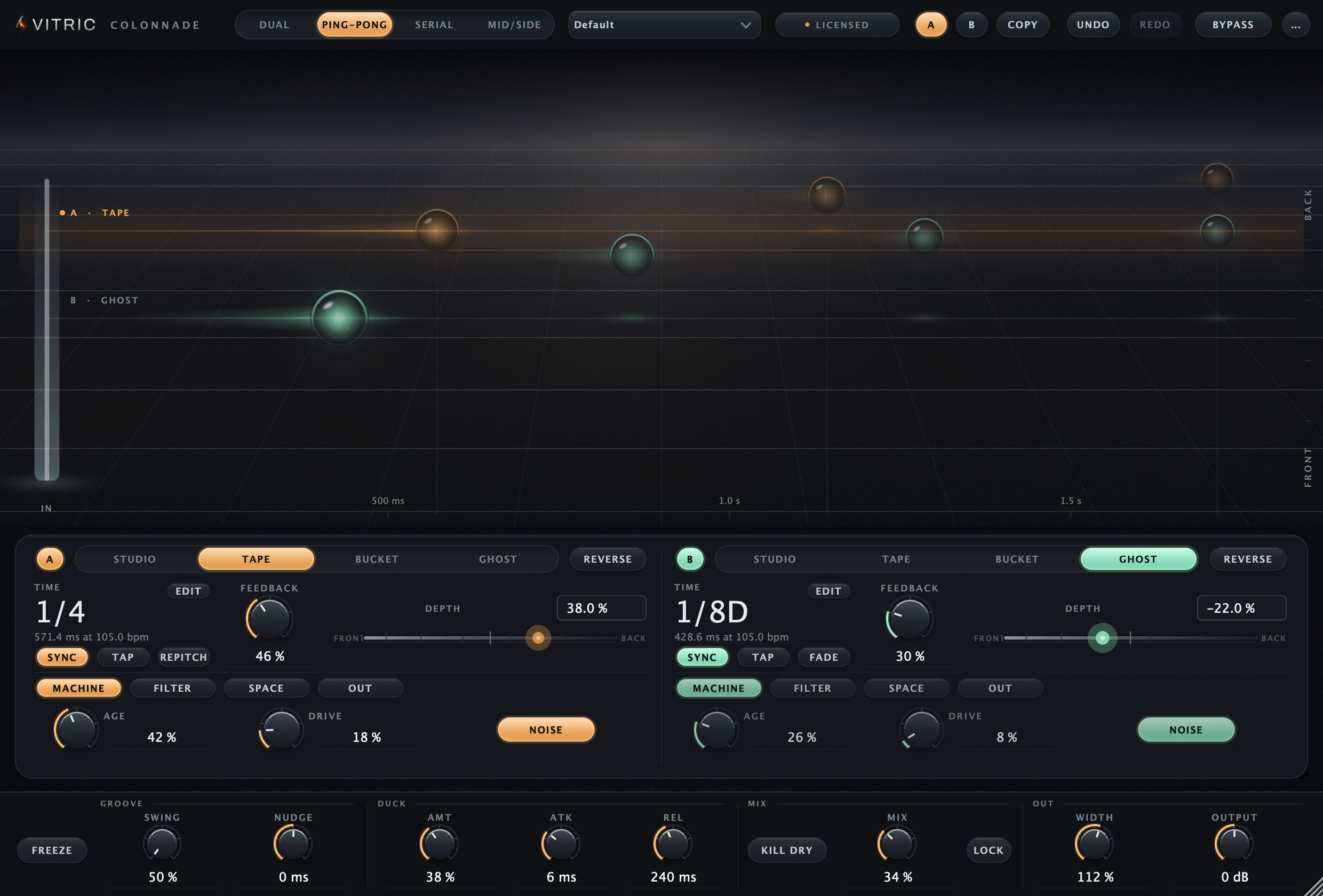
- Colonnade Delay, Tape: wow and flutter built from measured machine behavior, with program-dependent saturation, and head bump and high-frequency loss that track tape speed. The character sits inside the feedback loop, so it is written into every pass.
- Colonnade Delay, Ghost: a deep, slow warble, with companded bit reduction and sample rate reduction.
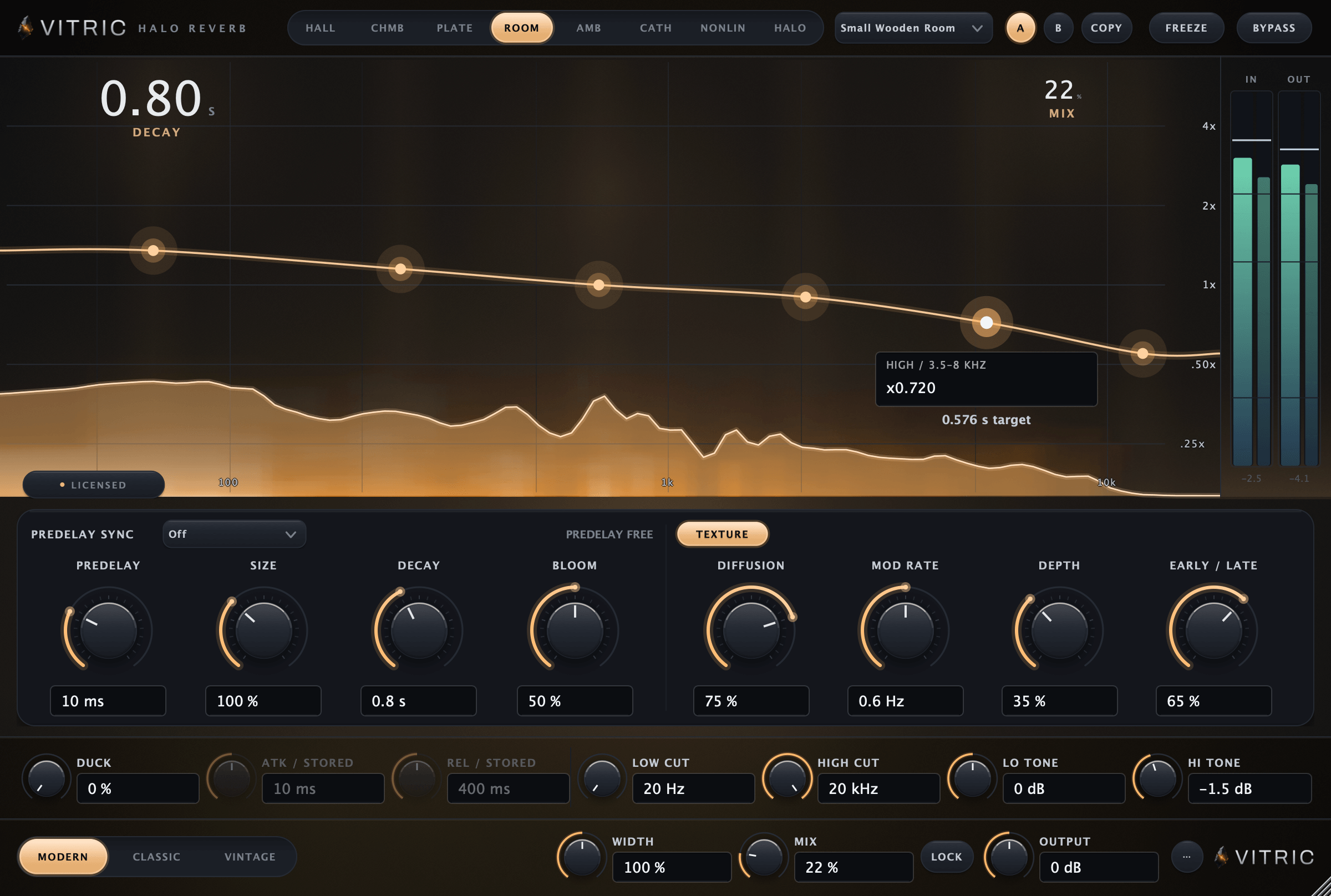
- Halo Reverb: Hall, Chamber, Room, Ambience and Cathedral run an eight-line modulated FDN, a feedback delay network tuned per space, and HALO runs the same network with granular pitch regeneration in the tail. MOD RATE (0.1 to 5.0 Hz) and DEPTH (0 to 100 percent) set how fast and how far the tail moves; the CLASSIC and VINTAGE eras make that movement less regular.
In an algorithmic reverb, that slow movement is usually there to keep a long tail from settling into fixed, ringing resonances. The Colonnade Delay manual and the Halo Reverb manual cover every control.
Chorus, flanger and phaser questions
What is the difference between a flanger and a phaser?
A flanger mixes in a copy delayed by a few milliseconds and sweeps that delay, which makes a comb of evenly spaced notches that feedback can sharpen into a ringing jet sound. A phaser has no delay line: all-pass filter stages make a few unevenly spaced notches, usually two to six, and an LFO sweeps them. The phaser is the subtler of the two.
Is chorus the same as flanger?
They are built the same way, a copy whose delay time an LFO sweeps, but a chorus uses longer delays, roughly 10 to 50 ms, and little or no feedback, so it sounds like a second, slightly detuned part. A flanger uses much shorter delays, typically under 20 ms, usually with feedback, so it sounds like a sweeping filter.
Why does my chorus disappear in mono?
Some stereo choruses put the wet signal in opposite polarity on each side, so in mono the wet signal cancels and only the dry part is left. Others keep the effect but sound thinner, because the moving copies comb filter against each other once both sides share one channel. Lower the width or mix, or pan a mono chorus against the dry part.