Distortion vs overdrive vs saturation vs bitcrushing: what's the difference?
Saturation, overdrive, distortion and fuzz all bend a waveform's peaks to add harmonics; they differ mainly in how hard they clip, and in how they respond to playing dynamics. Bitcrushing works another way, by cutting the digital resolution. Here is what each does to the wave, how each sounds, and where to use it.
Saturation, overdrive, distortion and fuzz are the same idea at different strengths, with different responses to playing: each pushes a signal past what the circuit or algorithm can pass cleanly, so the peaks of the waveform bend or flatten and new harmonics appear. Saturation is the gentle end, fuzz the extreme. Bitcrushing is different: it adds distortion by reducing the resolution of digital audio, in level steps, in time, or both.
What is the difference between saturation and distortion?
Saturation is mild distortion. It rounds the peaks a little, a soft clip that flattens them gradually, and adds harmonics related to the original tone, which makes a sound denser and easier to hear without sounding broken. Push harder and the same process becomes audible distortion. The saturator guide shows the harmonics measured.
Overdrive vs distortion
Overdrive aims to sound like a tube amplifier pushed into saturation, and it responds to how hard you play. Distortion is heavier, more compressed and less dependent on dynamics. The two words are often used interchangeably; where people do separate them, distortion is the more extreme.
What is fuzz?
Fuzz is extreme distortion, first made by guitarists with faulty equipment. It clips so hard that the wave turns close to a square, buzzy and full of harmonics. The harder a signal is clipped, the more its waveform moves toward a square wave and the harsher it sounds: soft clipping adds gentler harmonics, hard clipping puts more energy in the high ones.
What does a bitcrusher do?
A bitcrusher lowers the bit depth, the sample rate, or both. Fewer bits turn the wave into steps, adding noise and cutting the dynamic range; at the extreme the sound collapses into harsh, square-like clicks and buzz. A lower sample rate makes high frequencies alias or disappear, and at extreme settings sounds metallic. Bitcrushing is a staple of glitch, lo-fi electronic music and chiptune.
The four at a glance
| Effect | What it does to the wave | Sounds like |
|---|---|---|
| Saturation | Rounds the peaks gently | Warmer, denser, louder |
| Overdrive and distortion | Flattens the peaks, harder as drive rises | Grit, crunch, compression |
| Fuzz | Clips to a near square | Buzzy, harmonically rich |
| Bitcrushing | Cuts resolution into steps | Lo-fi, digital, metallic |
Saturation with Stoke
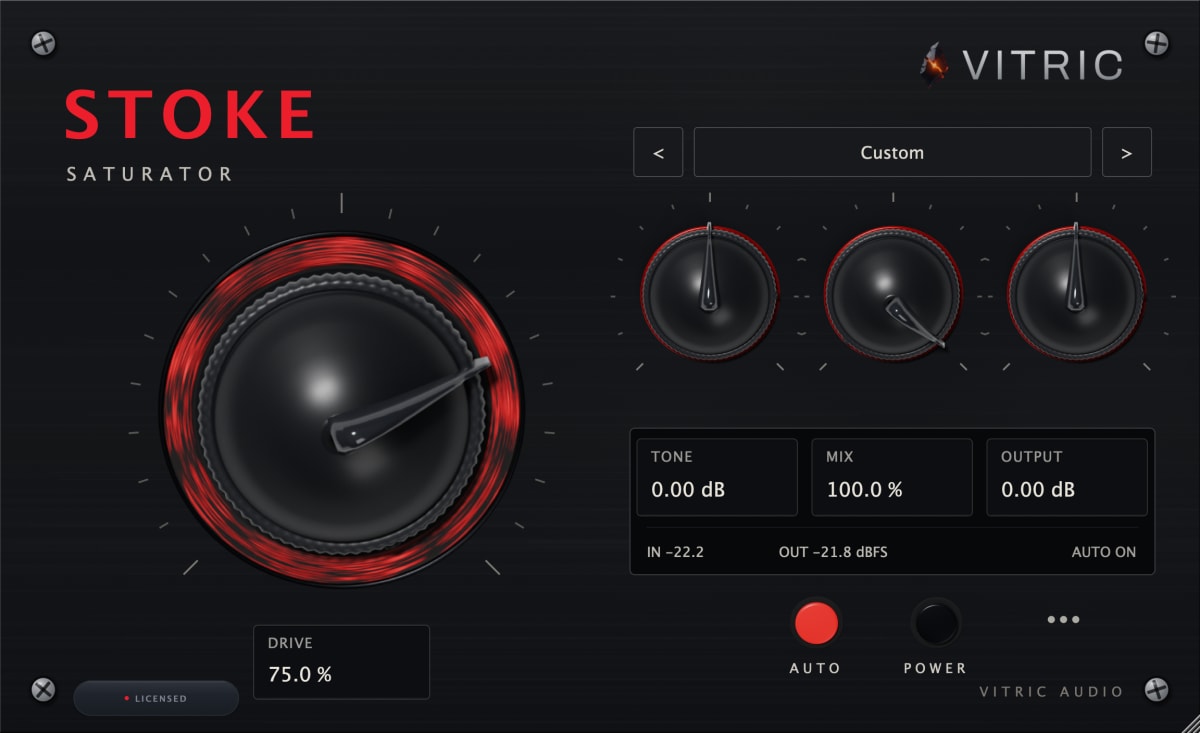
Stoke Saturator is an analog-style saturation plugin with four controls: Drive, Tone, Mix and Output. It adds harmonic distortion for density, Mix blends it with the dry track, and Auto uses a calibrated curve to limit the level change as Drive rises, so you can judge the tone rather than the volume.
Questions
Is saturation the same as distortion?
Saturation is a gentle form of distortion: the same bending of the peaks, used lightly enough to add warmth and density instead of obvious grit.
Is a bitcrusher a distortion effect?
Yes, but a digital one: it distorts by cutting bit depth, sample rate or both rather than by clipping the peaks.
Why does distortion sound louder?
Clipping flattens the peaks, so the average level rises against the peak level, and the added harmonics fill in the sound. Compare at matched loudness before deciding it sounds better.