What is an LFO? Low frequency oscillators explained
An LFO is an oscillator that runs too slowly to hear, used to move another setting over time: a filter for a sweep or a wobble, pitch for vibrato, volume for tremolo, pan for auto-pan. Here is what rate, shape and depth do, and how to sync an LFO to the tempo.
An LFO, or low frequency oscillator, is an oscillator that runs too slowly to hear as a pitch, usually below 20 Hz. Instead of being listened to, it moves another setting up and down over time: point it at a filter's cutoff and the sound sweeps or wobbles, at pitch and you get vibrato, at volume tremolo, at pan the sound moves between the speakers. LFOs have been part of synthesizers since the modular synths of the 1960s.
Rate, shape and depth
- Rate is how many cycles the LFO completes a second, in hertz. At 2 Hz the target goes up and back down twice a second.
- Shape is the path between the extremes. A sine glides smoothly, a triangle moves in straight lines, a saw ramps one way then jumps back, a square flips between two values, and random jumps to a new value each step.
- Depth, or amount, is how far the target moves. A little depth on pitch is a gentle vibrato; a lot is a siren.
Free rate or synced to the tempo?
A free LFO runs at a rate in hertz whatever the song is doing, which suits slow drift on a pad. A synced LFO locks to the song's tempo in note values, a quarter note, an eighth, dotted or triplet, so the movement stays in time: that is the usual way to make the wobble bass of dubstep and drum and bass. To turn a tempo into a rate in hertz for a plugin that only takes hertz, use the delay calculator: a quarter note at 120 BPM is 2 Hz.
What can an LFO control?
| Target | Effect |
|---|---|
| Filter cutoff | Sweeps, and the wobble when synced to the tempo |
| Pitch | Vibrato |
| Volume | Tremolo |
| Pan | Auto-pan: the sound moves between the speakers |
| Wavetable position | A tone that keeps changing as the oscillator moves through its table |
For a natural vibrato, keep the depth small and the rate near a singer's: most sung vibrato runs roughly 5 to 8 Hz. The wavetable, analog and sample synths guide covers the wavetable position target.
Retrigger, phase and fade-in
A free-running LFO keeps cycling across notes, so each note catches it at a different point. A retriggered LFO restarts with every note, so every note moves the same way; its start phase sets where in the cycle it begins. A fade-in lets the movement arrive after the note starts, so a held note can begin straight and gain vibrato as it goes.
LFOs in Kiln
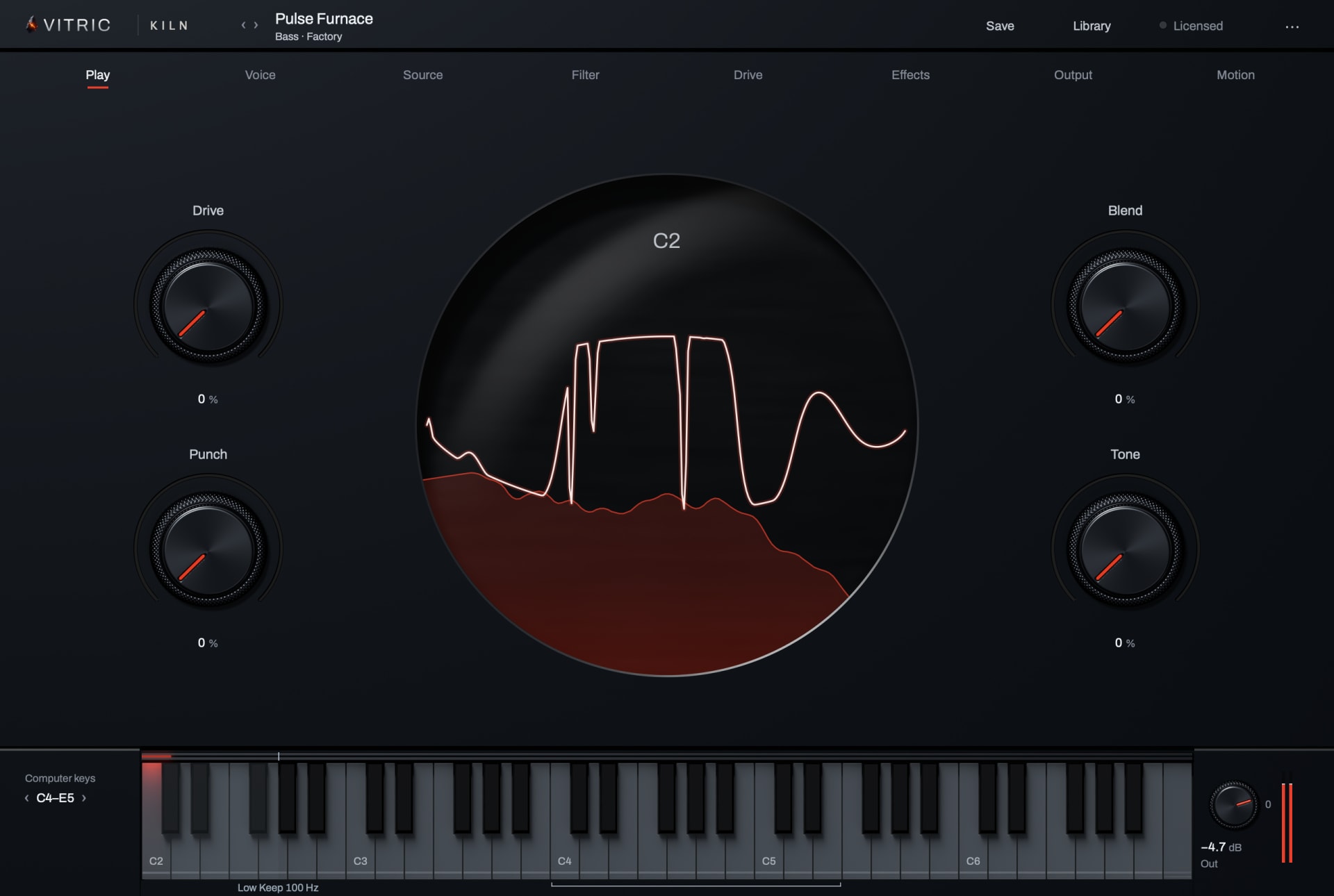
Kiln Synthesizer has four LFOs and four DAHDSR envelopes feeding a 48-slot modulation matrix, and each LFO can fade in after the attack over up to 5 seconds.
Questions
What does LFO stand for?
Low frequency oscillator: an oscillator running below the range of hearing, usually under 20 Hz, used to move another setting.
What is the difference between an LFO and an envelope?
An LFO repeats its movement for as long as it runs. An envelope runs once per note: attack and decay when the note starts, a held sustain level, then release when it ends.
What LFO rate is vibrato?
Most sung vibrato runs roughly 5 to 8 Hz, so a pitch LFO in that range with a small depth sounds natural.