Reverse reverb and reverse cymbals: how to make them
Reverse reverb is a reverb tail played backwards, so it swells up into a sound instead of trailing after it. You reverse the part, add reverb, print it, reverse the print and line it up, and a reversed cymbal makes the same kind of rise.
Reverse reverb is a reverb tail played backwards and placed in front of the sound it came from, so the space swells up into the note or word instead of trailing after it. It is made in four steps: reverse the part, add reverb, print the tail, and reverse that tail back. The dry sound itself still plays forwards.
Where did reverse reverb come from?
Jimmy Page says he pioneered the effect as backwards tape echo on the brass of the Yardbirds' "Ten Little Indians" in 1967, though a 1966 single by Lee Mallory may contain an earlier example. Led Zeppelin used it on "Whole Lotta Love" and "You Shook Me", shoegaze bands used it often, and today it is a common lead-in on the first word of a vocal in pop and EDM.
How do you make reverse reverb in any DAW?
- Copy the part. Usually just the first word, note or hit you want the swell to lead into.
- Reverse it. The command depends on your DAW: in Ableton Live it is the Reverse button in Clip View, in Logic Pro the Reverse parameter in the Region inspector, and in Pro Tools the AudioSuite Reverse plugin.
- Add reverb, fully wet. Choose a decay as long as you want the swell to be: a room for a quick pickup, a hall for a long rise.
- Print it. Bounce or render the reverb to a new audio clip, including the whole tail.
- Reverse the print. The tail now swells up and ends where the sound began.
- Line it up. Slide it so the swell's last transient lands on the first transient of the original, then trim, fade the start in, and set its level under the dry part.
To fit the swell to the song, set its decay from a length in beats: the reverb calculator turns one to eight beats into a decay time at your tempo. Decay is a fade measurement, not the moment the tail stops, so trim the reversed print to the length you want. The guide to what reverb is explains decay and pre-delay.
How do you make a reverse cymbal?
Reverse a crash cymbal hit, with its whole decay. The decay becomes a rise that grows until it stops dead, which makes a reversed cymbal a common lead-in to a new bar or section. Place it so its end lands on the bar line it leads into (zoom in to get the end point accurate), and pick or stretch a cymbal to fit the gap: the longer the decay, the longer the rise, for example one or two bars. A little reverb on the reversed cymbal softens the stop and blends it into the mix. The same works for a reversed piano chord or a reversed vocal phrase.
What is nonlinear reverse reverb?
Nonlinear reverbs offer a different kind of "reverse". Gated reverb, which Hugh Padgham and Steve Lillywhite brought to wide attention on Peter Gabriel's 1980 album, cuts a big reverb off abruptly; the AMS RMX16's NonLin2 program imitated it with a shaped, nonlinear decay. The same unit's Reverse 1 program built its reverb gradually after the hit, then stopped it suddenly. Nothing is played backwards: the reverb simply starts quiet and gets louder, which gives a reverse feel without printing anything. Because it starts after the hit, it cannot swell into a sound the way a printed reverse reverb does.
Reverse reverb in Vitric plugins
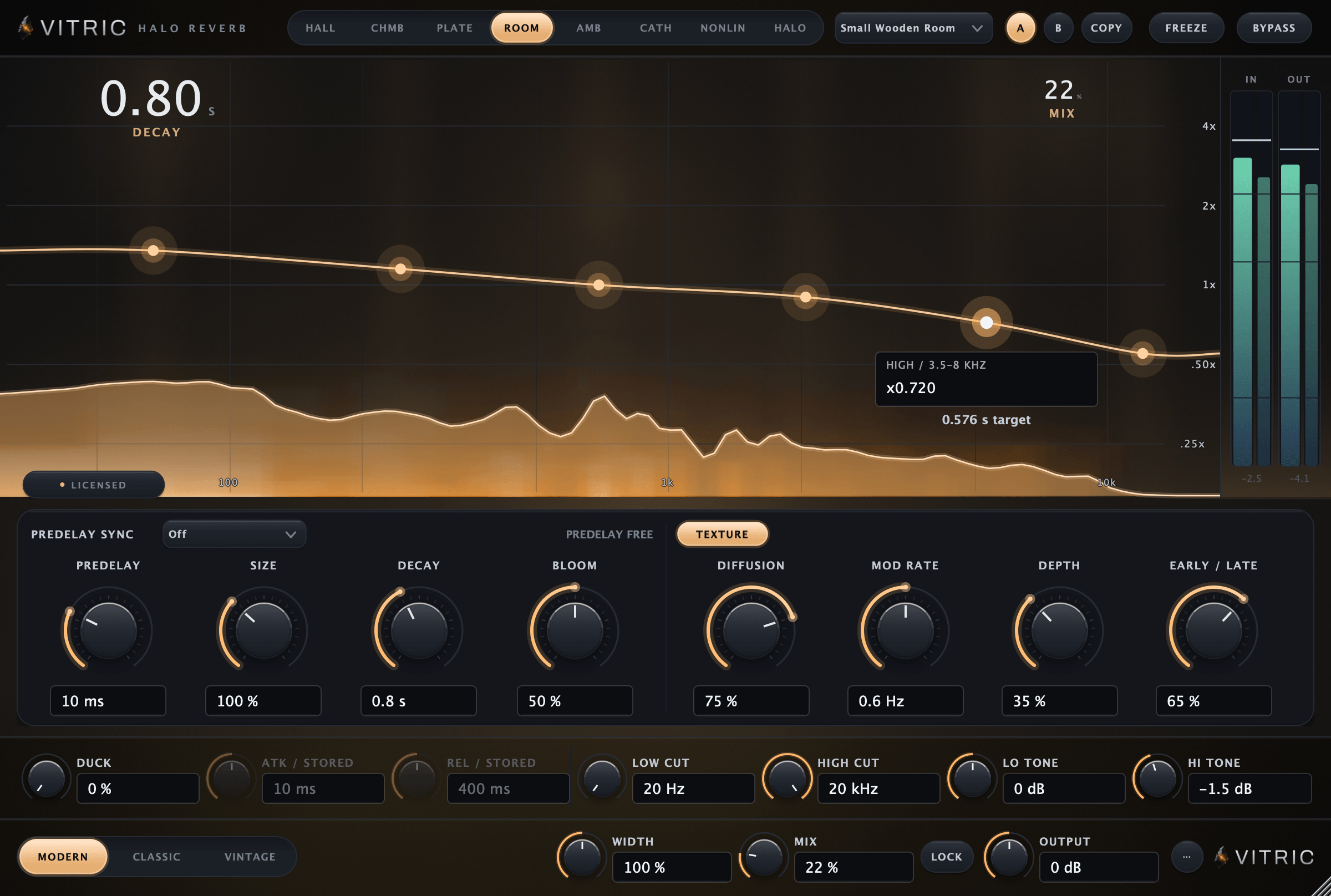
Halo Reverb's NONLIN space makes this kind of reverse or gated tail. It has no feedback loop: 32 decorrelated taps per channel play inside a finite WINDOW of 0.1 to 1.2 seconds, scaled by SIZE, and its SLOPE control sweeps the envelope from reverse through gated to decaying: turn SLOPE down for a reverse swell. The Halo manual covers each control.
Questions
What is reverse reverb?
A reverb tail reversed and placed before the sound it came from, so the reverb swells into the sound instead of following it.
Is reverse reverb the same as reversing the whole sound?
No. Only the reverb is reversed; the original part still plays forwards after the swell. Reversing the whole sound is a different effect, and the reverse audio tool does both.
Is reverse echo the same thing?
It is the same technique with an echo or delay in place of the reverb: reverse, add the echo, print it, reverse it back. The repeats then lead up to the sound. The types of delay guide covers the delays themselves.
How long should a reverse reverb be?
As long as the gap you want it to fill. A decay of roughly 2 to 5 seconds, set to the song's tempo, is a common starting point: too long and the fade-in is too slow, too short and the build-up is too fast. Trim the print to fit, whether that is a beat before a word or a bar before a new section.