What is a noise gate? Threshold, range, attack, hold and release explained
A noise gate turns a sound down when it falls below a threshold, so hiss, hum and bleed between notes, words or drum hits drop away. Here is what each control does, where to start, and how producers use gates creatively.
A noise gate turns a sound down when it falls below a level you set, the threshold. Between notes, words or drum hits, the hiss, hum or bleed from other microphones drops away. When the sound rises above the threshold again, the gate opens and lets it through. A gate only works in the gaps: while it is open, any noise under the sound passes along with it.
What each control does
- Threshold: the level at which the gate opens. Below it, the gate turns the sound down.
- Range: how far the gate turns the sound down when it is closed. Full attenuation mutes the gaps; a smaller range only lowers them, for when full silence is not wanted.
- Attack: how quickly the gate opens, in effect a fade-in. A fast attack keeps the front of a drum hit; too slow and the hit loses its edge.
- Hold: how long the gate stays open after the sound falls below the threshold, so it does not close in the short pauses between words.
- Release: how long the gate takes to close. A fast release cuts the sound off abruptly; a slower one fades it out. Too short a release can cause clicks.
- Hysteresis: on some gates, a second, lower threshold for closing, a few decibels under the opening one, which stops the gate chattering open and shut on a sound that hovers at the threshold.
- Sidechain: an input that lets another signal open the gate.
Where to use a gate
- Distorted guitar: high gain brings up hum and hiss between notes, and a gate clears it.
- Drums: on close mics, a gate keeps each mic on only while its drum is played, which greatly reduces bleed from the rest of the kit.
- Vocals and speech: a gentle gate lowers room noise between phrases. A range that leaves the gaps quieter rather than silent keeps the room from cutting in and out.
Creative gating
Gated reverb puts a gate after a big reverb so the tail is cut off short. The best-known example is the drum sound engineer Hugh Padgham created on Phil Collins's "In the Air Tonight"; see what reverb is. Keying uses the sidechain: a gate on the reverb, opened by the dry snare, lets the reverb through only while the snare plays. Trance gating goes further: one track opens and closes the gate on another, so the second track follows the first's rhythm. Many plugins also call a gate driven by a programmed pattern a trance gate.
Gates in Vitric plugins
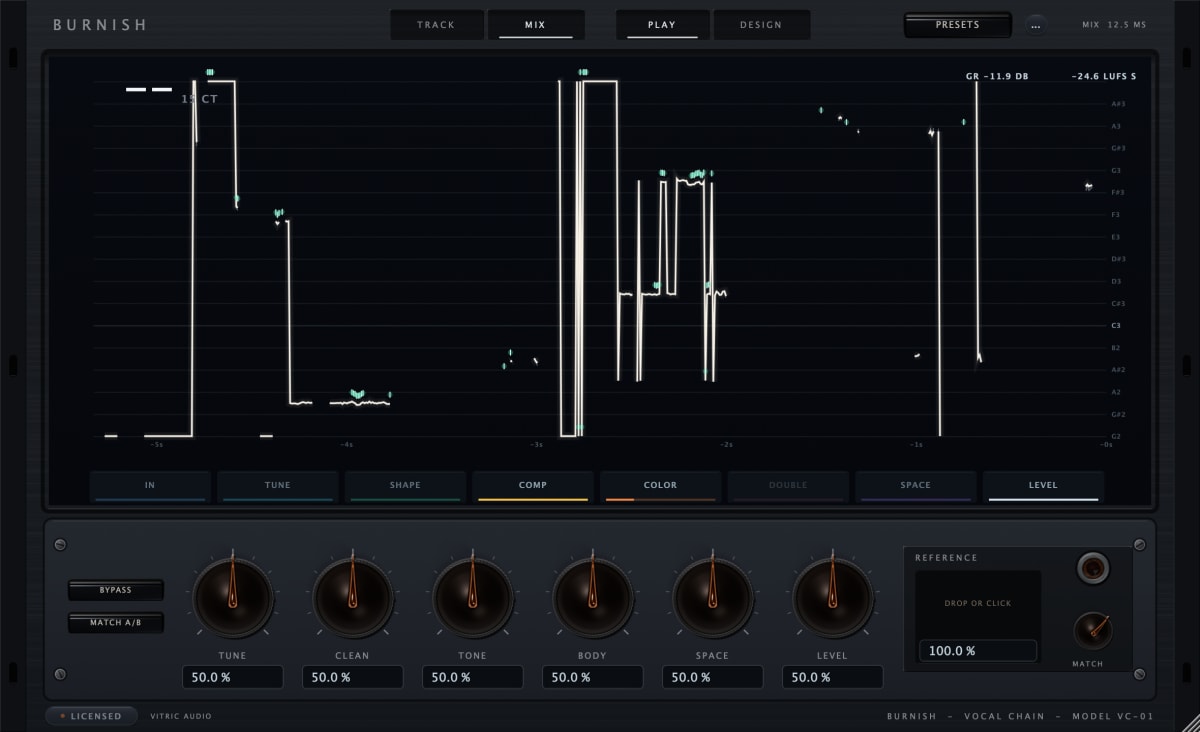
Burnish Vocal Chain has a vocal gate in its IN station. It turns the level down between phrases, never to silence: THRESH from -80 to 0 dB (default -55 dB), RANGE from 0 to 40 dB (default 18 dB) and REL from 20 to 500 ms (default 120 ms). In MIX mode it looks ahead 5 ms; TRACK mode removes that lookahead for low-latency recording. Halo Reverb's Nonlin space gives a gated or reverse drum reverb without a separate gate: a finite window with no feedback loop.
Questions
Does a noise gate remove noise under the sound?
No. It only turns down the gaps. While the gate is open, the noise passes with the sound. To reduce noise under the sound itself, you need noise reduction, or a cleaner recording.
Why does my gate chatter?
The sound is hovering around the threshold. Add hold, use hysteresis if the gate has it, or move the threshold a little further from the level of the tail.
Should I gate vocals?
Lightly, if the noise between phrases is audible. A small range sounds more natural than a full mute.