What is reverb?
Reverb is the sound that lingers as reflections build up and fade. Learn how early reflections, decay and pre-delay put a voice or instrument in a space.
Reverb, short for reverberation, is the sound that persists as reflections build up and fade after a source stops. Clap in a tiled room: the clap reaches you directly, then sound bouncing off the walls, floor and ceiling arrives by longer paths. Those reflections overlap into a fading wash. That wash gives the clap a place and a sense of distance.
What is reverb in music?
Reverb in music can be the room already captured by a microphone or an effect added later. It can make a close vocal feel less isolated, put separately recorded instruments in a shared space, or turn a short synth note into a long texture. More reverb relative to the direct sound often pushes a part farther back; less keeps it close.
Reverb and echo have related meanings: both describe reflected sound. An echo is a repeat you can pick out, like a recognizable second word. In a dense reverb tail, so many reflections overlap that you hear a continuous decay instead. Real rooms can contain both: an obvious reflection from a distant wall followed by a diffuse tail.
Early reflections vs the reverb tail
Early reflections are the first returns after the direct sound. Their spacing, direction and level give clues about nearby surfaces. A strong cluster of short reflections can put a snare in a small room without leaving a long wash behind every hit.
The tail is the later, denser field of reflections. Each bounce loses some energy through absorption, and air and surfaces absorb different frequencies by different amounts. The result is a decay that changes tone as it fades. A dark tail can sit behind a bright vocal; a bright, long tail can compete with its next line.
Balance the two by listening for depth and sustain separately. If the part needs a room but not more sustain, favor early reflections or shorten the tail. If it needs a floating atmosphere, try more late reverb. Turning up the whole return changes both at once.
What do decay and RT60 mean?
Decay is the length of the fade. RT60 is the time for the reverberant level to fall by 60 dB after the source stops. A two-second RT60 describes that drop over two seconds; it does not mean the reverb suddenly switches off at two seconds.
The audible length also depends on the input, return level and arrangement. A quiet tail disappears sooner under drums than in a piano break. Low and high frequencies can have different decay times, so damping or a frequency-dependent decay control may clear muddiness more effectively than shortening everything.
Try 0.4 to 0.8 seconds for a tight drum room, 1.2 to 1.8 seconds for a vocal plate, and 2 to 3 seconds for a sparse sustained part. These are settings to audition, not measurements of every room, plate or hall. Check the busiest section before committing.
What does pre-delay do?
Pre-delay adds a gap between the dry sound and the onset of the processed reverb. On a lead vocal, start around 20 to 40 ms. The consonant gets a little room before the reverb fills in behind it, so you can hear the word without making the whole effect quieter.
Shorter values connect the dry sound and space more closely. Longer values can expose the reverb as a separate slap, especially on short words or percussion. Pre-delay is not decay: increasing the gap does not shorten the tail unless you also change its decay setting.
Room, plate, hall or spring?
| Type | Character | A useful starting job |
|---|---|---|
| Room | Nearby reflections and a compact sense of space | Drums, percussion, close guitars |
| Plate | A dense, often bright tail from a vibrating metal sheet or its simulation | Vocal sustain or snare length |
| Hall | A larger space with a more gradual build into the tail | Strings, piano, pads |
| Spring | Vibrating springs or their simulation, with a resonant, rippling sound | Guitar, organ, audible effects |
Room and hall describe acoustic spaces; plate and spring describe mechanical ways of making reverberation. Software can model either. The name is a starting character, not a rule about which instrument belongs there. A short hall can work on drums, and a plate can make a synth feel distant.
How do you use reverb on a send?
- Create an aux return. Insert the reverb and set its mix to 100 percent wet. Keep the dry vocal on its own channel; the send adds only the space.
- Start with a post-fader send. Lowering the vocal fader then also lowers what feeds the reverb. A pre-fader send is useful for deliberate effects where the tail should remain as the dry track fades.
- Set timing before adding level. Try a plate at 1.5 seconds and 25 ms of pre-delay, then raise the send until the space is audible. Back it down and compare in the mix.
- EQ the return. Try a high-pass around 150 to 250 Hz to reduce low-end buildup and a low-pass around 6 to 10 kHz if the tail spits on esses. Adjust for the source; these filters change the wet sound while the dry vocal stays intact.
- Share the space deliberately. Feed backing vocals or instruments to the same return at their own send levels. Automate a louder send on a phrase ending when only that word needs a long tail.
An insert is also valid: blend dry and wet with the plugin's mix control. A send is convenient when several parts should share one space or when you want separate EQ and level control over the reverb. If you use a send, keep the return 100 percent wet; a partial mix there puts a second copy of the dry sound into the mix.
Can you sync decay to the song's tempo?
Yes, as a musical starting point. One quarter-note beat lasts 60,000 divided by BPM milliseconds. At 120 BPM that is 500 ms, so four beats span 2,000 ms. Subtract a 31.25 ms pre-delay (a 64th note at that tempo) and the decay target is 1,968.75 ms, about 1.969 seconds.
The reverb calculator does this for different tempos, pre-delay notes and total durations. Copy the numbers into your reverb, then listen at the next phrase. This does not gate the tail on the beat: RT60 is a level drop, and the next note may arrive while part of the tail is still audible. Shorten it further when the arrangement needs the space.
Try it in Halo Reverb
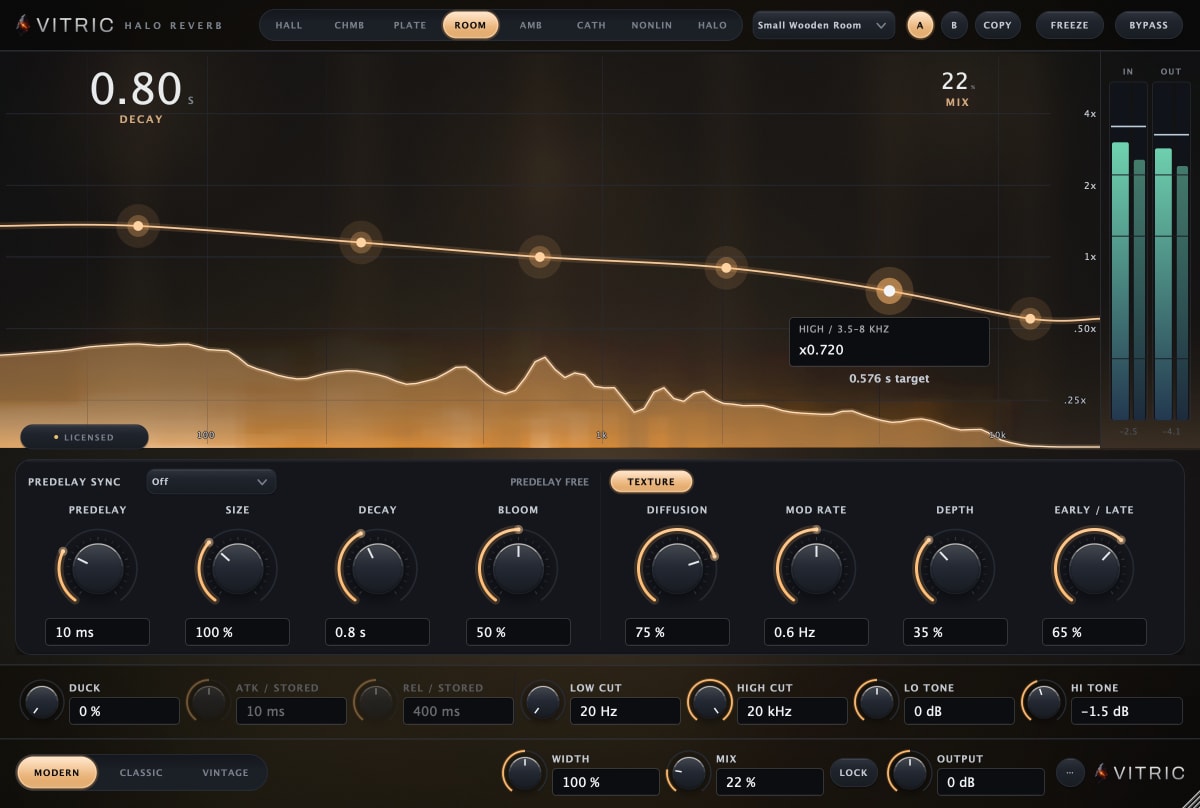
Vitric's Halo Reverb includes Room, Plate and Hall among its eight spaces. Start with Plate, set Mix to 100 percent on a send, then enter 25 ms of pre-delay and 1.5 seconds of decay. Its wet-path low and high cuts shape the return, and built-in ducking lowers the wet signal while the dry phrase plays.
In its feedback spaces, the six-band decay contour changes how long different frequency regions ring. Shortening a low band's decay is different from simply turning that band down with EQ. Halo can sync pre-delay to the host; enter calculator-derived decay times manually. The Halo Reverb manual covers the space-specific controls and timing ranges.