Types of reverb: room, hall, chamber, plate, spring, shimmer and more
Room, hall and chamber reverbs come from real spaces; plate and spring reverbs from vibrating metal; digital, convolution, gated and shimmer reverbs from processing. Here is how each type is made, how it sounds, and where to start with it.
Most reverb types are named after the space or the method that first made them. Room, hall and chamber reverbs come from real spaces. Plate and spring reverbs come from vibrating metal. Digital, convolution, gated and shimmer reverbs come from processing. A plugin can model any of them, so the name is a starting character, not a rule about which instrument belongs where.
Room, hall and chamber: real spaces
Room reverb is the sound of a smaller space: nearby reflections and a compact sense of space. It suits drums, percussion and close guitars; the reverb guide suggests trying 0.4 to 0.8 seconds of decay for a tight drum room.
Hall reverb is a larger space with a more gradual build into the tail. It suits strings, piano and pads. Whatever the type, the reverb guide suggests 2 to 3 seconds of decay for a sparse, sustained part.
Chamber reverb comes from the earliest studio reverb: playing a recording through a loudspeaker in a reverberant room and recording it again. Echo chambers were in use from the 1930s, and Bill Putnam used one, a studio bathroom, on the Harmonicats' "Peg o' My Heart" in 1947.
Plate and spring: vibrating metal
Plate reverb uses a transducer to vibrate a large sheet of metal. EMT introduced it in the late 1950s with the EMT 140. Its tail is dense and often bright, which is why it is a classic on vocals and snare: try 1.2 to 1.8 seconds on a vocal plate.
Spring reverb sends the signal through a set of springs in a box. Laurens Hammond filed a patent for a spring reverb system in 1939, and Hammond used spring reverb in its organs. Its resonant, rippling sound has a high, ping-like "drip" that is most obvious on short, staccato notes, and surf and dub reggae musicians favored it.
Digital, convolution, gated and shimmer: processing
Digital reverb builds a tail from many delay lines with fading trails, imitating sound bouncing off surfaces. The EMT 250 arrived in 1976, and digital reverb became common in the 1980s. Algorithmic reverb plugins, such as Halo Reverb, build their tails this way, and can model rooms, halls and plates.
Convolution reverb uses an impulse response, a recording of how a real space responds to a short sound, and recreates that space on your track. Sony announced the first real-time convolution reverb processor, the DRE S777, in 1999.
Gated reverb puts a noise gate on a reverb, for a big sound with a short tail. Hugh Padgham and Phil Collins pioneered it, and it became a staple of 1980s pop drums.
Shimmer reverb changes the pitch of the reverberated sound, so a pitched layer builds inside the tail. Brian Eno pioneered it in the 1980s, and U2's 1984 album The Unforgettable Fire popularized it. It is common in ambient music.
Reverb types at a glance
| Type | Made by | A useful starting job |
|---|---|---|
| Room | A small space | Drums, percussion, close guitars |
| Hall | A large space | Strings, piano, pads |
| Chamber | A speaker and a mic in a reverberant room | Any part that needs a natural room tail |
| Plate | A vibrating metal sheet | Vocal sustain, snare length |
| Spring | Springs in a box | Guitar, organ, audible effects |
| Gated | A reverb cut by a noise gate | Big, short drums |
| Shimmer | A pitch-shifted reverb tail | Ambient pads and atmospheres |
Reverb types in Halo Reverb
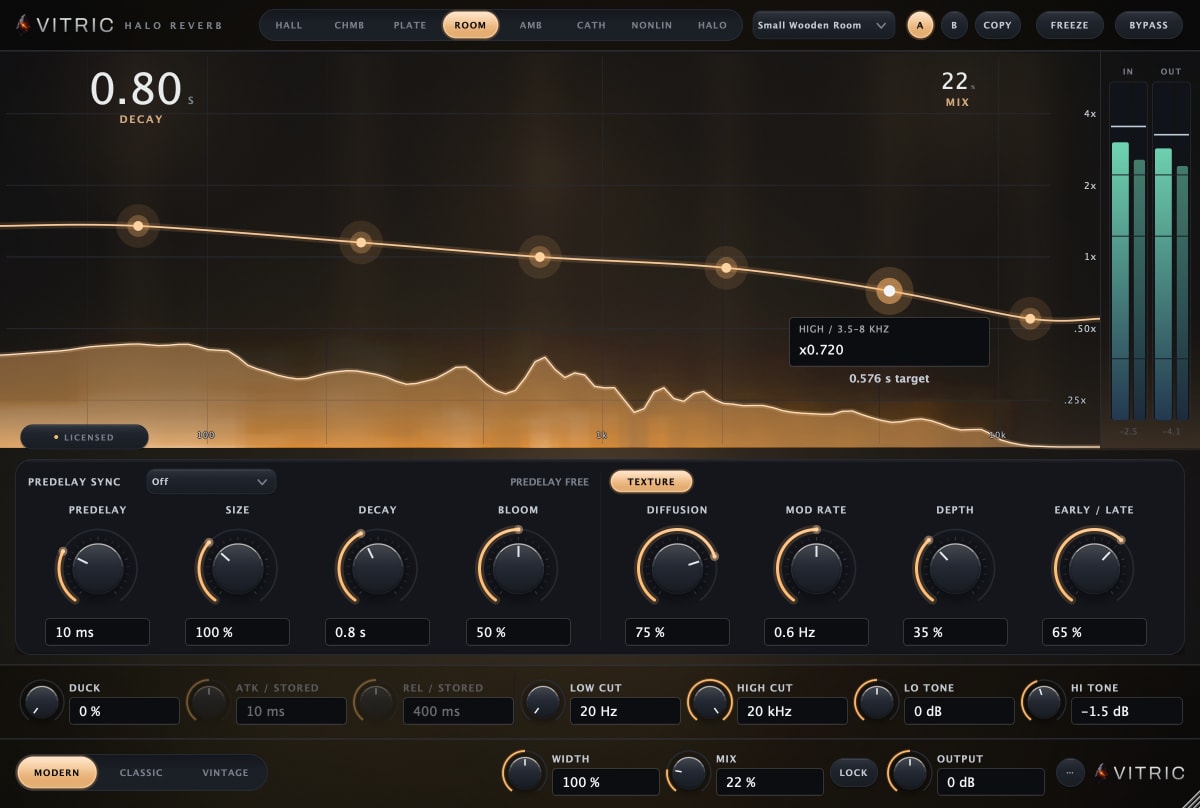
Halo Reverb has eight spaces in four engine families. Hall, Chamber, Room, Ambience and Cathedral share a modulated feedback network tuned per space, for vocals, keys, strings and score. Plate is its own engine, a figure-eight plate for vocals and snare. Nonlin gives a finite window with no feedback loop, for gated and reverse drums and 80s moves. HALO adds a granular pitch shifter inside the tail's feedback path, with five intervals, for shimmer and tuned air.
Questions
What is the difference between plate and hall reverb?
A hall is a large space with a gradual build into a long tail. A plate is a vibrating metal sheet with a dense, often brighter tail that sits close behind a vocal or snare.
What reverb is best for vocals?
A plate is a classic starting point for vocal sustain; a hall suits a slower, more spacious vocal. Set the pre-delay so the words stay clear: see what reverb is.
Is spring reverb only for guitar?
No. It is a classic on guitar and organ, dub reggae musicians favored it too, and it works as an audible effect on any source.