What is an 808? The drum machine, the bass, and how to mix it
An 808 started as the kick drum of Roland's TR-808 drum machine and became the long, tuned sub bass of hip-hop and trap. Here is what it is, how an 808 note is built and how to make it sit.
The 808 is named after the Roland TR-808 Rhythm Composer, a drum machine Roland released in 1980. It did not play recordings of drums: every sound was synthesized by analog circuits, and its bass drum was a deep, decaying tone with a Decay control that could stretch it into a long, booming note. Producers began tuning that kick and playing it as a bass line. Today "an 808" usually means exactly that: a long, pitched sub-bass note built on the TR-808 kick's sound, whether it comes from the original machine, a sample or a synthesizer.
How an 808 note is built
- The attack. A short click or punch at the start that gives the note its edge and timing. Some 808s carry a full kick drum on top.
- The body. A tone very close to a sine wave at the note's pitch. This is the sub bass you feel.
- The tail. How long the note rings, set by the sample's decay or by the note length you play.
- The glide. In trap especially, 808 notes often slide in pitch from one note to the next.
- Harmonics. A clean 808 is almost pure fundamental. Distortion or saturation adds harmonics above it, which gives it grit and helps it read in a busy mix.
Where 808 notes sit
Most 808 lines live in the first octave and a half of the bass range. These are common root notes and their frequencies, with the octave below each one for reference:
| Note | Frequency | Octave below |
|---|---|---|
| E1 | 41.2 Hz | 20.6 Hz |
| F1 | 43.65 Hz | 21.83 Hz |
| G1 | 49.0 Hz | 24.5 Hz |
| A1 | 55.0 Hz | 27.5 Hz |
| B1 | 61.74 Hz | 30.87 Hz |
| C2 | 65.41 Hz | 32.7 Hz |
| D2 | 73.42 Hz | 36.71 Hz |
Values are equal temperament at A4 = 440 Hz. The full chart and the steps for matching a sample to your song are in how to tune an 808, and the EQ frequency chart converts any note to its frequency.
808, kick or bass?
All three, depending on the track. In sparse hip-hop and trap, the 808 often is the kick: its attack plays the rhythm and its tail plays the bass line. When a separate kick drum plays too, the two compete for the same low frequencies, and the mix has to decide which one owns each moment.
Mixing an 808
- Tune it first. An 808 a semitone off the key fights every chord. Fix the root note in the sampler before you reach for EQ.
- Keep the low end mono. Stereo width on a sub-bass note makes it weaker in mono and unpredictable between systems.
- Settle the kick and 808. Pick one to carry the attack, shorten or duck the 808 under the kick, or tune the kick to the 808, so their lows add up instead of cancelling.
- Watch the tail. Long notes pile up under the next one. Note length is often a cleaner fix than EQ or compression.
- Add harmonics with care. Saturation gives the 808 upper content the ear can follow; see what a saturator does. Check the result on more than one system.
- Leave headroom. A sustained sub note holds a lot of energy, so it often decides how loud the master can get.
Adding sub weight with Plinth
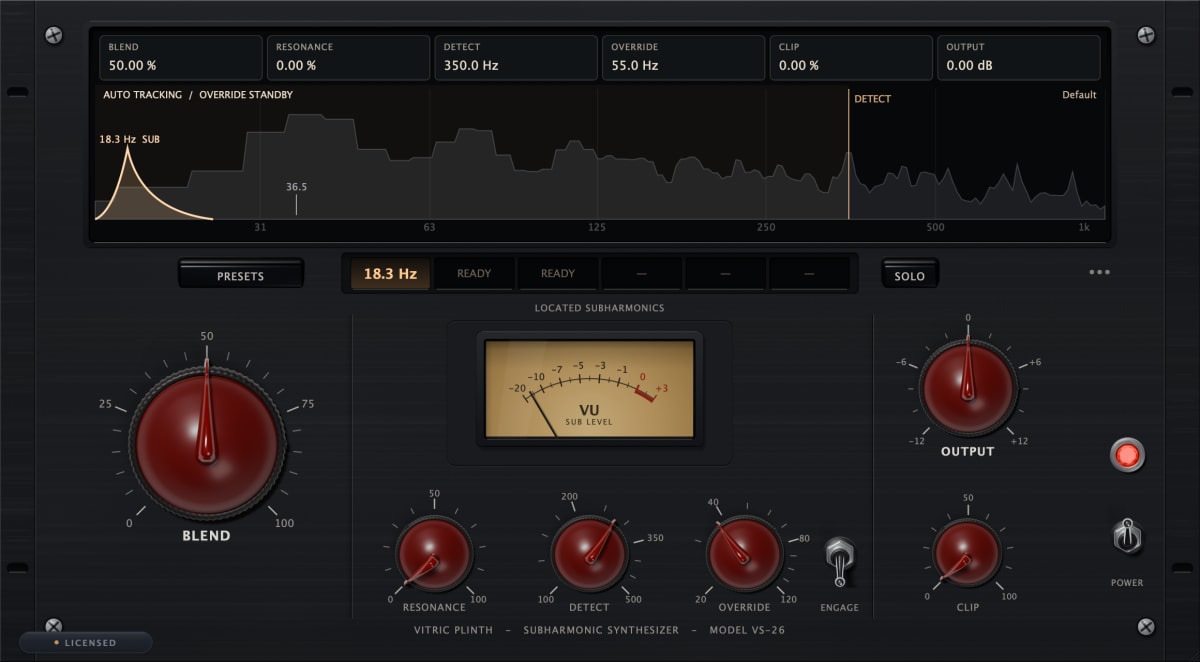
When an 808, a kick or a bass part feels thin underneath, Plinth Subharmonic Synthesizer generates a mono sub one octave below the fundamentals it detects, with up to three voices and zero reported latency. Its analyzer separates the detected source from the added sub, Blend sets the sub's level as a volume sum with the dry low band, and CLIP soft-clips the summed signal. ENGAGE and OVERRIDE pin the frequency by hand instead of tracking it.
Mind the table above: an octave below the lowest 808 notes lands around 20 to 25 Hz, at the bottom of human hearing and below what many speakers reproduce. Plinth's analyzer and SUB LEVEL meter show what it is adding, so judge the result on full-range monitors or good headphones, and expect it to matter most on higher notes, kicks and bass parts.