What does a saturator do? Saturation explained, with the harmonics measured
A saturator gently distorts a sound by rounding off its peaks, adding harmonics that make it denser, warmer and easier to hear. Here is what it adds, measured, and how to use it.
A saturator is a processor that adds gentle distortion on purpose. It rounds off the loudest parts of a waveform, the way magnetic tape, a tube stage or a transformer does when it is pushed, and in doing so it adds new frequencies, called harmonics, above the original notes. Used lightly, the result sounds denser, warmer and more present; pushed hard, it becomes audible grit and drive.
What a saturator adds, measured
A clean sine wave has no harmonics. Pass it through a saturation curve and new tones appear at whole-number multiples of its frequency. Which harmonics appear, and how fast they fade, is the character of the saturator. We ran a 100 Hz sine through four textbook curves; levels are in dB relative to the 100 Hz fundamental.
| Curve | 2nd | 3rd | 9th | 11th |
|---|---|---|---|---|
| Soft, gentle | None | -18.4 | -66.3 | -82.2 |
| Soft, strong | None | -12.6 | -39.4 | -48.2 |
| Hard | None | -12.6 | -32.8 | -38.4 |
| Asymmetric | -15.1 | -14.1 | -58.9 | -55.5 |
Three things show up in the numbers:
- More drive, more and louder harmonics. The gentle curve's harmonics drop away quickly; the strong one keeps them up much higher in the spectrum.
- Soft vs hard. Matched on the 3rd harmonic, the soft clip's upper harmonics keep falling, while the hard clip's 9th and 11th stay about 7 to 10 dB louder. High harmonics are what make hard clipping sound bright and harsh, and soft saturation sound smoother.
- Odd vs even. A symmetric curve treats the top and bottom of the wave the same and adds only odd harmonics (3rd, 5th, 7th). Make it asymmetric and the even harmonics appear: the 2nd is an octave up and the 4th two octaves up, which many people hear as fuller and more consonant.
These are generic curves for illustration, not a model of any particular plugin. Real saturators shape their curve, filter the signal before and after it, and change character with level.
Why saturation sounds louder
Rounding off peaks lowers the peak level, and the added harmonics add energy, so the average level rises relative to the peaks. The sound has more density for the same headroom, which is why saturation is part of making a mix loud. It is also why every saturated version sounds better at first: louder almost always does. Match the output level before you compare, or use an automatic gain compensation if the saturator has one.
Saturation, distortion and clipping
They are the same family on one scale. Saturation usually means the gentle end, where the effect is felt more than heard; distortion is the audible, deliberate end; clipping is the hardest form, where peaks are flattened. The table above is that scale in numbers.
Where saturation helps
- 808s and bass on small speakers. Phones and laptop speakers barely reproduce the fundamental of a sub-bass note. The added harmonics sit higher, where those speakers work, and the ear fills in the missing low note, so the bass line stays audible.
- Drums. Light saturation rounds transient peaks and adds body, so drums sit louder without simply being turned up.
- Vocals, keys and guitars. A little drive adds presence and helps a part cut through without EQ boosts.
- Buses. Gentle saturation on a group or the mix bus can make separate parts feel like one recording.
- In parallel. Blending a heavily driven copy under the clean signal adds weight while the dry signal keeps its attack. A Mix control does this inside one plugin.
Watch for aliasing
Digital saturation can create harmonics above the highest frequency the sample rate can hold. Those fold back down as tones that are not musically related to the note, a harsh, metallic edge called aliasing. Oversampling or anti-aliasing designs reduce it, which is why good saturators are measured on it.
Where to put it in the chain
Before a compressor, saturation changes what the compressor reacts to; after it, saturation colors a signal that is already controlled. The trade-offs are in saturation before or after compression.
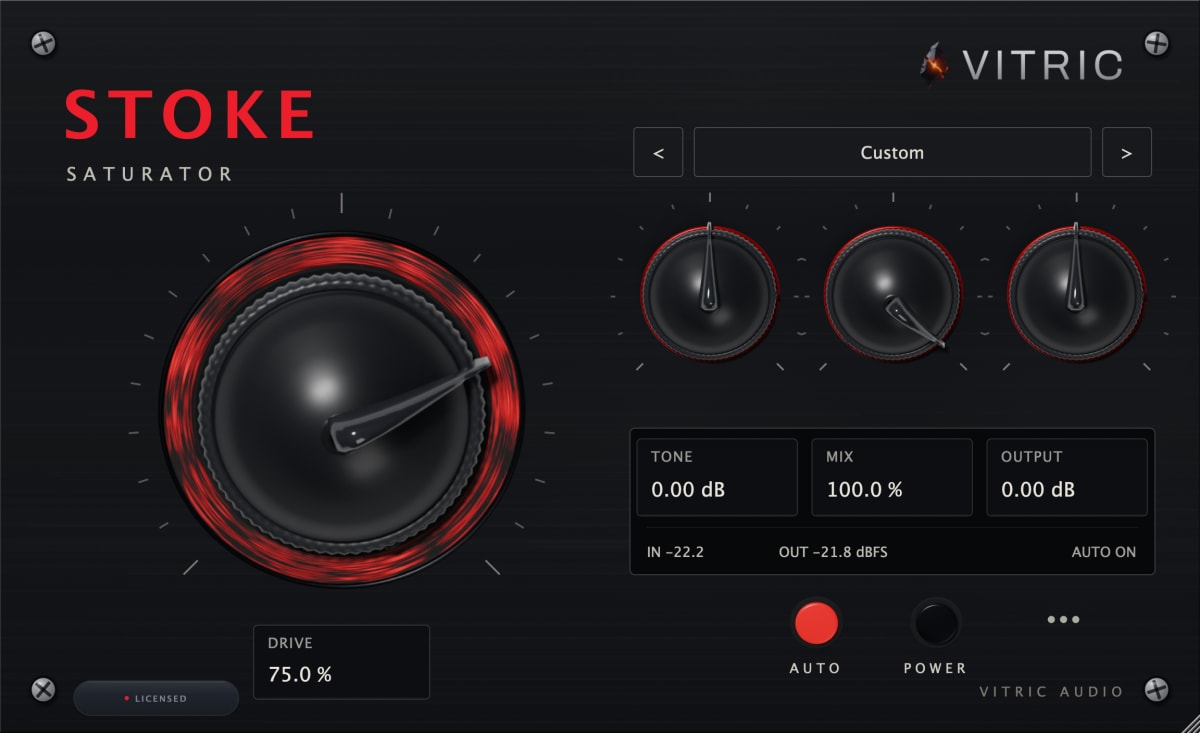
Saturation with Stoke
Stoke Saturator keeps it to four knobs: Drive sets the character, Tone tilts the processed signal, Mix sets how much of the harmonic contribution is blended with the aligned dry path, and Output sets the final level. AUTO applies a calibrated compensation curve as Drive changes, so you can judge the character rather than the volume, and POWER off passes the input bit-exactly at the reported 6 samples of latency at 48 kHz. Its published test results include 20 to 120 Hz energy held within 0.5 dB at Drive 50% on synthesized 808, kick and bassline signals.