Drum patterns: trap, drill, boom bap, house and reggaeton, as grids
Five drum patterns every producer should know, drawn as 16-step grids you can copy into any DAW: house, boom bap, trap, UK drill and the reggaeton dembow, with the tempo and the detail that makes each one sound like its genre.
A genre's drum pattern is the fastest way to make a beat sound like that genre. Each pattern below is one bar on a 16-step grid, the same grid as a drum machine or your DAW's step sequencer, so you can copy it step for step. They are starting points: real tracks add ghost notes, fills and variations on top.
How to read a drum grid
Each square is a sixteenth note, four to a beat, so a bar of 4/4 has 16 steps. The numbers above the grid mark the beats. A filled square is a hit. Set your DAW's grid to 1/16, program the hits, and loop the bar.
House: four on the floor
Four on the floor means a kick on every beat of the bar. In Ableton's classic house example the clap lands on beats two and four and a closed hi-hat on every offbeat, between the kicks. House usually runs from 115 to 130 BPM.
Boom bap
The name is the sound: the boom of the kick on beats one and three, the bap of the snare on two and four. Boom bap was prominent in East Coast hip hop from the late 1980s to the early 1990s, programmed on samplers such as the Akai MPC and the E-mu SP-1200, and it depends on swing: the hits on the beat stay put and the notes between them land slightly late. Set your DAW's swing to 1/8 so the hats on steps 3, 7, 11 and 15 move, and vary the velocities rather than leaving every hit at full level. Eighth-note hats are a common start.
Trap
Trap is often programmed in half-time: the session runs at about 140 BPM, but the snare or clap lands on beat three, so the groove feels like 70. Half-time leaves room for fast hi-hats, the sound of the genre: double-time, triple-time and other fast divisions between the eighths. The kick is a deep 808, often tuned with a long decay so it sounds as a bass note. See what an 808 is and how to tune one to the song.
UK drill
UK drill runs at about 138 to 151 BPM, faster than Chicago drill. Two details set it apart from trap. The hi-hats play a steady 3+3+2 pattern instead of straight or triplet subdivisions, and the snare moves: on beat three in one bar, on beat four in the next, repeating every two bars. Under it, the bass often slides between notes.
Reggaeton: the dembow
The dembow is the drum pattern of reggaeton: a kick on every beat under a snare on the fourth and seventh sixteenths of each half bar. The downbeat and the two snares mark out 3+3+2, with the steady kick as the 4/4 bass drum underneath: the "boom-ch-boom-chick" of early 1990s Jamaican dancehall. It takes its name from Shabba Ranks's 1990 song "Dem Bow", built on the Fish Market riddim that Steely & Clevie produced in 1989. Start around 90 BPM.
Drum patterns and tempo
| Genre | Tempo | The giveaway |
|---|---|---|
| House | 115 to 130 BPM | Kick on every beat |
| Boom bap | 80 to 100 BPM | Kick 1 and 3, snare 2 and 4, swung |
| Trap | About 140 (70 half-time) | Snare on 3, fast hats |
| UK drill | 138 to 151 BPM | 3+3+2 hats, moving snare |
| Reggaeton | About 90 BPM | The dembow |
The BPM by genre guide covers more styles and where each number comes from. To find the tempo of a beat you are copying, tap along with the BPM tapper.
Weight under the kick
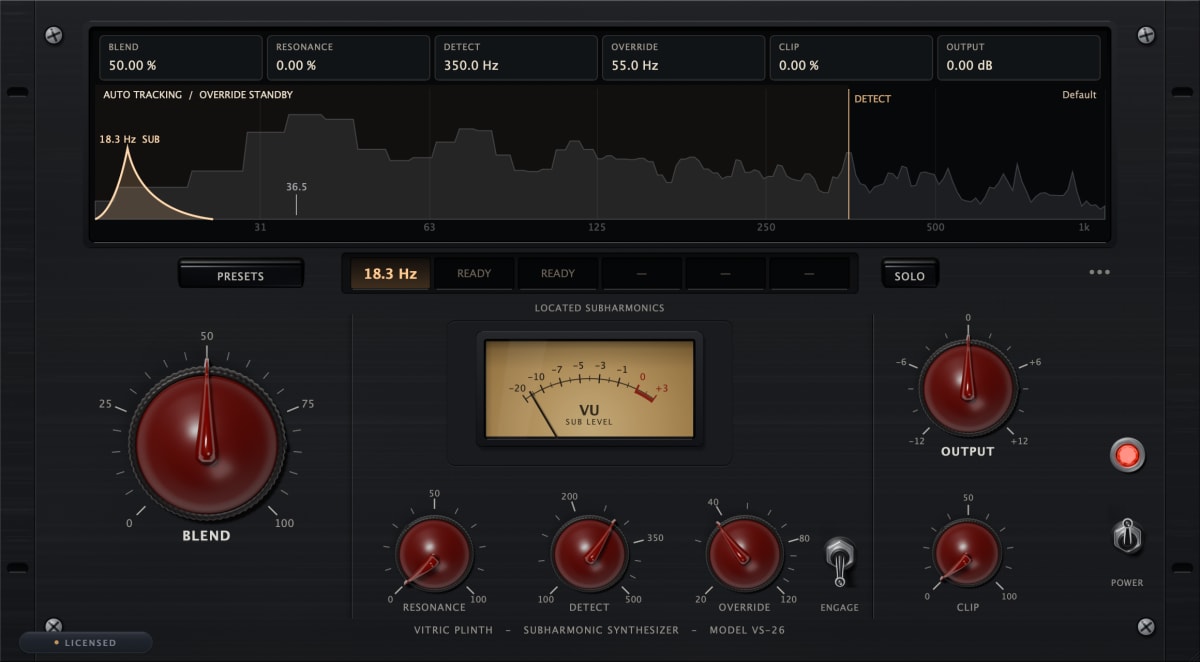
When a kick or bass in these patterns needs more low end than it has, Plinth Subharmonic Synthesizer generates a mono sub one octave below the fundamentals it detects, shows the source and the added sub together, and sets the level of the sub with Blend.
Questions
What is a drum pattern?
A repeating rhythm for the kit, usually one or two bars long: which drum plays on which step. Many genres can be recognized from their drum pattern alone.
What is the difference between trap and drill drums?
Both sit near 140 BPM with the snare on beat three of the bar. Trap keeps the snare on beat three and fills the space with fast, divided hi-hats; UK drill plays its hats in 3+3+2 and moves the snare to beat four every second bar.
What is four on the floor?
A steady kick on every beat of a 4/4 bar: one, two, three, four. It drives disco and many styles of electronic dance music, including house.
Why does my programmed beat sound stiff?
Every hit is on the grid at the same level. Add swing, vary the velocities, and leave some gaps; boom bap producers got their feel from swing settings on samplers such as the MPC and from playing the pads by hand.