How to make phonk: the cowbell melody, distorted 808s, drums and drift phonk
A modern phonk beat is a pitched 808 cowbell melody over a heavily distorted 808 bass, hard drums and chopped vocal samples, all pushed through distortion and lo-fi processing. Here is where the sound comes from and how to build each part, step by step.
Phonk is a hip hop subgenre built on the sound of 1990s Memphis rap. A typical modern phonk beat, drift phonk especially, has four parts: a short melody played on a pitched 808 cowbell, an 808 bass pushed into heavy distortion, hard-hitting drums, and chopped vocal samples, all made deliberately rough. Drift phonk, the faster and more aggressive branch, has overtaken the original style in popularity.
What is phonk?
Phonk takes its sound from 1990s Memphis rap and the samples of that era, and draws on Southern hip hop artists such as DJ Screw, Three 6 Mafia, Tommy Wright III and DJ Spanish Fly. Houston's chopped and screwed style (slowed down, with cut and repeated phrases) is seen as its precursor. The name is slang for funk. It was coined and popularized by the rapper SpaceGhostPurrp; in the early 2010s artists from his Raider Klan collective, along with the rapper Lil Ugly Mane and the producer DJ Smokey, revived the Memphis sound. Classic phonk is built on samples: old rap acapellas, often from Memphis tapes, combined with jazz and funk records.
Drift phonk emerged in Russia in the late 2010s, with TR-808 cowbells, heavy bass and distorted sounds at higher tempos than earlier phonk. It spread through TikTok in 2020, often under drifting, street racing and weight lifting videos; Kordhell's "Murder in My Mind" is one of its best known tracks. Funk automotivo, often labeled "Brazilian phonk" outside Brazil, is a separate Brazilian funk style that borrows from it.
What BPM is phonk?
The guides disagree, so treat these as a range rather than a rule. Native Instruments puts modern phonk, especially drift phonk, around 90 to 120 BPM and builds its example at 117. EDMProd says anything from 120 to 150 works, and that at 170 or 180 you are in half-time. The quickest way to choose is to tap the tempo of a reference track you like with the BPM tapper; see BPM by genre for how a half-time feel changes the count.
Step 1: the cowbell melody
EDMProd calls the pitched cowbell the most famous sound in phonk melodies, and a classic source is the cowbell from a Roland TR-808. The 808 builds it from two of its pulse-wave oscillators, so a single hit holds two clashing tones; an envelope shapes them and a band-pass filter removes the upper and lower partials.
Load one hit into a sampler and tune it before you write. Because of those two tones, its pitch can be hard to name: play it against your 808 or check it with the pitch detector, set the sampler's root note to match, and confirm by ear. Then play it across the keyboard and write a short riff, a bar or two, and loop it.
Native Instruments bases its melody on the Phrygian mode, which it calls one of the darker minor scales: the natural minor scale with its second note lowered a half step. EDMProd names Phrygian dominant as a very common phonk scale, though the notes it writes out (A Bb C D E F G) are plain Phrygian; it adds that the 1st, 2nd, 5th and 6th notes sound best for phonk (A, Bb, E and F in A). Phrygian dominant proper is Phrygian with the third raised a half step, the fifth mode of the harmonic minor scale, and is worth trying as a variation.
Neither guide leaves its melody clean: EDMProd runs its synth lead through distortion to make it "huge, dirty, and distorted", and Native Instruments bitcrushes its cowbell together with the bass and a counter melody. Native Instruments keeps that counter melody sparse: an eerie synth lead or an ambient pad.
Step 2: the distorted 808
Start with a clean 808 tuned to the riff's home note (see how to tune an 808). EDMProd's guidelines: put an 808 on every kick, stay mostly on the root note, and, if you like, cut the 808 on snares or claps and add some glides between octaves. Then push it hard. Native Instruments describes producers clipping, distorting and saturating their 808s until they drive the track, keeps the sub frequencies in mono with a utility plugin, and sidechains the bass to the kick so it ducks when the kick hits (see sidechain compression).
Distortion adds upper harmonics, and those harmonics help a small speaker carry the 808's pitch when it cannot reproduce the fundamental. Compare the low end at a matched level before and after, because heavy drive can make the bass sound louder rather than better. More on the sound itself in what is an 808.
Step 3: the drums
Phonk drums vary a lot from track to track, but both guides make them heavy and gritty. Native Instruments starts with a heavy kick and a snappy, distorted snare, layers an extra snare on every second hit and adds hi-hats with varied velocities for a rolling feel; EDMProd layers its snare with a second snare and a clap, puts its hats on a bus with heavy saturation, and calls heavy distortion the one thing phonk drums have in common. EDMProd also notes that phonk drums can follow trap, UK drill or four-on-the-floor patterns, and that "Murder in My Mind" uses a pretty basic house beat. The drum patterns guide has step grids for all three.
Step 4: vocal chops
Phonk leans on vocal samples, classically from Memphis rap. EDMProd suggests pitching vocals up or down or shifting their formants, putting the sample in mono with a radio-style EQ that removes most of the lows and highs, and degrading it with distortion and bitcrushing; it notes that phonk vocals are often buried in the mix and hard to make out. Chop a phrase into single words or short phrases and place them in the gaps of the riff.
Sampling a released record, a Memphis tape included, needs permission from the people who own it before you release your track; an uncleared sample can be claimed or taken down. Use sample packs whose license covers release, or record your own lines.
Step 5: the lo-fi grit
Native Instruments says phonk is almost always lo-fi; EDMProd says it aims for low-quality audio on purpose. Both group parts and process them together: Native Instruments bitcrushes a group of cowbell, bass and counter melody, then distorts the drums and that group as one; EDMProd processes buses as a whole for cohesion. Saturation, distortion and bitcrushing do the work. Keep a little contrast: if everything is equally crushed, nothing stands out.
Step 6: arrange it
Drift phonk tracks are typically short and energetic. Native Instruments lays a phonk track out as an intro, a main loop, occasional breakdowns and an outro, and keeps it interesting by dropping elements in and out every eight or sixteen bars. EDMProd's template adds a switch section, where the lead melody and the vocals change over the same beat and 808s, that works like a sort of chorus or breakdown. Its map of "Murder in My Mind", about two and a half minutes long:
- A two-beat pre-intro, then an 8-bar intro.
- An 8-bar drop, then the same drop for 8 bars with vocals.
- An 8-bar switch.
- The drop again for 8 bars, then 8 bars with vocals.
- A 16-bar switch and a 4-bar outro.
Phonk with Vitric plugins
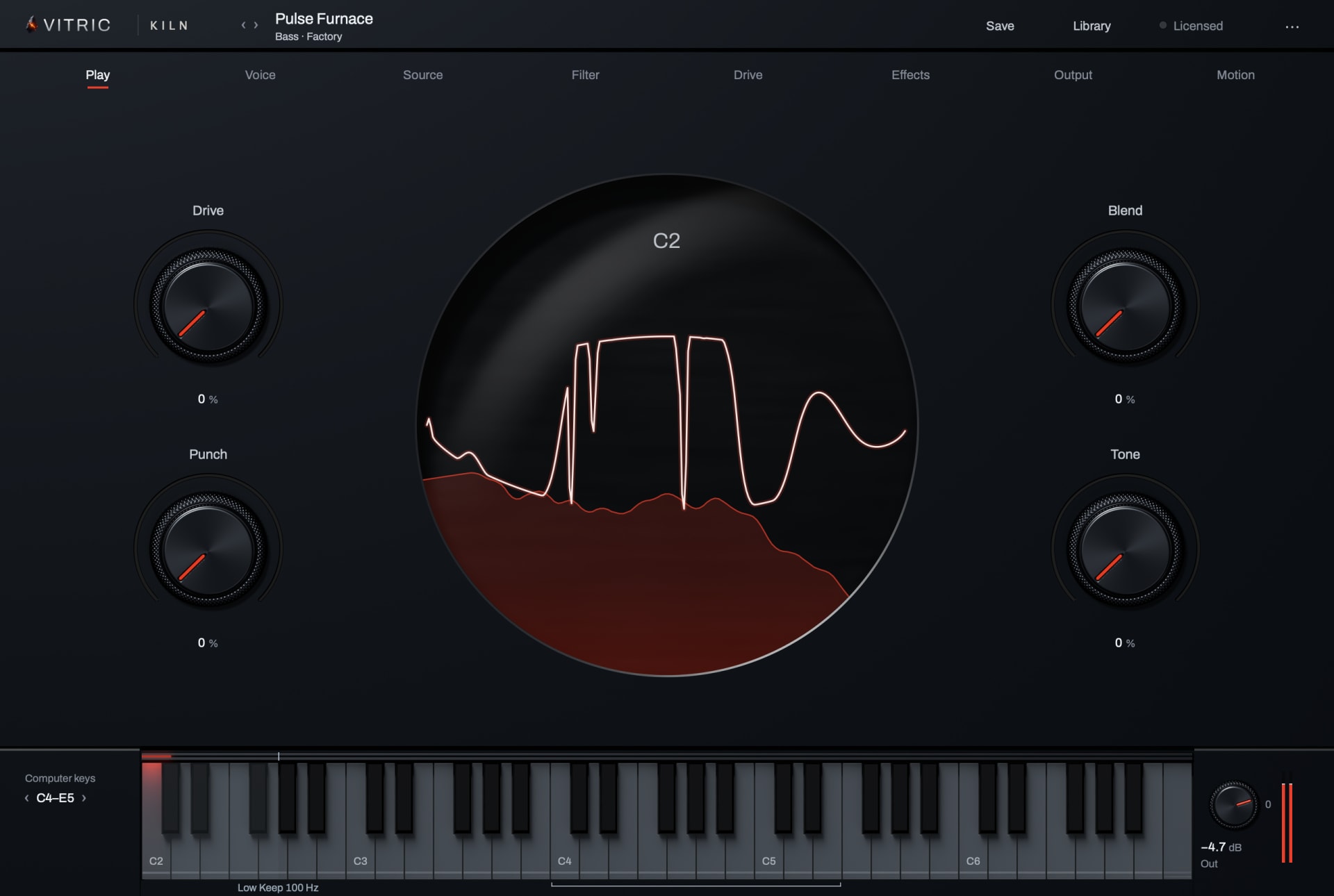
- Kiln Synthesizer: its library includes 808s, and its bass engine gives every voice its own drive in six characters, with a Low Keep that holds the sub clean underneath, a pitch knock on every note and smooth glide for the octave slides.
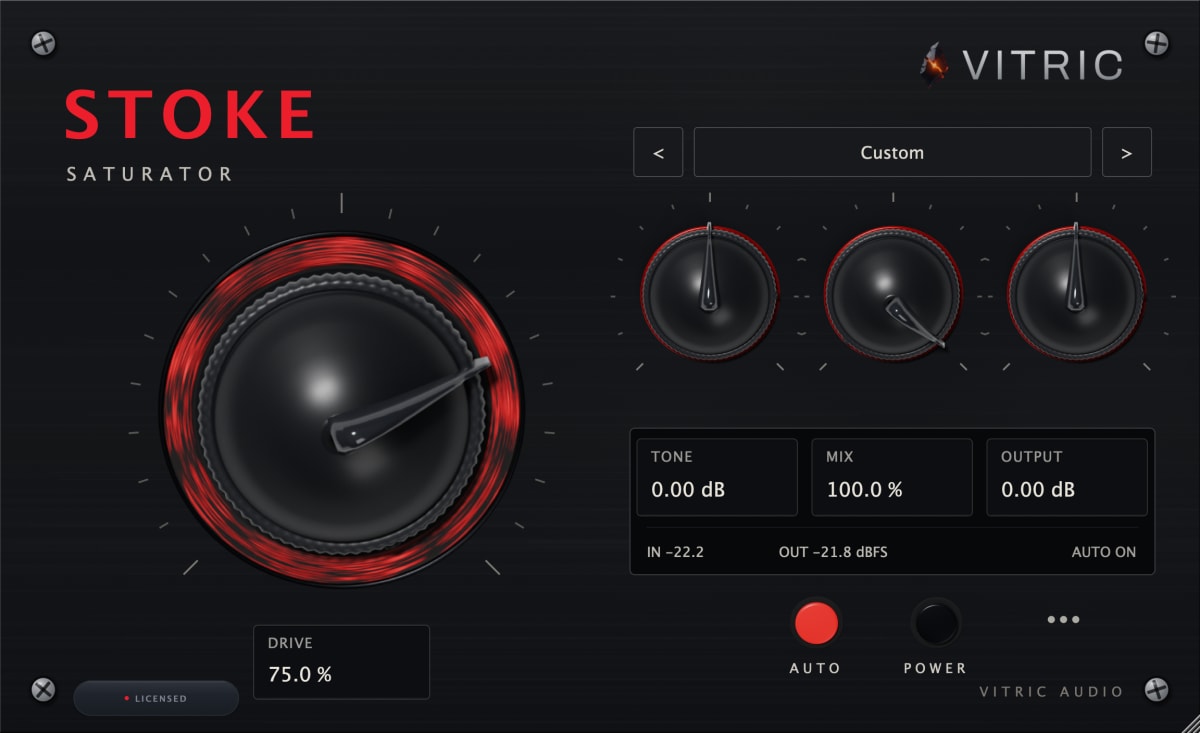
- Stoke Saturator: Drive, Tone, Mix and Output, with Auto to keep the level in check as you push Drive, for a dirty 808, cowbell or drum bus. In its tests, synthesized 808, kick and bassline signals keep their 20 to 120 Hz energy within 0.5 dB either way at Drive 50% with neutral Tone and Output. See what a saturator does.
Questions
What BPM is phonk?
Guides give anything from about 90 to 150 BPM: Native Instruments puts modern phonk, especially drift phonk, around 90 to 120, and EDMProd says 120 to 150 works, with 170 to 180 counting as half-time. Match a reference track you like.
What scale is phonk in?
There is no single one, but the production guides reach for dark scales: Phrygian, a minor mode with a lowered second, and Phrygian dominant, which has a major third.
What makes phonk sound like phonk?
Memphis-style vocal samples and deliberately rough, lo-fi processing, and in modern phonk the pitched 808 cowbell riff over a heavily distorted 808.
What is the difference between phonk and drift phonk?
Phonk is the wider Memphis-rooted style. Drift phonk, from Russia in the late 2010s, is faster and harder, built around 808 cowbells, heavy bass and distortion, and spread through TikTok from 2020.
Which DAW is best for phonk?
Any DAW with a sampler and a piano roll works: the sound comes from the cowbell, the 808 and the processing, not the software.