How to make drum and bass: tempo, the beat, breakbeats, reese bass and a DJ-friendly arrangement
Drum and bass runs at about 160 to 180 BPM, most often around 174, with a snare on beats two and four, breakbeats layered under the drums and a heavy sub-bass with a moving mid bass on top. Here is how to build each part and arrange it so DJs can mix it.
Drum and bass (DnB) is fast UK dance music built on breakbeats and heavy bass. To make it, set your project to about 174 BPM, program a beat with the snare on beats two and four, layer a sampled break under it, write a deep sine sub-bass with a moving mid bass on top, and arrange the track in long sections with an intro a DJ can mix in over.
What is drum and bass?
Drum and bass emerged in the UK in the early 1990s, with roots in the late-1980s UK rave scene and breakbeat hardcore, and in Jamaican dub and reggae and the UK's sound system culture, which shaped its bass-heavy sound. Its early form, jungle, used sped-up breakbeats, heavy bass lines and samples drawn from dub, reggae and dancehall; later producers added programmed one-shot drums and more synthesizers. The genre places great importance on the bassline, a deep sub-bass pattern. Its many styles include liquid, built on harmonic and melodic grooves, neurofunk, which grew out of techstep, and jump-up, with robotic and heavy bass sounds.
What BPM is drum and bass?
Usually 160 to 180 BPM. EDMProd says most tracks are written between 170 and 180, with the majority at 174 to 175, and Native Instruments' tutorial uses 174. Half-time sections feel like 85 to 90; see BPM by genre for how that works.
Step 1: the beat
The second kick lands on the "and" of beat three, between the two snares. Native Instruments repeats the bar four times and adds an extra snare on the last eighth note of the fourth bar as a small fill. Real tracks add ghost snares and more percussion on top.
Step 2: breakbeats
A break is a few bars where the drummer plays alone, usually sampled from a funk or soul record and looped. The Amen break, a seven-second, four-bar break played by Gregory Coleman on the Winstons' 1969 track "Amen, Brother", became a staple of drum and bass and jungle in the 1990s; the Think and Apache breaks are other well-used sources. Native Instruments starts from a break loop for the classic jungle feel, turns it and its one-shot kit down to -6 dB each for headroom, and programs the beat above on top for a contemporary sound. EDMProd warns that stacking several breaks gets messy if you are not careful: high-pass each one so it does not clash with the bass, and EQ it to leave room for the kick and snare.
Breaks were recorded far slower than 174, so they have to be sped up. EDMProd notes that the time-stretching mode drastically changes the sound, and that a plain repitch, which speeds the break up and raises its pitch together, works well for an old-school feel. Slice the break at each hit and you can rearrange the hits into new patterns.
Clear what you sample. The Winstons received no royalties for the Amen break, and a break copied from an old record still belongs to that record's owner: a royalty-free label on a pack cannot clear it. Use breaks that were played and recorded for a sample pack and licensed for release, or replay the pattern with your own drum sounds.
Step 3: the bass
EDMProd says most drum and bass basses sit in the sub-bass range, about 75 to 100 Hz and below, and that the genre tends to be written in keys like E minor, F minor and F# minor. A common way to get weight and character together is a composite: Native Instruments high-passes a mid bass at 250 Hz and layers a separate sine-style sub on the same MIDI notes, for a sound that is both defined and heavy.
The reese is a staple drum and bass mid bass. It comes from the bassline of Kevin Saunderson's 1988 track "Just Want Another Chance", released under his Reese alias and played on a Casio CZ-1000. Renegade sampled it on "Terrorist" (Moving Shadow, 1994), countless tracks have used it since, and it is known simply as the Reese bassline. EDMProd's recipe: a supersaw (a detuned saw with many unison voices) playing a low note, filtered, with chorus, phaser or flanger for movement and saturation or distortion for grit. For the sound design in detail, see synth bass: sub, reese and wobble.
The kick and the sub share the lowest octave, so make room: EDMProd notes that sidechain compression can duck the bass under the kick, though basic mixing should solve most kick and bass problems (see sidechain compression).
Step 4: arrange it for DJs
Drum and bass is made to be mixed. EDMProd says that when writing for DJs you will normally need an intro of at least 16 to 32 bars, then breakdowns and drops of 16 to 32 bars each, then an outro. Native Instruments' example track follows that shape:
- A DJ-friendly intro over bars 1 to 32, building to a breakdown at bar 33 that brings in the lead.
- The beats and bass drop at bar 49, with more musical elements added in each 16-bar section.
- At bar 97 the lead drops out and the track winds down to a bassless outro at bar 113.
The drop is the point where the rhythm or bassline switches. Many mixing points begin or end with a drop, and DJs sometimes use it to switch from one track to the next, so give yours a clear one.
Drum and bass with Vitric plugins
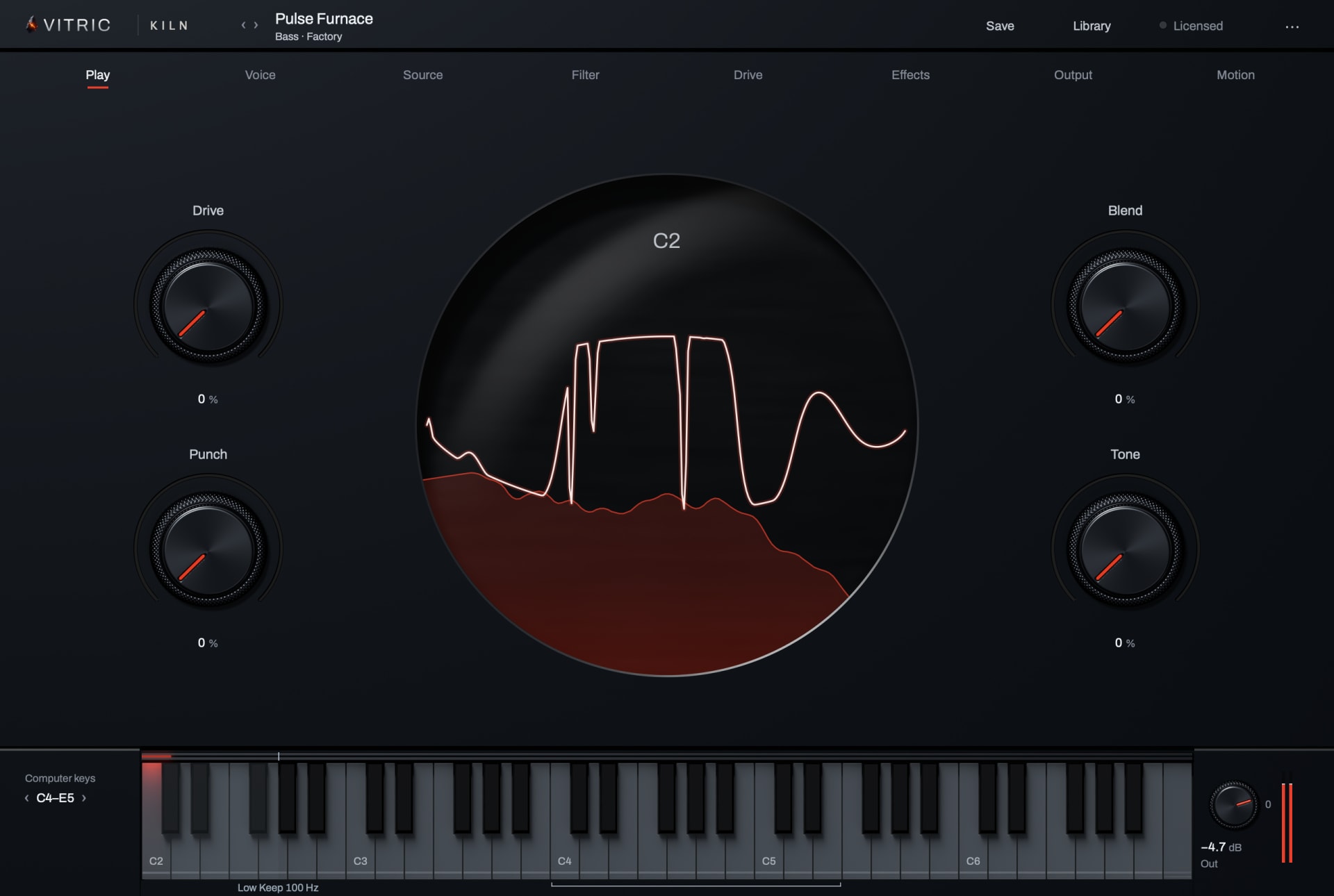
- Kiln Synthesizer: three oscillator slots, each with a saw shape and up to 16 detuned unison voices for reese-style mid basses, FM between slots for bite, and a dedicated sub source beside the slots for the clean layer; per-voice drive with a Low Keep that holds the sub clean underneath, and Bass Mono to narrow the low end.
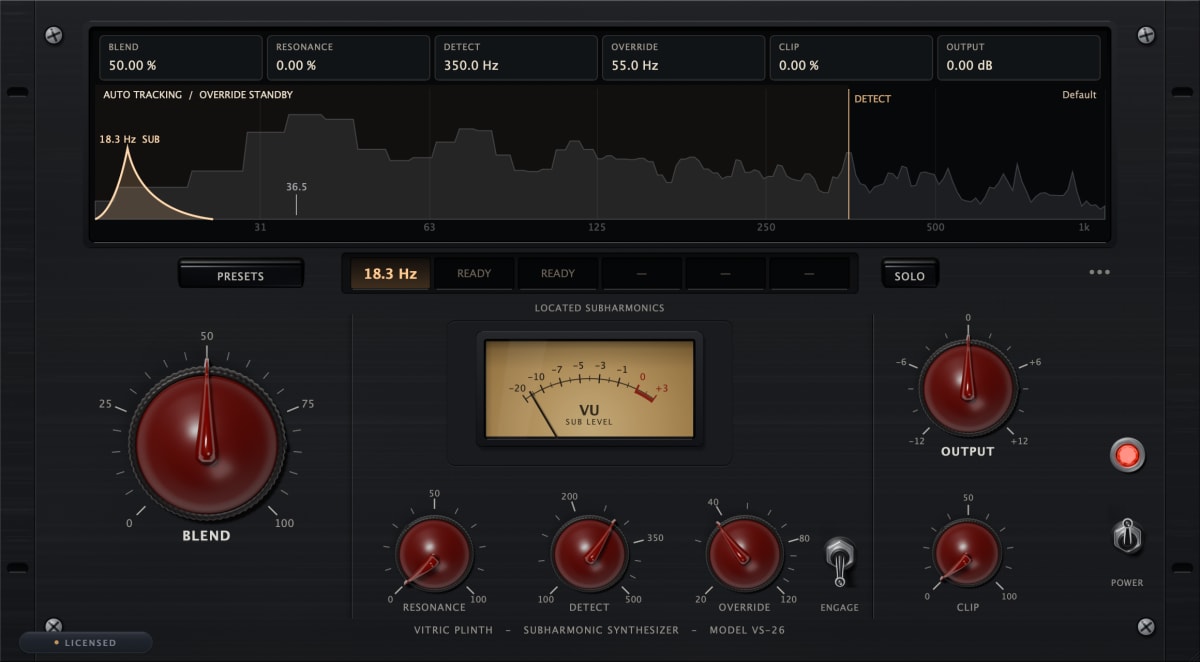
- Plinth Subharmonic Synthesizer: generates a mono sub one octave beneath the fundamentals in your audio; set its level with Blend. Put it before any high-pass on the bass, so it still hears the fundamental, and feed it a part played an octave above the sub you want: a mid bass on E2 gets a sub on E1. Press SOLO to hear the generated sub by itself.
Questions
What BPM is drum and bass?
Usually 160 to 180 BPM, most often around 174. Half-time sections feel like 85 to 90.
What is the basic drum and bass beat?
At 174 BPM: kick on beat 1 and on the "and" of beat 3, snare on beats two and four, a shuffle or hat on every eighth note, often with a sampled break underneath.
What is the Amen break?
A seven-second, four-bar drum break played by Gregory Coleman on the Winstons' 1969 track "Amen, Brother", the B-side of "Color Him Father", and a staple of jungle and drum and bass since the 1990s.
What is a reese bass?
A thick, moving mid bass made from detuned saw waves, named after the bassline of Kevin Saunderson's 1988 "Just Want Another Chance", released under his Reese alias.
What is the difference between jungle and drum and bass?
Jungle came first: fast, chopped breakbeats under basslines and vocal samples drawn from dub, reggae and dancehall. Drum and bass grew out of it in the mid-1990s, with more programmed drums and synthesized sounds. The names overlap, and in the US jungle is often used for both; jungle is still made today.