How to make reggaeton: the dembow beat, tempo, chords, bass and arrangement
Reggaeton is built on the dembow: a kick on every beat under a snare on the 4th and 7th sixteenths of each half bar, a 3+3+2 rhythm, at about 90 to 100 BPM. Here is where the rhythm comes from and how to build the drums, chords, bass and arrangement of a reggaeton track.
Reggaeton is dance music from Puerto Rico built on one rhythm, the dembow: a kick on every beat and a snare on the fourth and seventh sixteenth notes of each half bar; the downbeat kick and the two snares mark out the 3+3+2 pattern. To make it, program the dembow at about 90 to 100 BPM, add the classic percussion, a short chord loop, a sine sub-bass on the chord roots and a catchy melody, then arrange it in eight-bar sections like a song.
Where do reggaeton and the dembow come from?
Reggaeton grew from the Spanish-language reggae of Panama in the late 1980s and evolved in Puerto Rico in the early 1990s out of the underground rap scene, where DJ Playero built tracks on the dembow and producers such as DJ Nelson followed. The early style was simply called "underground" and later "perreo", after the dance. The rhythm comes from Jamaican dancehall: Berklee traces the riddim to the production duo Steely and Clevie, who first used it for Gregory Peck's "Poco Man Jam" around 1989 (some sources say 1990), with the instrumental released as "Fish Market"; it took its name from Shabba Ranks' 1990 song "Dem Bow". The version Puerto Rican producers went on to sample was a 1990 rework, Dennis the Menace's "Pounder (Dub Mix II)". The 3+3+2 itself is the tresillo, a pattern common in Latin American music.
Daddy Yankee's "Gasolina" (2004) helped take reggaeton to a global audience; the video for Luis Fonsi and Daddy Yankee's "Despacito" passed a billion views in 97 days; and Bad Bunny's "Un Verano Sin Ti" topped the Billboard 200. Since "Te Bote" in 2018, a sparer, minimalist dembow has spread alongside Latin trap. In the Dominican Republic, dembow became its own genre, harder and faster.
What BPM is reggaeton?
About 90 to 100 BPM. MixGraph, a DJ set-planning service, gives reggaeton a range of 88 to 100; "Despacito" is 89; Native Instruments sets its tutorial to 90. See BPM by genre to compare it with other styles.
Step 1: the dembow beat
Program half a bar and copy it: kicks on beats one and two, snares on the 4th and 7th sixteenths, then repeat. The downbeat kick and the two snares fall on sixteenths 1, 4 and 7 of each half bar, three, three and two sixteenths apart: the 3+3+2 (tresillo) rhythm, with the kick on every beat as the 4/4 bass drum underneath. Said out loud it is the "boom-ch-boom-chick" the dembow is known for.
The full classic dembow kit is a kick, a kickdown drum, a palito (a stick sound), a snare, timbal hits and timbal rolls, and sometimes a hi-hat. Native Instruments builds its tutorial beat from just the kick and snare, which is close to the sparer modern style. The drum patterns guide shows the same dembow next to trap, drill, boom bap and house.
Step 2: chords and bass
Native Instruments loops three chords, G# major, C minor in second inversion and A# major in second inversion; in C minor those are the VI, i and VII chords (Ab, Cm and Bb). They sit on a pad with its filter pulled down to around 100 Hz, and a sine-based sub plays the chord roots. A short loop of three or four chords in one key is a good start; for more, see chord progressions in every key.
Step 3: rhythm synth and melody
On top, Native Instruments adds a rhythmic synth that plays on the snare hits and moves with the chords, a main melody, and a second riff that joins in the second half of the chorus, with louder and quieter notes. An effect sound on the third beat of the loop's last bar leads into the next section.
Step 4: arrange it like a song
Native Instruments' arrangement:
- Intro: 8 bars of drums with the verse versions of the chords and rhythm synth.
- Chorus: 8 bars, then 8 more with the second riff.
- Verse: 8 bars, then an 8-bar pre-chorus.
- Chorus with the second riff: 8 bars, then an 8-bar bridge.
- Outro: the verse, then the pre-chorus without its bass line.
Reggaeton with Vitric plugins
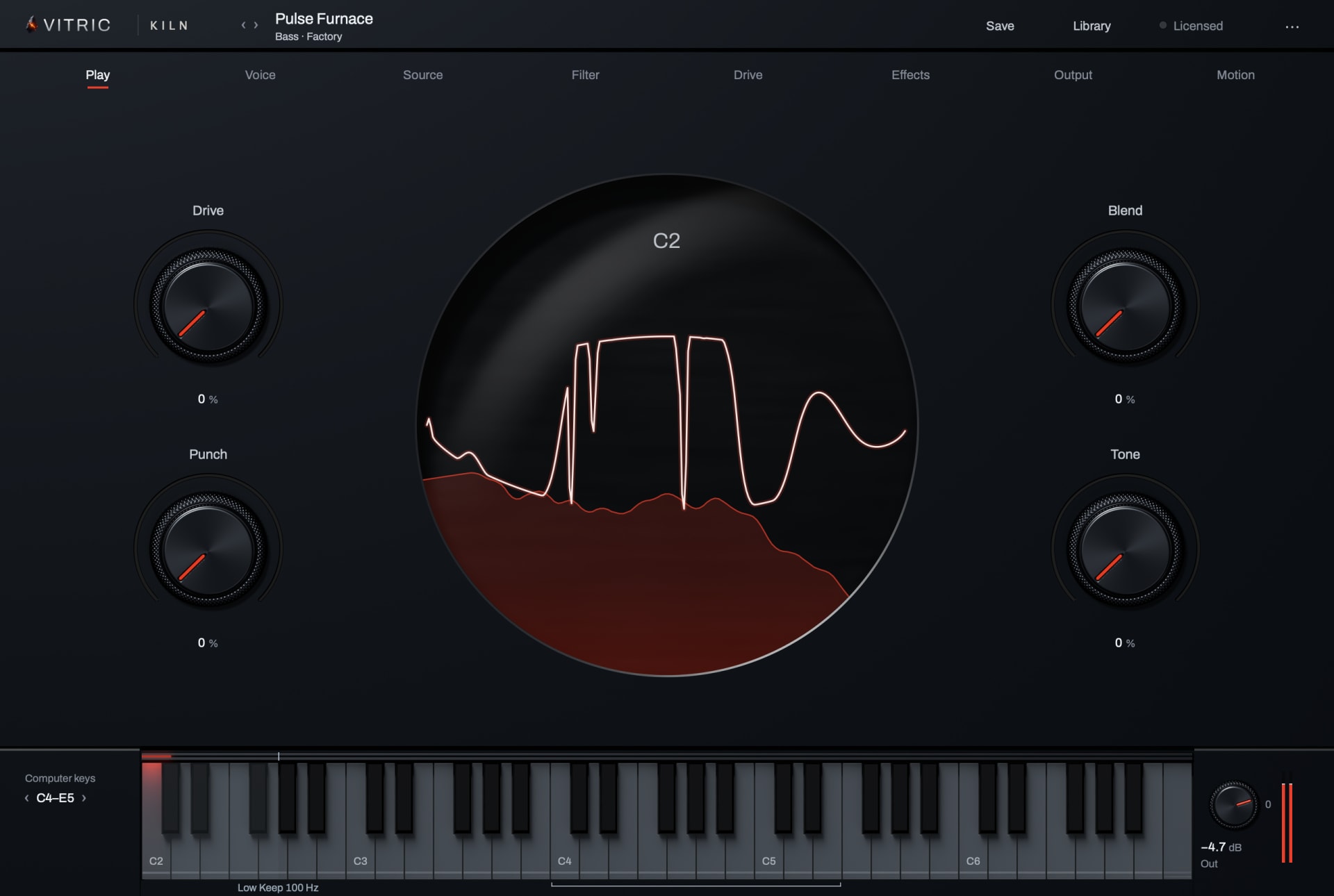
- Kiln Synthesizer: its library includes sustained sub basses and leads, and its bass engine adds per-voice drive with a Low Keep that holds the sub clean underneath, for a sub on the chord roots and the melodies on top.
Questions
What is the dembow rhythm?
A kick on every beat with a snare on the 4th and 7th sixteenth notes of each half bar: the downbeat kick and the two snares mark out 3+3+2 over the steady kick. It comes from Jamaican dancehall and is named after Shabba Ranks' "Dem Bow".
What BPM is reggaeton?
About 90 to 100 BPM.
What is perreo?
The dance associated with reggaeton, which emerged in Puerto Rico in the early 1990s; the early genre was also called perreo.
What is the difference between reggaeton and dembow?
Dembow is the rhythm reggaeton is built on. In the Dominican Republic it is also its own genre, a harder, faster style that grew out of Puerto Rican reggaeton.