Music scales: major, minor, pentatonic, blues and the modes, with a chart and the main scales in every key
A scale is the set of notes a melody or chord part draws from, defined by its pattern of whole and half steps. Here are the common ones (major, the three minors, pentatonic, blues and the modes) with a chart, each formula, and the major, minor, harmonic minor and pentatonic scales in every key.
A scale is a set of notes in order, starting from a home note, and its pattern of whole and half steps is what makes it major, minor or something else. Start the same pattern on any of the 12 notes and you get that scale in a new key. The C major scale is C D E F G A B, all white keys on a piano.
What is a scale?
A half step (H) is the distance from one key to the very next, black or white. A whole step (W) is two half steps. A scale lists which notes to use between a home note and the same note an octave up, and the order of its steps is its formula.
Scales chart: 12 common scales on C
In the formulas below, W+H is a step of one and a half (three half steps).
| Scale | Steps | On C |
|---|---|---|
| Major | W W H W W W H | C D E F G A B |
| Natural minor | W H W W H W W | C D Eb F G Ab Bb |
| Harmonic minor | W H W W H W+H H | C D Eb F G Ab B |
| Melodic minor (up) | W H W W W W H | C D Eb F G A B |
| Major pentatonic | W W W+H W W+H | C D E G A |
| Minor pentatonic | W+H W W W+H W | C Eb F G Bb |
| Blues | W+H W H H W+H W | C Eb F Gb G Bb |
| Dorian | W H W W W H W | C D Eb F G A Bb |
| Phrygian | H W W W H W W | C Db Eb F G Ab Bb |
| Lydian | W W W H W W H | C D E F# G A B |
| Mixolydian | W W H W W H W | C D E F G A Bb |
| Locrian | H W W H W W W | C Db Eb F Gb Ab Bb |
The major scale in every key
| Key | Notes | Sharps or flats |
|---|---|---|
| C major | C D E F G A B | None |
| G major | G A B C D E F# | 1 sharp |
| D major | D E F# G A B C# | 2 sharps |
| A major | A B C# D E F# G# | 3 sharps |
| E major | E F# G# A B C# D# | 4 sharps |
| B major | B C# D# E F# G# A# | 5 sharps |
| F# major | F# G# A# B C# D# E# | 6 sharps |
| Db major | Db Eb F Gb Ab Bb C | 5 flats |
| Ab major | Ab Bb C Db Eb F G | 4 flats |
| Eb major | Eb F G Ab Bb C D | 3 flats |
| Bb major | Bb C D Eb F G A | 2 flats |
| F major | F G A Bb C D E | 1 flat |
C major is the major scale with no sharps or flats, which is why it is all white keys; its chords are C, Dm, Em, F, G, Am and Bdim (see chord progressions in every key). Each key spells every letter once, so F# major has E# (it sounds as F). The major and minor keys guide shows the key signature for each one.
The natural minor scale in every key
| Key | Notes | Relative major |
|---|---|---|
| A minor | A B C D E F G | C major |
| E minor | E F# G A B C D | G major |
| B minor | B C# D E F# G A | D major |
| F# minor | F# G# A B C# D E | A major |
| C# minor | C# D# E F# G# A B | E major |
| G# minor | G# A# B C# D# E F# | B major |
| Eb minor | Eb F Gb Ab Bb Cb Db | Gb major |
| Bb minor | Bb C Db Eb F Gb Ab | Db major |
| F minor | F G Ab Bb C Db Eb | Ab major |
| C minor | C D Eb F G Ab Bb | Eb major |
| G minor | G A Bb C D Eb F | Bb major |
| D minor | D E F G A Bb C | F major |
Every natural minor scale uses the same seven notes as the major scale that starts on its third note, its relative major: A minor and C major, C minor and Eb major. Against the major scale on the same home note, the natural minor lowers the third, sixth and seventh. In Eb minor, Cb sounds as B, and Eb minor's relative, Gb major, sounds the same as F# major.
Harmonic minor scale (and melodic minor)
The harmonic minor scale is the natural minor with its seventh note raised a half step. Its steps are whole, half, whole, whole, half, one and a half, half. The raised seventh restores the leading tone, the note a half step below home that pulls back to it in a major key: in A minor, G becomes G#, and the chord on E becomes E major (E G# B) instead of E minor. The chords of A harmonic minor are Am, Bdim, C augmented, Dm, E, F and G#dim. Raising the seventh leaves a gap of one and a half steps (an augmented second) between the sixth and seventh notes.
| Scale | Notes |
|---|---|
| A harmonic minor | A B C D E F G# |
| E harmonic minor | E F# G A B C D# |
| B harmonic minor | B C# D E F# G A# |
| F# harmonic minor | F# G# A B C# D E# |
| C# harmonic minor | C# D# E F# G# A B# |
| G# harmonic minor | G# A# B C# D# E Fx |
| Eb harmonic minor | Eb F Gb Ab Bb Cb D |
| Bb harmonic minor | Bb C Db Eb F Gb A |
| F harmonic minor | F G Ab Bb C Db E |
| C harmonic minor | C D Eb F G Ab B |
| G harmonic minor | G A Bb C D Eb F# |
| D harmonic minor | D E F G A Bb C# |
B# sounds as C, E# as F, Cb as B, and Fx (F double sharp) as G. Start a harmonic minor scale on its fifth note and you get the Phrygian dominant scale: from A harmonic minor, E F G# A B C D. The melodic minor scale avoids the awkward gap by raising the sixth as well as the seventh on the way up (A B C D E F# G#); on the way down, the sixth and seventh fall back to their natural minor positions.
Pentatonic scales
A pentatonic scale has five notes. The major pentatonic keeps notes 1, 2, 3, 5 and 6 of the major scale, and the minor pentatonic keeps 1, b3, 4, 5 and b7 of the natural minor (the numbers count the notes of the major scale from home; b3 is the third lowered a half step). The major pentatonic leaves out the fourth and seventh notes (F and B in C major), the upper note of E-F and the lower note of B-C, so neither scale has a half step anywhere. Pentatonic lines work well over several chords in the same key, and the minor pentatonic is a very popular scale for improvising in blues and rock.
Each major pentatonic shares its five notes with the minor pentatonic three half steps below:
| Keys | Major pentatonic | Minor pentatonic |
|---|---|---|
| C / Am | C D E G A | A C D E G |
| G / Em | G A B D E | E G A B D |
| D / Bm | D E F# A B | B D E F# A |
| A / F#m | A B C# E F# | F# A B C# E |
| E / C#m | E F# G# B C# | C# E F# G# B |
| B / G#m | B C# D# F# G# | G# B C# D# F# |
| F# / Ebm | F# G# A# C# D# | Eb Gb Ab Bb Db |
| Db / Bbm | Db Eb F Ab Bb | Bb Db Eb F Ab |
| Ab / Fm | Ab Bb C Eb F | F Ab Bb C Eb |
| Eb / Cm | Eb F G Bb C | C Eb F G Bb |
| Bb / Gm | Bb C D F G | G Bb C D F |
| F / Dm | F G A C D | D F G A C |
F# major pentatonic and Eb minor pentatonic use the same five notes, all black keys; the minor is spelled with flats, like Eb minor everywhere on this page. Two handy shapes: the five black keys on a piano are the F# (Gb) major pentatonic, which is also Eb minor pentatonic, and a guitar's open strings, E A D G B E, are all notes of the E minor pentatonic.
The blues scale
The six-note blues scale is the minor pentatonic plus the flat fifth: 1, b3, 4, b5, 5, b7. A blues is A C D Eb E G; C blues is C Eb F Gb G Bb. The major blues scale is 1, 2, b3, 3, 5, 6, which in C is C D Eb E G A.
The modes
The seven modes use the notes of a major scale but start on each of its seven notes in turn. On the white keys, Ionian starts on C, Dorian on D, Phrygian on E, Lydian on F, Mixolydian on G, Aeolian on A and Locrian on B. Moved to any home note, each one is easiest to remember by the note that sets it apart:
- Ionian is the major scale.
- Dorian is the natural minor with a raised sixth: C D Eb F G A Bb.
- Phrygian is the natural minor with a lowered second: C Db Eb F G Ab Bb.
- Lydian is the major scale with a raised fourth: C D E F# G A B.
- Mixolydian is the major scale with a lowered seventh: C D E F G A Bb.
- Aeolian is the natural minor scale.
- Locrian lowers the second and the fifth of the natural minor (C Db Eb F Gb Ab Bb), so the chord on its home note is diminished.
Scales in your DAW
- FL Studio: in the Piano roll toolbar, right-click the Snap to scale icon, pick a scale, then its root note; the scale's notes are highlighted (set Piano roll shading to Auto if the rows are not shaded). Left-click the icon to snap notes to the scale as you add or move them. FL Studio does not move existing notes until you edit them: select them all, drag them up a half step and back down, and they snap to the new scale.
- Ableton Live 12: turn on Scale Mode in the clip properties or the Control Bar and set the Root Note and Scale Name. Scale notes are highlighted, Fold to Scale hides the other rows, and the Fit to Scale button in the Pitch and Time Utilities moves notes to the closest scale degree.
- Logic Pro: in the Piano Roll Editor, select the notes and choose the scale and key from the Scale Quantize pop-up menus to move them into that scale.
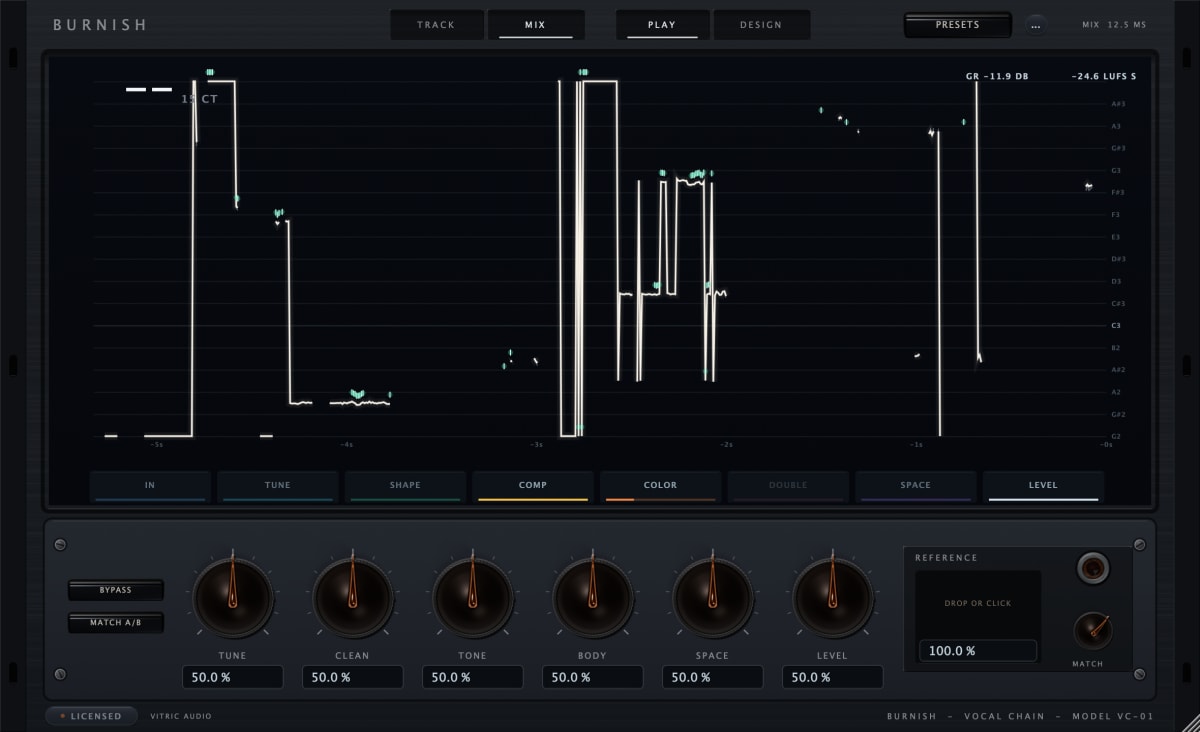
To find the key of a track before you pick a scale, drop it into the free key and BPM finder. For a vocal, the TUNE station in Burnish Vocal Chain takes the key, the scale and the allowed notes, so pitch correction pulls toward the notes of your scale. Its scale menu offers Chromatic, Major, Minor, Harmonic Minor, Dorian, Mixolydian, Major Pentatonic and Minor Pentatonic, and its note keyboard switches off any notes you do not want; for blues, Lydian or any other scale, choose Chromatic and switch off the notes the scale does not use.
Questions
What notes are in the C major scale?
C D E F G A B, then C again. It has no sharps or flats.
What is the formula for a major scale?
Whole, whole, half, whole, whole, whole, half. Start it on any note to get that note's major scale.
What is the difference between the major and minor scale?
On the same home note, the natural minor scale lowers the third, sixth and seventh notes by a half step. C major is C D E F G A B; C minor is C D Eb F G Ab Bb.
What is a pentatonic scale?
A five-note scale. The two common ones, major and minor pentatonic, have no half steps: C major pentatonic is C D E G A, and A minor pentatonic uses the same notes from A: A C D E G.
What is the harmonic minor scale?
The natural minor scale with its seventh note raised a half step. A harmonic minor is A B C D E F G#.
How do I find which scale a song uses?
Find its key first, by ear or with the key finder, then compare the notes the melody and chords use with the tables above. A song in a minor key may use the natural minor throughout, or raise the seventh where the harmony leans on the chord on the fifth note.