BPM by genre: tempo ranges for house, techno, drum and bass, trap, drill and more
The tempo ranges producers use for 15 genres, from lo-fi at 70 to 90 BPM to drum and bass at 160 to 180, with half-time feels explained and a source for every number.
Tempo is the first decision in a new project, and every genre has a range its listeners expect. Here are the ranges for 15 genres, each taken from a source you can check, with the ones that are written at one tempo and felt at half of it. Use them as starting points: plenty of good records sit outside them.
What BPM is each genre?
| Genre | Typical BPM | Notes | Source |
|---|---|---|---|
| Lo-fi hip hop | 70 to 90 | Slow and relaxed | Serato |
| R&B | 70 to 100 | MixGraph | |
| Hip hop | 80 to 100 | MixGraph | |
| Reggaeton | About 90 to 100 | Dembow rhythm (3+3+2) | Native Instruments, MixGraph |
| Afrobeats | About 95 to 115 | MixGraph catalog median 110 | MixGraph |
| Pop | 95 to 130 | MixGraph | |
| Amapiano | In the 110s (108 to 115) | Log drum bass | Native Instruments, MixGraph |
| House | 115 to 130 (most 120 to 130) | Four on the floor | Wikipedia |
| Techno | 120 to 150 | Four on the floor | Wikipedia |
| Drift phonk | 90 to 150 | Cowbell, aggressive bass | Native Instruments, EDMProd |
| Jersey club | 130 to 140 | Fast, bouncy groove | Wikipedia |
| Trap | About 140 (130 to 150) | Felt at half: about 70 | Wikipedia, MixGraph |
| Dubstep | 132 to 142, mostly 140 | Felt at half: 70 | Wikipedia |
| UK drill | 138 to 151 | Faster than Chicago drill | Wikipedia |
| Drum and bass | 160 to 180 | Fast breakbeats; half-time sections at 85 to 90 | Wikipedia, MixGraph |
Where sources disagree we show the overlap or say so in the section below. MixGraph is a DJ set-planning service that publishes tempo ranges per genre; the other sources are encyclopedia entries and DAW and instrument makers' production guides.
What does half-time mean?
Some genres are written at one tempo and felt at half of it. Trap is the clearest case: Wikipedia notes trap is "often programmed in half-time" and that a typical beat sits "around 70 (140) BPM". The project runs at 140, which gives room for fast hi-hat rolls, while the kick and snare land as if the song were at 70. Dubstep works the same way at 140, and drum and bass at 170 to 180 often has a half-time section that feels like 85 to 90.
When a song sounds slow but its hats move fast, count the snare: if it lands on beat 3 of each bar instead of beats 2 and 4, you are hearing half-time, and the written tempo is double what you feel.
What BPM is drum and bass (DnB)?
Drum and bass is usually between 160 and 180 BPM, with Wikipedia's lead giving 165 to 185 for its fast breakbeats. MixGraph lists 170 to 180, with half-time feels at 85 to 90.
What BPM is house music?
House runs 115 to 130 BPM, and its most typical form sits between 120 and 130 over a repetitive four-on-the-floor kick.
What BPM is techno?
Techno covers 120 to 150 BPM, usually in 4/4 and often over a repetitive four-on-the-floor beat.
What BPM is dubstep?
Dubstep is almost always 132 to 142 BPM, and most releases are at 140. With the snare on the third beat of each bar it feels like 70, which is why a dubstep drop can sound heavy and slow at a fast written tempo.
What BPM is trap?
Trap is usually written around 140 BPM and felt at about 70. Wikipedia gives a wider spread, from 100 to 176 written (50 to 88 felt), and notes the double-time and triple-time hi-hat subdivisions that the fast grid makes easy to program.
What BPM is drill?
UK drill and grime typically sit around 138 to 151 BPM, and UK drill is generally faster than the Chicago drill it grew from.
What BPM is lo-fi?
Lo-fi hip hop (often written lofi) keeps the tempo slow and relaxed, around 70 to 90 BPM.
What BPM is reggaeton?
Reggaeton sits around 90 to 100 BPM over the dembow pattern, a 3+3+2 rhythm with a steady kick. Native Instruments' tutorial starts a reggaeton project at 90 BPM.
What BPM are hip hop and R&B?
Hip hop usually falls between 80 and 100 BPM, and R&B between 70 and 100. Trap-style rap is written near 140 and felt near 70, so check whether a reference is half-time before matching it.
What BPM are afrobeats and amapiano?
Afrobeats runs about 95 to 115 BPM; across 242 afrobeats tracks MixGraph measured on 20 October 2026 the median was 110. Amapiano sits in the 110s, around 108 to 115, and Native Instruments' amapiano walkthrough sets the project to 114.
What BPM are jersey club and phonk?
Jersey club bounces at about 130 to 140 BPM. Phonk has no settled tempo: a Native Instruments guide puts drift phonk around 90 to 120 BPM, while EDMProd says anything from 120 to 150 works, so treat phonk's range as loose and start from the reference track you are working to.
How do you find the BPM of a song?
Tap along with the kick or snare on the BPM tapper, which averages your taps, or drop a file into the key and BPM finder to read both tempo and key. To count by hand, count beats for 15 seconds and multiply by four. If the answer feels too slow or too fast for the genre, the song is probably half-time or double-time: halve or double it and compare with the table above.
How do you set delay and reverb to the tempo?
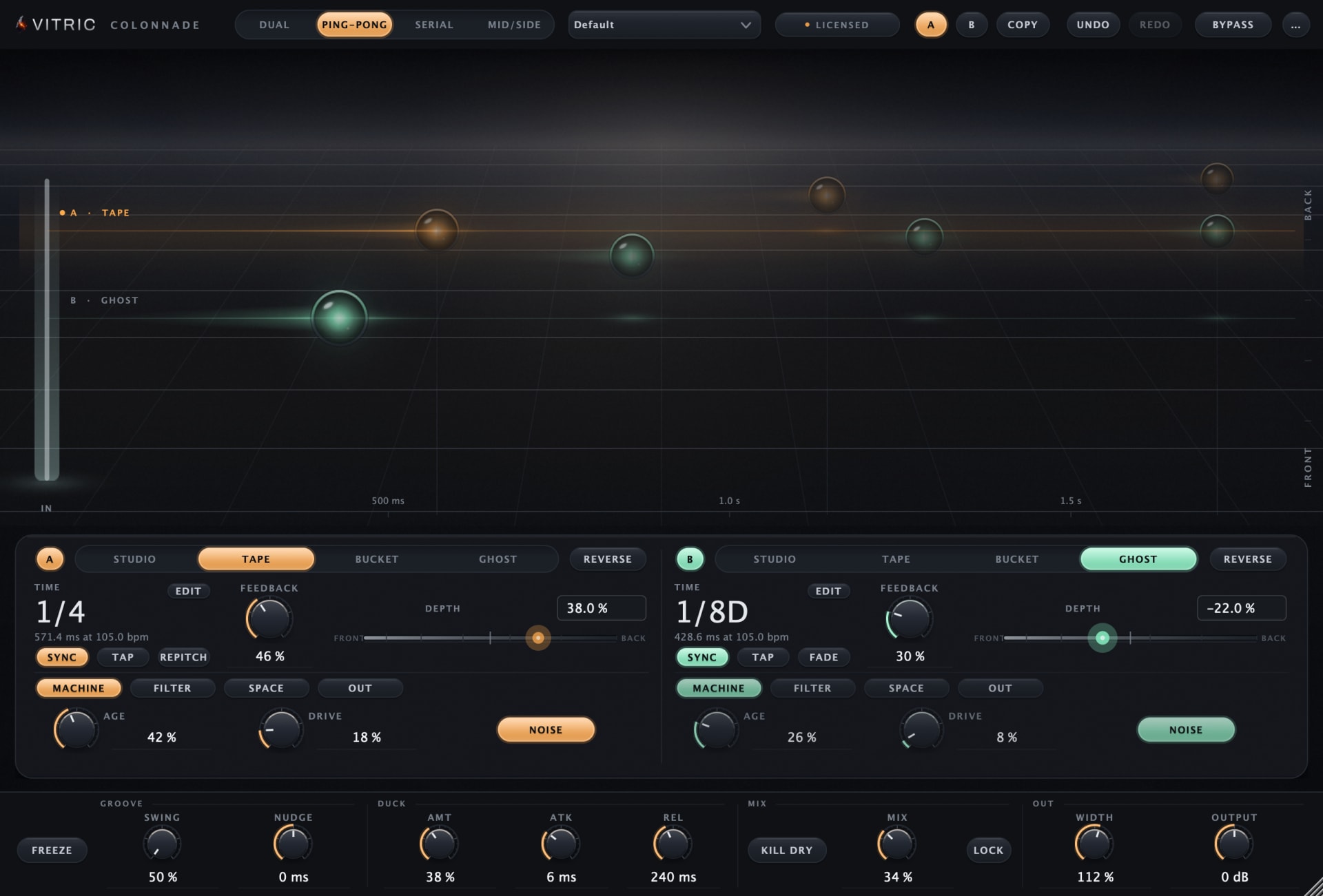
One beat lasts 60,000 divided by the BPM, in milliseconds. At 140 BPM a quarter note is 428.6 ms and an eighth note 214.3 ms; at 174 BPM a quarter note is 344.8 ms. The delay calculator lists every note value for your tempo, and the reverb calculator sets pre-delay and decay to the beat. In a synced delay you pick the note value instead:Colonnade Delay has 21 sync divisions, or free time from 1 ms to 4 seconds. For what each delay style does, see types of delay.
Frequently asked questions
Is 140 BPM trap or dubstep?
Both. Trap, dubstep and much UK drill share a written tempo near 140 and a half-time feel near 70. The drums, the bass sound and the groove tell them apart, not the number.
What BPM should I start a beat at?
Pick the middle of your genre's range from the table, make the drums, then nudge the tempo a few BPM up or down until the groove and the vocal sit right.
Does BPM change the key?
No. Tempo and key are separate. Speeding up a sample by resampling raises its pitch, but changing the project tempo of MIDI parts does not.