Harmonic Multiband vs FabFilter Pro-MB
What FabFilter Pro-MB clearly does better, where the two overlap, and what the Harmonic Multiband's detector saturation does that Pro-MB does not attempt.
Ask which multiband compressor to buy and the most common answer is FabFilter Pro-MB. It earned that. Released in 2013 and refined since, it is the plugin most engineers picture when they say multiband. We build a multiband compressor, so Pro-MB is the tool we measure ourselves against, and this article is that comparison written straight: where Pro-MB is ahead, where the two overlap, and the one design idea the Harmonic Multiband is built around that Pro-MB does not attempt.
Every Pro-MB claim below was checked against FabFilter's published specifications in July 2026. Where the products differ, we say which way the difference cuts, including when it cuts against us.
What Pro-MB is
Pro-MB gives you up to six freely placed processing bands, each doing compression or expansion, over crossovers with slopes adjustable from 6 to 48 dB per octave. Its headline engineering is the choice of three processing modes: Dynamic Phase, which adds no latency and no pre-ringing and only shifts phase while gain is actually changing, plus conventional Linear Phase and Minimum Phase modes. Per band you get threshold, range, attack, release, ratio, variable knee, output gain, lookahead up to 20 ms, variable stereo linking, mid-only or side-only processing, an external sidechain input, and triggering from a separate frequency range. It runs up to four times linear-phase oversampling, has a global mix from 0 to 200 percent, and ships in VST, VST3, AU, CLAP, AAX Native and AudioSuite formats. As of July 2026 it sells for 199 US dollars with a 30-day trial.
That is an expert's feature set, and none of it is padding. Thirteen years of releases have sanded the workflow smooth.
Where Pro-MB is ahead
Being specific about this is the point of an honest comparison, so here is the list.
- Crossover flexibility. Pro-MB lets you set slopes anywhere from 6 to 48 dB per octave and place bands freely, with unprocessed gaps if you want them. The Harmonic Multiband uses a fixed Linkwitz-Riley LR4 tree: six contiguous bands with draggable crossover points, one slope. If your work needs a gentle 6 dB transition on one split and a steep one on another, Pro-MB is the tool.
- Processing modes. Dynamic Phase is a genuinely clever piece of engineering, and Pro-MB also offers a true Linear Phase mode for mastering situations where any phase rotation at the crossover is unacceptable. The Harmonic Multiband has one crossover behavior, described below.
- Mid/side per band. Pro-MB can compress only the mid or only the side signal within a band. The Harmonic Multiband processes stereo per band and does not offer per-band mid/side.
- Sidechain routing. Pro-MB accepts an external sidechain and can trigger a band from a different frequency range than the one it processes. The Harmonic Multiband's sidechain options are internal: a per-band sidechain high pass and the detector saturation covered below.
- Lookahead headroom. 20 ms in Pro-MB against 10 ms in the Harmonic Multiband, both host-compensated.
- Formats and trial length. Pro-MB adds CLAP and AudioSuite to the usual three formats, and its trial runs 30 days against our 3. Both trials are full-function.
Where they meet
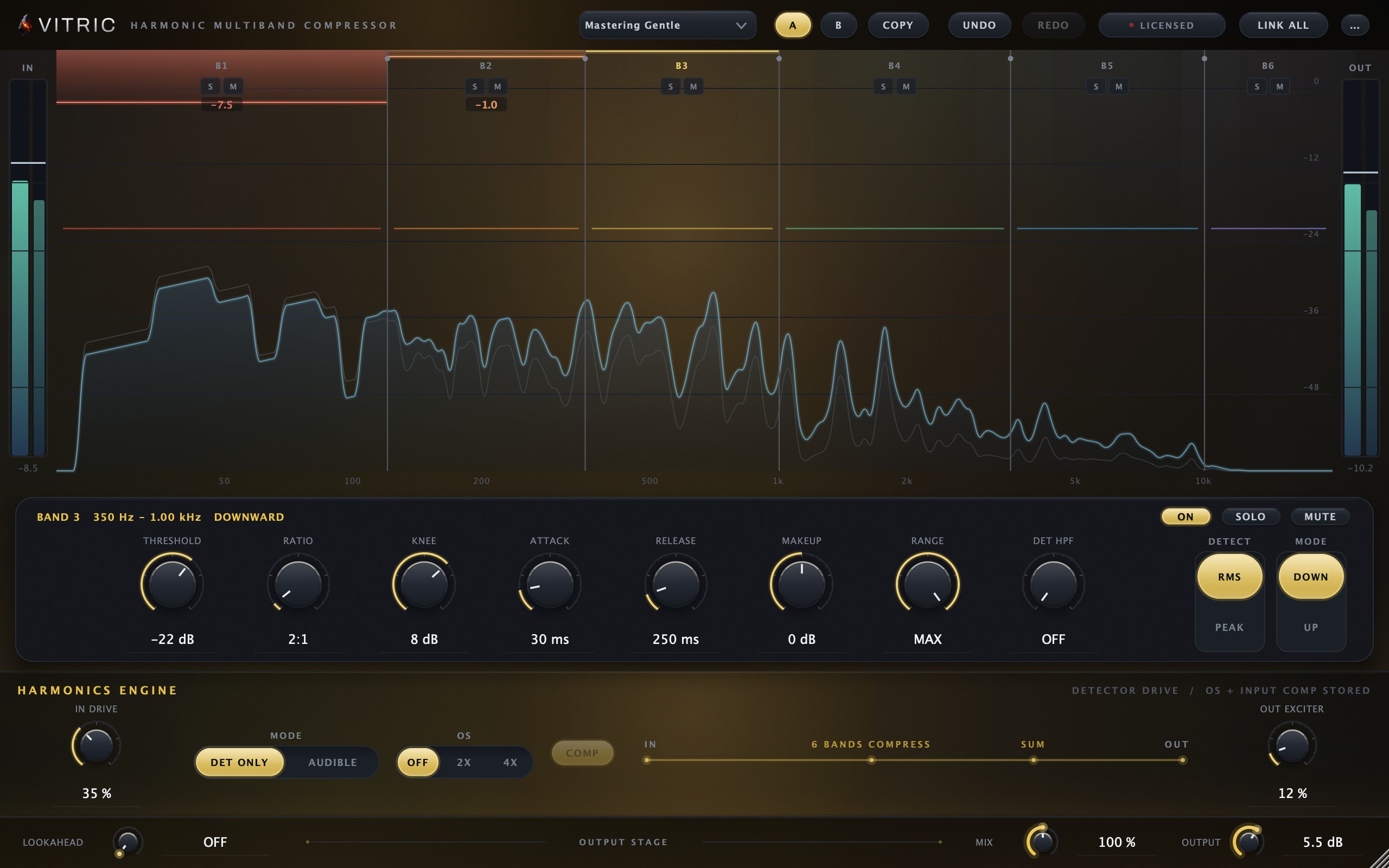
The core duty overlaps almost completely. Both are six-band dynamics processors with draggable crossovers and thresholds on a real-time analyzer, per-band attack, release, ratio, knee, range and makeup, downward and upward modes, oversampling for the nonlinear stages, and a mix control that runs past 100 percent to 200 for parallel work. The Harmonic Multiband adds a blendable RMS-to-peak detector per band and A/B states with Copy and Link All. For plain multiband compression, de-harshing a vocal, tucking a boomy low mid, either plugin does the job, and neither embarrasses the other.
What the Harmonic Multiband is built around
The reason our plugin exists is the Harmonics Engine, a dual-stage saturation system wired into the multiband structure itself. It is not an insert effect bolted alongside the compressor. It sits in the signal path at two specific points, and the first of those points is the interesting one.
IN DRIVE is a tanh soft clipper per band, 0 to 100 percent, placed after the crossover split, with two modes. In DET ONLY mode the saturation is applied only to the sidechain copy feeding that band's detector. The audio path stays completely clean. What changes is the measurement: the detector sees rounded peaks and a smaller crest factor, so the band compresses smoother and deeper, the way vintage opto and tube units do, because their circuits rounded peaks before detection by construction. In AUDIBLE mode the same drive stage saturates the audio itself before compression, 2x or 4x oversampled, with a delay-compensated dry path. The mechanism behind this trick has its own article in the guides index if you want the full argument.
You can approximate the full-band version of this in any DAW: duplicate the track, saturate the copy, feed it to a compressor's external sidechain. Per band, inside a multiband, the routing multiplies and the gain staging gets fragile, which is exactly why we built it in. Pro-MB does not attempt detector-side saturation, per band or otherwise. It is not a missing feature so much as a different thesis about what a multiband is for.
The second stage, OUT EXCITER, works on the summed mix. It isolates just the harmonics the drive stage added, runs them through a dynamic low pass that sits open near 18 kHz at low drive for air and closes toward 2 kHz at high drive for warmth, and blends them back. A COMP switch auto-matches output level so added loudness never biases the judgement.
The crossover trade
Pro-MB's Dynamic Phase mode avoids the fixed phase rotation of conventional crossovers and only bends phase while gain is moving. That is a real advantage, and we will not pretend otherwise.
The Harmonic Multiband takes the classic route instead: an allpass-compensated Linkwitz-Riley LR4 tree that sums flat within plus or minus 0.5 dB with the dynamics at rest. LR4 is the crossover topology audio has trusted for decades, in monitors and in processors, and its behavior is a known, fixed quantity: no mode switch, one less variable while you work. Which philosophy you prefer is a legitimate matter of taste and material. If you master with surgical thresholds and care about phase above all, Pro-MB's mode selection is the stronger offer.
Side by side
| Spec | FabFilter Pro-MB (as of July 2026) | Harmonic Multiband |
|---|---|---|
| Bands | Up to 6, freely placed, gaps allowed | 6, contiguous, draggable crossovers |
| Crossovers | 6 to 48 dB/oct; Dynamic, Linear, Minimum Phase modes | Fixed LR4, allpass-compensated, sums flat within 0.5 dB |
| Detection | Per-band, separate trigger range, external sidechain | Blendable RMS-to-peak, sidechain high pass, DET ONLY saturation |
| Saturation | None in the signal path | Per-band tanh drive, detector-only or audible, oversampled |
| Exciter | None | OUT EXCITER on the sum, dynamic low pass, auto level match |
| Mid/side | Per band | Not offered |
| Lookahead | Up to 20 ms | Up to 10 ms |
| Formats | VST, VST3, AU, CLAP, AAX, AudioSuite | VST3, AU, AAX |
| Trial | 30 days | 3 days, full-function |
How to choose
Pick by the work, not the brand. If your sessions need per-band mid/side, external sidechain triggering, adjustable crossover slopes, a linear-phase mode, or CLAP and AudioSuite hosts, Pro-MB is the stronger tool and the extra capability is worth having. It is the category standard for defensible reasons.
If what you are chasing is the way driven analog units compress, smoother and deeper because their detectors never saw literal peaks, or you want saturation and excitation designed into the dynamics rather than patched around them, that is the specific problem the Harmonic Multiband Compressor was built to solve, and no setting in Pro-MB reproduces DET ONLY mode. Plenty of rooms will end up holding both, because they overlap on the core job and differ at exactly the edges described above. Both have full-function trials, so the honest advice is the boring advice: run them on your own material and keep what survives the level-matched A/B.