What is a vocoder? How it makes a synth talk, and how it differs from a talk box
A vocoder makes one sound speak with the shape of another: it measures how a voice's energy moves across a set of frequency bands and applies those movements to a synth. Here is how it works, how to set one up, and how it differs from a talk box and pitch correction.
A vocoder makes one sound speak with the shape of another. It splits a voice, the modulator, into a set of frequency bands and measures how loud each band is from moment to moment. It splits a second sound, usually a synth, the carrier, into the same bands and turns each one up or down to match the voice. Played together, the synth's notes come out with the voice's words: the classic robot voice.
Where did the vocoder come from?
Homer Dudley invented it at Bell Labs in 1937 as a way to analyze and rebuild speech. Musicians picked it up later: the Siemens Synthesizer, developed between 1956 and 1959, was one of the first attempts to make music with a vocoder, Robert Moog built one of the first solid-state musical vocoders in 1968, and Daft Punk used vocoders on their albums from Homework in 1997 to Random Access Memories in 2013.
How do you set up a vocoder?
- Carrier. Put the vocoder on a synth track. Choose a sound with plenty of harmonics, such as a sawtooth: the vocoder can only pass frequencies the carrier has, so a dull carrier gives muffled words.
- Modulator. Route your vocal to the vocoder's sidechain or modulator input. Check which input your vocoder treats as the carrier: some sit on the vocal track and take the synth from a sidechain instead.
- Bands. More bands follow the voice more closely; fewer give a rougher, more robotic sound.
- Play. Hold chords on the synth while the vocal plays. The synth sets the notes; the voice sets the words.
Vocoder vs talk box vs pitch correction
| Effect | How it works | Sound |
|---|---|---|
| Vocoder | Electronic: the voice's band levels shape a synth | The synth speaks; robot voice |
| Talk box | Acoustic: the instrument's sound goes through a tube into the mouth and a microphone picks it up | The instrument talks |
| Pitch correction | Moves the voice's own pitch to the nearest note | The voice, in tune or stepped |
A talk box needs no electronics to shape the sound: the player's mouth does it. Peter Frampton made it famous on guitar, and Roger Troutman of Zapp on synth. Talk boxes are often heard on rock guitar and in funk; vocoders in electronic music. Pitch correction keeps the singer's own voice; see how to use autotune.
A vowel sound without a voice
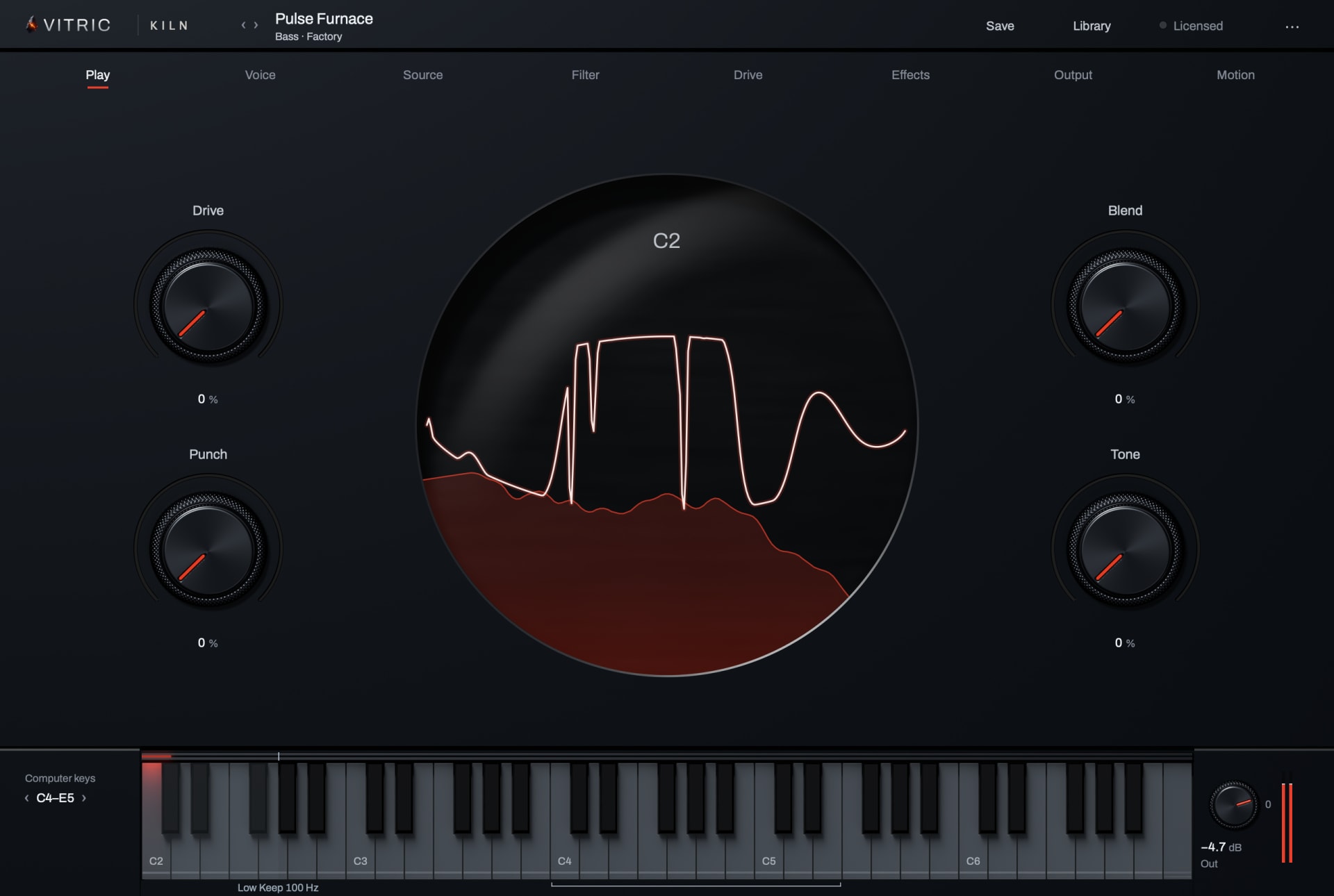
A formant filter shapes a sound with vowel-like resonances, so a synth can sound vocal without a modulator. Kiln Synthesizer has a formant filter among its five filter types (SVF, ladder, comb, formant and Glass), in two filter slots. Any bright synth patch works as a vocoder carrier.
Questions
What does a vocoder do?
It applies the changing tone of one sound, usually a voice, to another, usually a synth, so the synth seems to speak.
Is a vocoder the same as autotune?
No. A vocoder makes a different sound take on the voice's words; pitch correction keeps the voice and moves its pitch.
How many bands should a vocoder have?
Analog vocoders usually had 8 to 20. More bands follow the voice more closely; fewer sound rougher and more robotic.