Filter effects and ring modulation: sweeps, auto-filters and ring mod explained
Filter sweeps, auto-filters and envelope filters all move a filter's cutoff over time; a ring modulator multiplies two signals into metallic, bell-like tones. Here is how each effect works and how producers use it.
Most filter effects do one thing: move a filter's cutoff over time. A sweep moves it slowly across a section, an auto-filter moves it with an LFO, and an envelope filter moves it with how hard you play. A ring modulator is a different animal that often sits next to them in effects racks: it multiplies two signals and turns them into new, often metallic tones.
Filter sweeps
A sweep is automation: draw the cutoff of a low-pass filter rising over a few bars and the sound opens up from dull to bright, a common way to build into a drop or a chorus. Sweeping a high-pass upward does the reverse, thinning a part out. Adding some resonance makes the sweep more vocal and obvious. For how the filters themselves work, see low-pass and high-pass filters.
Auto-filters
An auto-filter moves the cutoff with an LFO instead of your automation, so the sweep repeats on a fixed timer, independent of how you play. Synced to the tempo, it gives rhythmic filter movement; on a bass, it is the wobble. See what an LFO is.
Envelope filters and auto-wah
An envelope filter, often called an auto-wah, follows the loudness of what you play and sweeps the cutoff with it: play harder and the filter opens further. It works like a wah pedal but responds faster than a foot could move one. The Mu-Tron III was the first envelope-controlled filter made for musical instruments.
Comb and formant filters
Not every filter is low-pass or high-pass. A comb filter has a row of evenly spaced peaks and notches, which gives hollow, metallic or flanger-like tones as it moves. A formant filter imitates the resonances of the voice, so sweeping it sounds like moving between vowels.
Ring modulation
A ring modulator multiplies two signals, usually your sound and a sine wave called the carrier. The output holds the sum and the difference of their frequencies, and ideally neither original. Ring a 440 Hz sine tone with a 300 Hz carrier and you hear 740 Hz and 140 Hz instead; a real note adds a pair like this for every harmonic. Because those new frequencies are rarely in a musical relationship with the note, ring modulation tends to sound inharmonic: bell-like, metallic or robotic. The name comes from the ring of diodes in the original circuit.
At very low carrier frequencies, ring modulation is heard as a tremolo instead. It has a long history: Karlheinz Stockhausen used it in 1956, and Brian Hodgson of the BBC Radiophonic Workshop used it to create the voices of the Daleks in Doctor Who.
Filter effects in Kiln
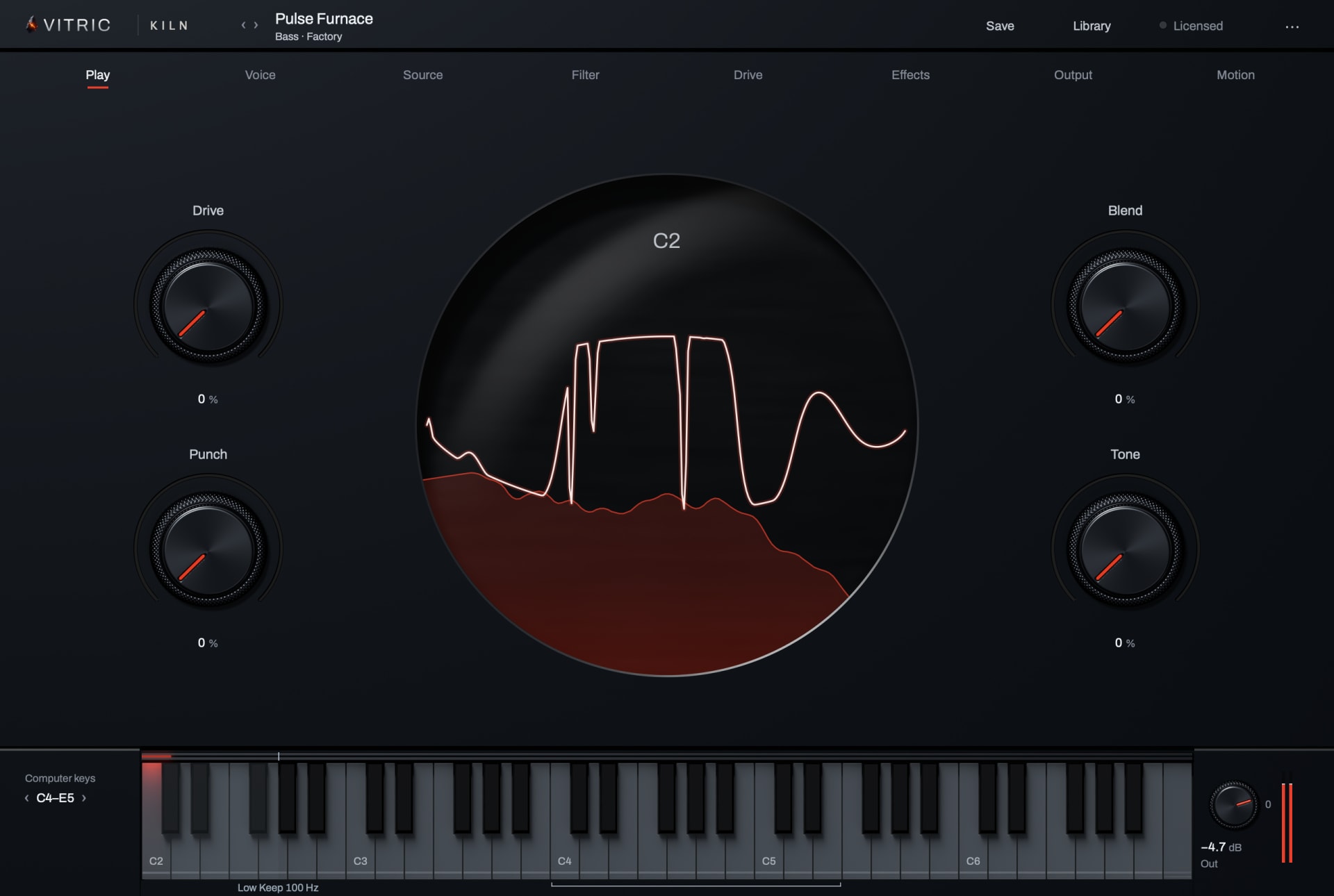
Kiln Synthesizer has two filters, each with five models: SVF, which morphs from low-pass through band-pass to high-pass; LDR, a ladder that self-oscillates near the top of its resonance; CMB, a comb; FRM, a formant filter whose morph moves the vowel; and GLS, the Glass resonator. KEY sets how much the cutoff follows the note you play. Route an LFO to Filter 1 Cutoff in the modulation matrix for an auto-filter, or ENV 2 for a sweep on every note; raise that envelope's VEL and harder notes sweep further. Kiln has no ring modulator; for metallic tones, try the CMB comb, or GLS with MAT toward metal. The Kiln manual has a filter wobble recipe.
Questions
What is the difference between ring modulation and amplitude modulation?
Both multiply two signals. In amplitude modulation, the modulator is shifted to be positive first, so the original carrier stays in the output; in ring modulation it is not, so the carrier disappears.
Why does a ring modulator sound metallic?
It creates sum and difference frequencies that usually do not line up with the harmonics of the note, and inharmonic partials sound bell-like or clangorous.
What is an auto-filter?
A filter whose cutoff moves on its own, usually by an LFO, so it sweeps in a repeating pattern.