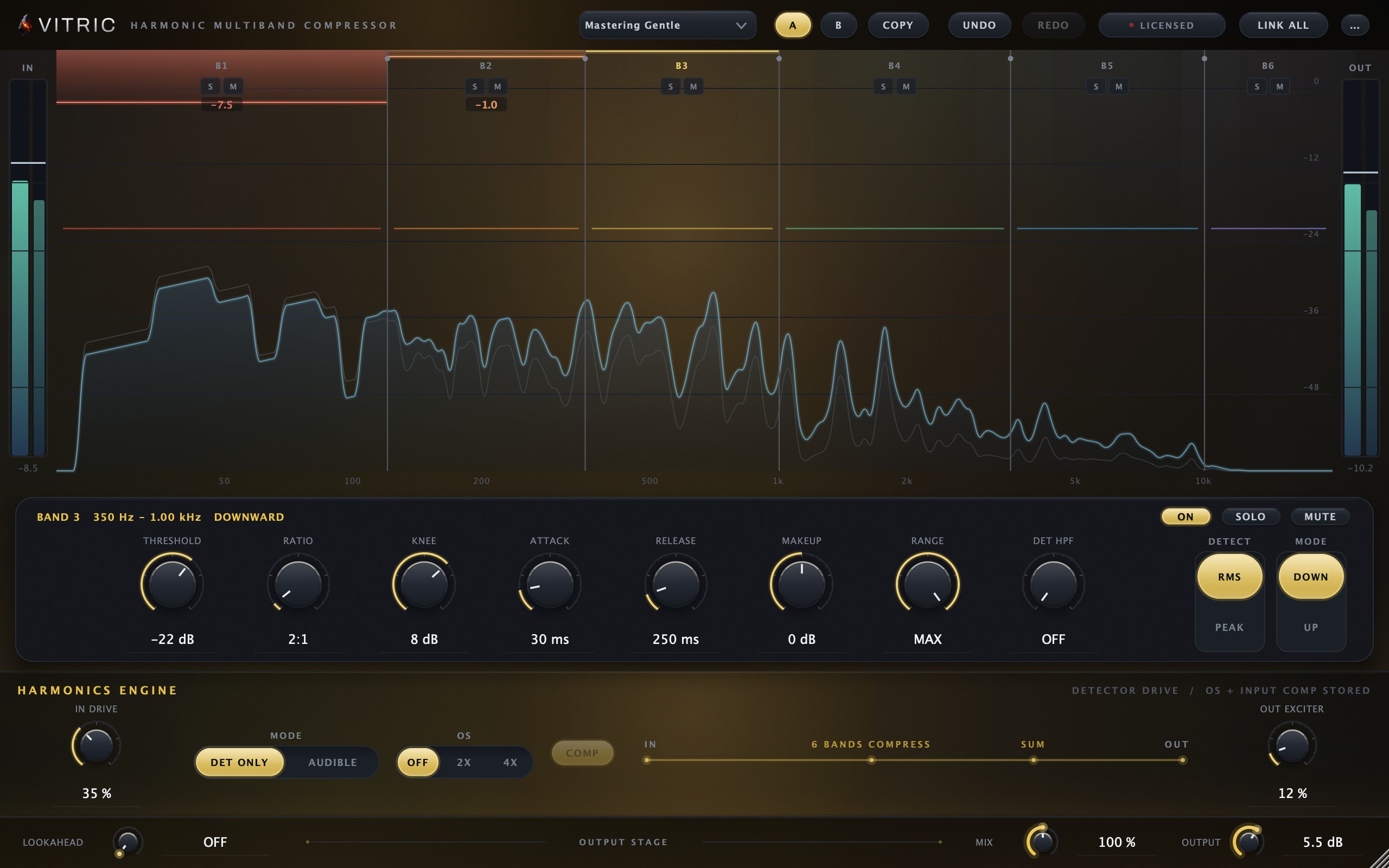
Why engineers put saturation before compression
Running a saturator in front of a compressor does more than add harmonics. It rounds the peaks the detector measures, and that changes every decision the compressor makes.
Engineers have chained a saturator in front of a compressor for decades: on drum busses, on vocals, on the mix bus. Ask why and the usual answer is that it sounds better, which is true and useless. The useful answer is that saturation changes the signal before the compressor measures it, so the compressor makes different decisions. You are not just adding harmonics on the way in. You are editing what the compressor is allowed to know.
This article walks the mechanism: what a saturator actually does to a peak, what a compressor's detector actually sees, and why the combination behaves like neither plugin alone.
What a saturator does to a peak
Most saturators are, at their core, a waveshaper: a fixed transfer curve applied to the signal, sample by sample. A soft clipper built on a curve like tanh is nearly linear for small values and bends progressively harder as the input gets hotter. Quiet material passes almost untouched. The loudest instants get pulled down the most.
Two things fall out of that, and they are the same thing seen from two sides.
First, the waveform's peaks get rounded. On a snare hit, the initial spike is the hottest part of the signal, so it takes the most bending. The sustain and the room tone after it sit lower on the curve and pass nearly clean. The gap between the peak level and the average level, the crest factor, shrinks. This happens even at drive settings where nobody in the room would call the sound distorted.
Second, bending a waveform is exactly what "adding harmonics" means. Send a sine wave through a nonlinear curve and it comes out as the original frequency plus new components at whole-number multiples of it. A symmetric curve like tanh generates odd harmonics; make the curve asymmetric and even harmonics appear as well. The harmonics are not sprinkled on top of the rounding. They are the spectral description of the rounded shape. One phenomenon, two measurements.
So a saturator is a peak-rounding device that pays for its rounding in harmonics. Keep both halves in mind, because the rest of this trick is about wanting one half without the other.
What the detector hears
A compressor is three parts. A detector measures the signal's level. A gain computer turns that level into a gain-reduction amount through the threshold, ratio and knee. Ballistics, the attack and release, decide how fast the gain is allowed to move.
The detector is the part that matters here. It tracks an envelope of the signal, leaning toward the peaks or toward the average depending on the design, and everything downstream only ever sees that envelope. The compressor does not react to your snare. It reacts to a line drawn over your snare.
Feed it a raw drum bus and that line is spiky. The transient jumps far above the body of the sound, the envelope shoots up, gain reduction clamps hard and then has to recover before the next hit. You feel this as a familiar set of compromises. A fast attack catches the spike but shaves the hit dull. A slow attack keeps the hit but lets the spike sail through, so the compressor mostly reacts late, to the part you wanted left alone. The threshold never sits right because it is refereeing two signals at once: the spikes and the body.
Now put a soft clipper in front and change nothing on the compressor. The spikes arrive pre-rounded, so the distance between transient and body has shrunk before the detector ever measures it. The envelope is smoother. Gain reduction moves less, and in smaller steps, because the level it is chasing no longer whips around. The compressor stops flinching at every hit and starts leaning on the body of the sound, which is usually what you wanted a bus compressor to do in the first place. Same threshold, same ratio, same ballistics: different behavior, because the measurement changed.
Why this reads as vintage
This is a large part of why classic hardware compresses the way it does. In a tube or optical unit, the signal passes input transformers and amplifier stages that are themselves gently nonlinear before and inside the detection path. The circuit rounds peaks by construction, so the detector was never fed a spiky, literal envelope to begin with.
Topology compounds it. Many classics detect feedback style: the detector listens at the unit's output, after the gain element and after the circuit's own color, so it hears peaks that have already been rounded twice, once by the nonlinearity and once by its own gain reduction. A clean feedforward digital compressor measures the raw input instead, which is precise, and precisely why it can feel like it is snapping at the signal. It is reacting to information the hardware never saw. That difference in detection is a real design axis in compressors, not a mystique: Caliper models it directly, running feedback-style detection on its FET, Opto and Tube modes and clean feedforward math on Clean.
Order matters
Swap the chain and you get a different tool, not a worse one. With the compressor first, the detector reacts to the raw transients, grabby and literal, and the saturator then colors an already-leveled signal. That has its own virtue: a compressed signal drives the saturator at a consistent depth, so the color stays even from phrase to phrase.
| Chain | What the detector hears | What you get |
|---|---|---|
| Saturator into compressor | Rounded peaks, smaller crest factor | Smoother, deeper compression that holds the body instead of chasing spikes |
| Compressor into saturator | The raw signal, spikes intact | Literal, grabbier compression, then a consistent drive level into the color stage |
Saturation first changes how the compressor behaves. Saturation second changes how the result sounds. Plenty of chains use both.
Doing it with two plugins, and the gotchas
The two-insert version works today in any DAW: any saturator, then any compressor. Three things to watch.
- Gain staging. Most saturators add level. A hotter signal into a fixed threshold means more gain reduction, so what sounds like "the saturator made the compressor better" is sometimes just the compressor working harder. Match levels before you judge.
- Loudness bias. The whole chain usually ends up louder, and louder reads as better on first listen. Level-match the A/B or you are rating volume, not the technique.
- Aliasing. New harmonics extend upward, and on bright material they can extend past the highest frequency your session can represent, folding back down as inharmonic junk. Use a saturator with oversampling when you drive anything with real top end.
There is also a limitation you cannot gain-stage your way out of: with two inserts, the compressor can only hear the saturation if you also hear it. The response change and the distortion arrive as a package. The workaround is to saturate a duplicate of the track and feed that copy into the compressor's external sidechain, leaving the audio path clean. It works, and it is fragile: extra routing, two gain stages to keep matched, and every tweak made twice. On a multiband compressor it gets worse, because each band has its own detector, and a full-band saturated sidechain feeds every one of them harmonics that belong to other bands.
The detector-only version
Follow the logic to its end and the clean form of the trick is obvious: apply the saturation only inside the sidechain, to the copy of the signal the detector measures, and leave the audible path untouched. The compressor responds the way the vintage units do, smoother and deeper, leaning on the body. The audio picks up zero added harmonics, because the nonlinearity never touches it. You keep the half of saturation that changes behavior and skip the half that changes tone. And when you do want the tone, you saturate the audible path instead and let the compressor squeeze the harmonics along with the signal, which is its own sound: denser and more aggressive.