Acoustic treatment for a home studio: bass traps, panels and where to put them
Acoustic treatment controls the reflections and the ringing bass inside your room. It does not soundproof it. Here is how to work out your room's bass problems from its size, where bass traps and panels go, how thick they need to be, and how to check the result.
Acoustic treatment changes how sound behaves inside your room. It soaks up the reflections that blur the stereo image and damps the bass notes that boom at your chair, and that is most of the difference between a mix that only sounds right at home and one that travels. It is not soundproofing: panels do almost nothing to stop your music reaching the neighbours, or traffic noise reaching your mic.
What is acoustic treatment, and how is it different from soundproofing?
Treatment works on the sound inside the room: absorbers turn part of the energy that hits them into heat, so less of it bounces back to your ears. Soundproofing, or isolation, works on sound passing through the walls, floor and ceiling, and that takes mass, airtight seals and construction that decouples one wall layer from the next.
A mineral wool panel is light and porous, and air passes through it. A room lined with panels sounds drier to you, but the bass still reaches next door. If the problem is noise getting in or out, you need building work. If the problem is mixes that do not translate, treatment is the fix.
What do bass traps do, and where should they go?
Every room resonates at a set of low frequencies called room modes. The strongest are the axial modes, which bounce between one pair of opposite surfaces. The first axial mode along a dimension is the speed of sound divided by twice that dimension, and the rest are whole-number multiples of it:
f = 343 / (2 × L), with L in metres and 343 m/s as the speed of sound in air at 20 °C. Working in feet, use f = 1,125 / (2 × L).
| Room dimension | 1st mode | 2nd mode | 3rd mode |
|---|---|---|---|
| 2.4 m (7.9 ft) | 71 Hz | 143 Hz | 214 Hz |
| 3.0 m (9.8 ft) | 57 Hz | 114 Hz | 172 Hz |
| 3.6 m (11.8 ft) | 48 Hz | 95 Hz | 143 Hz |
| 4.0 m (13.1 ft) | 43 Hz | 86 Hz | 129 Hz |
| 4.5 m (14.8 ft) | 38 Hz | 76 Hz | 114 Hz |
| 5.0 m (16.4 ft) | 34 Hz | 69 Hz | 103 Hz |
Take a bedroom 3.6 m long, 3.0 m wide and 2.4 m high, about 12 by 10 by 8 feet. Its axial modes below 200 Hz land at 48, 57, 71, 95, 114, 143, 172 and 191 Hz, and 143 Hz turns up twice: it is the third length mode and the second height mode. Modes that coincide are harder to hide than modes spread apart (in a cube, all three dimensions share every mode), so expect a bass note near 143 Hz to stand out. The EQ frequency chart shows which notes and instruments sit at your room's numbers, and the human hearing range guide shows where they fall in what we hear.
Each mode is loud in some places and nearly silent in others. Every axial mode peaks against the walls; halfway across the room the odd-numbered modes cancel and the even-numbered ones peak. Sit dead centre along this room's length and you are in the null of the 48 and 143 Hz length modes and on the peak of the 95 Hz one, so move the chair forward or back and measure again. Across the width you sit centred for the stereo image, so the 57 and 172 Hz width modes will always read weak at your seat.
Why bass traps go in corners
Because every mode peaks at the walls, a corner where two walls meet sits at a pressure peak for the modes of both, and a three-way corner, where two walls meet the floor or ceiling, sits at a peak for every mode in the room. That makes corners the most efficient place for traps that work on pressure, such as membrane or panel traps.
Most home studio traps are porous instead, mineral wool or fiberglass that absorbs by friction as air moves through it, and porous traps need depth. Trevor Cox, professor of acoustic engineering at the University of Salford, gives the rule of thumb in Sound On Sound: to be effective, a porous absorber must be at least a tenth of a wavelength thick, which is about 69 cm at 50 Hz. He adds that bare foam is an inefficient bass absorber unless it is very thick, and that bass needs absorption over a large area, not a few pieces in the corners. The corner still helps a porous trap: a thick panel set across it leaves a deep triangle of air behind, which puts the material out where the air moves more.
A sensible start for that bedroom is 4 in panels straddling all four vertical corners, floor to ceiling, then the wall-to-ceiling corners. Expect them to calm the upper bass and low mids most. The 48 and 57 Hz modes need more depth than a bedroom can spare, so seat position and, last, EQ handle the rest, and the sub bass guide covers checking the lowest octave on other systems.
Where do acoustic panels go? First reflection points, the mirror trick and the ceiling cloud
The first sound to bounce off a side wall, the ceiling or the desk reaches you a few milliseconds after the direct sound and combines with it, which shows up as comb filtering: a row of narrow peaks and dips in the response. The EBU's standard for broadcast listening rooms, Tech 3276, asks for every reflection arriving within 15 ms of the direct sound to be at least 10 dB quieter than it, from 1 kHz to 8 kHz. Panel placement at the reflection points is how a small room gets near that. To find them:
- Sit in your mix position with your head where it is when you work.
- Have a friend slide a mirror flat along the side wall at about the height of the tweeters.
- Mark every spot where you can see a speaker in the mirror. Each side wall has two: one for the near speaker and, closer to you, one for the far speaker.
- Repeat on the other side wall, then on the ceiling between you and the speakers.
Sound On Sound's glossary calls these mirror points and names them as the ideal place for absorbers. Cover both marks on each wall, centred at tweeter height. With the tweeters at ear height, the ceiling point sits about halfway between the speakers and your head; a panel hung there a few inches below the ceiling is a cloud, and the space above it works as an air gap. Tech 3276 also names the desk surface as a source of strong early reflections, so keep it clear between you and the speakers, and treat both sides of the room alike: the standard asks for a room that is acoustically symmetrical about the listening direction.
How thick should panels be, and does an air gap help?
Depth sets how low a porous panel works. Applying Cox's tenth-of-a-wavelength rule, with the wavelength equal to 343 / f, to common builds gives these figures:
| Build | Depth from the wall to the panel face | Effective down to about |
|---|---|---|
| 2 in (5 cm) panel, flat on the wall | 5 cm | 690 Hz |
| 2 in panel on a 2 in air gap | 10 cm | 340 Hz |
| 4 in (10 cm) panel, flat on the wall | 10 cm | 340 Hz |
| 4 in panel on a 4 in air gap | 20 cm | 170 Hz |
| What a 50 Hz mode would need | 69 cm | 50 Hz |
The gap rows rest on a measurement: in Cox's tests a 25 mm panel set 25 mm off the wall absorbed the same as a 51 mm panel mounted flat. Treat them as a guide rather than a promise. A gap also adds some ripple to the absorption curve, and below the figures in the table absorption tapers off rather than stopping.
So 2 in panels already cover the 1 to 8 kHz band of the EBU reflection target, and they are fine at reflection points when space is tight. Use 4 in, or 2 in on a gap, where you can, and the deepest material you can fit in the corners. Avoid thin foam all over the walls: Cox measured 13 mm foam working only from about 2 kHz up, so the room loses its top end while the bass rings on.
How do you check your room before and after?
Measure before you hang anything, then after each stage, with everything else unchanged: mic position, speaker level and input gain.
- Record a sine sweep. Play a 20 Hz to 20 kHz sweep through your speakers at a moderate level and record it with a mic where your head goes. A measurement mic gives a curve you can trust; any other mic colours it, but with the same mic both times the comparison holds.
- Compare the recordings. Load the before recording as the mix in the free spectrum analyzer and the after recording as the reference, and turn off Match reference loudness to mix so both keep their recorded levels. The difference curve then shows what the treatment changed: a positive value is energy it took away. Use 1/6 or 1/12 octave smoothing to see single modes, and hover a peak to read its frequency.
- Read the slope. A logarithmic sweep spends equal time in each octave, so on that analyzer's power-per-hertz display it slopes down like pink noise. Judge peaks and dips against the slope, not a flat line; see how to read a spectrum analyzer.
- Check the decay time. REW, the free measurement program in the room correction guide, measures with its own sweep and shows the decay time per octave or third octave in its RT60 graph.
Tech 3276 sets the nominal decay time, averaged from 200 Hz to 4 kHz, between 0.2 and 0.4 seconds, rising with room size, and it is written for control rooms with at least 30 m² of floor, nearly three times the bedroom above. Paul White, writing in Sound On Sound, puts a control room at around 0.3 s and calls the 0.5 s of a typical living room a reasonable target for a project studio. In a bedroom, aim for roughly 0.2 to 0.3 s in the mids and highs, and stop adding absorption when you get there. Below a few hundred hertz, REW's help says RT60 means little in a domestic room; its waterfall and spectrogram views show which bass notes keep ringing.
Can EQ or room correction replace treatment?
No, but it has a job once the treatment is up. EQ can cut a modal peak at your listening position. It cannot fill a deep, narrow dip, which moves with every step and eats headroom when boosted, and it cannot remove reflections or stop the bass ringing across the room. Tech 3276 puts the steps in the same order: treatment and speaker and seat positions first, then equalization, used carefully and preferably only below 300 Hz.
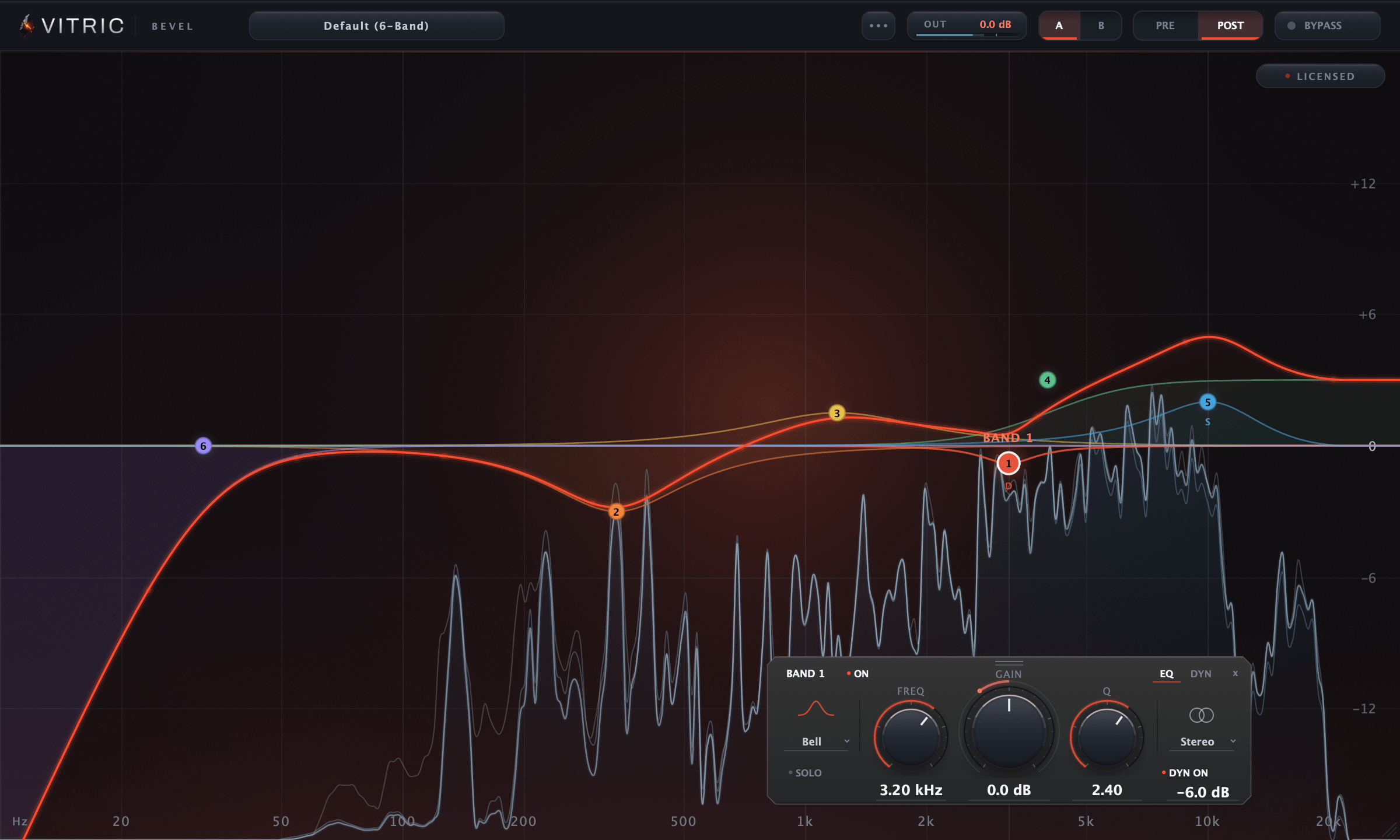
If you correct the monitors with a plugin EQ, keep it out of your bounces: use a monitor or control-room insert if your DAW has one, or bypass it before you export. Bevel EQ suits the job. Put it on your sweep recording and hover a peak to read its frequency and nearest note, then on the monitor insert type that frequency into a narrow bell (Q runs up to 40) and solo the band to hear what you are cutting. With headphones the room has practically no influence, as Tech 3276 notes, so they are the best cross-check while the panels go up; see mixing with headphones.
Questions
Do acoustic panels soundproof a room?
No. They absorb reflections inside the room; they do not stop sound getting in or out.
How do you soundproof a room?
Add mass to the walls, floor and ceiling, seal every gap, and decouple the layers so vibration cannot pass straight through. It is building work, separate from treatment.
Sources: EBU Tech 3276, Listening conditions for the assessment of sound programme material (2nd edition, 1998); Trevor Cox, Choosing and Using Porous Absorbers (Sound On Sound, 2015); Paul White, Practical Acoustic Treatment, Part 3 (Sound On Sound, 1998); Sound On Sound glossary, Mirror points; Wikipedia, Room modes; Wikipedia, Bass trap; Wikipedia, Soundproofing; REW help, RT60 graph.