Sub bass: frequencies, mono, and making it heard on small speakers
Sub bass is the lowest part of a track, roughly 20 to 60 Hz: felt as much as heard. Here is where common bass notes sit, why the sub stays in mono, why too much costs headroom, and how to make it heard on phones and laptops.
Sub bass is the lowest part of a track, roughly 20 to 60 Hz. It is felt as much as heard: the fundamentals of kicks, 808s and the lowest bass notes live there. Get it right and a track feels big on a system with a subwoofer; get it wrong and it either eats your headroom or leaves the bass line missing on small speakers.
Where bass notes sit
| Note | Fundamental | In the sub band? |
|---|---|---|
| B0 (five-string bass) | 30.9 Hz | Yes |
| C1 | 32.7 Hz | Yes |
| E1 (four-string bass, lowest open string) | 41.2 Hz | Yes |
| A1 | 55.0 Hz | Yes |
| C2 | 65.4 Hz | Just above |
| G2 | 98.0 Hz | No |
808s usually play between C1 and G2, so the low notes of an 808 line sit in the sub and the high ones above it. An 808 here means a long, pitched sub-bass note built on the TR-808 drum machine's kick: see what an 808 is.
Keep the sub in mono
Pan the sub to the center and keep stereo effects out of it, so the low end does not change when the mix is played back in mono, and the sides stay free for wider parts higher up.
Make room for it
- One owner. Decide whether the 808 or the bass carries the sub in each section; two sub sources at once fight for the same space.
- High-pass the rest. Vocals, guitars, pads and hats rarely need anything down here; high-pass them somewhere between 30 and 100 Hz, set by ear for each part.
- Watch the headroom. Too much sub eats headroom and makes a limiter pump; too little and the track feels small on a system with a subwoofer.
Making sub bass heard on small speakers
Most laptop and phone speakers cannot play the sub band. You still hear the bass line, because the ear works out the pitch of a missing fundamental from its harmonics: see the human hearing range. So a bass that is almost a pure sine can disappear on a phone, while one with harmonics stays audible. Add them with gentle saturation, which puts new harmonics higher up, where those speakers work. An EQ boost cannot do it: boosting a nearly pure sub tone at 1 kHz will not create harmonics that are not there. See what a saturator does.
Check it on the right speakers
Make small sub boosts, on the kick or 808, only while listening on something that reproduces it: good headphones, monitors with enough low end, or a subwoofer. Then check the mix on a phone to hear what survives.
Sub bass with Vitric plugins
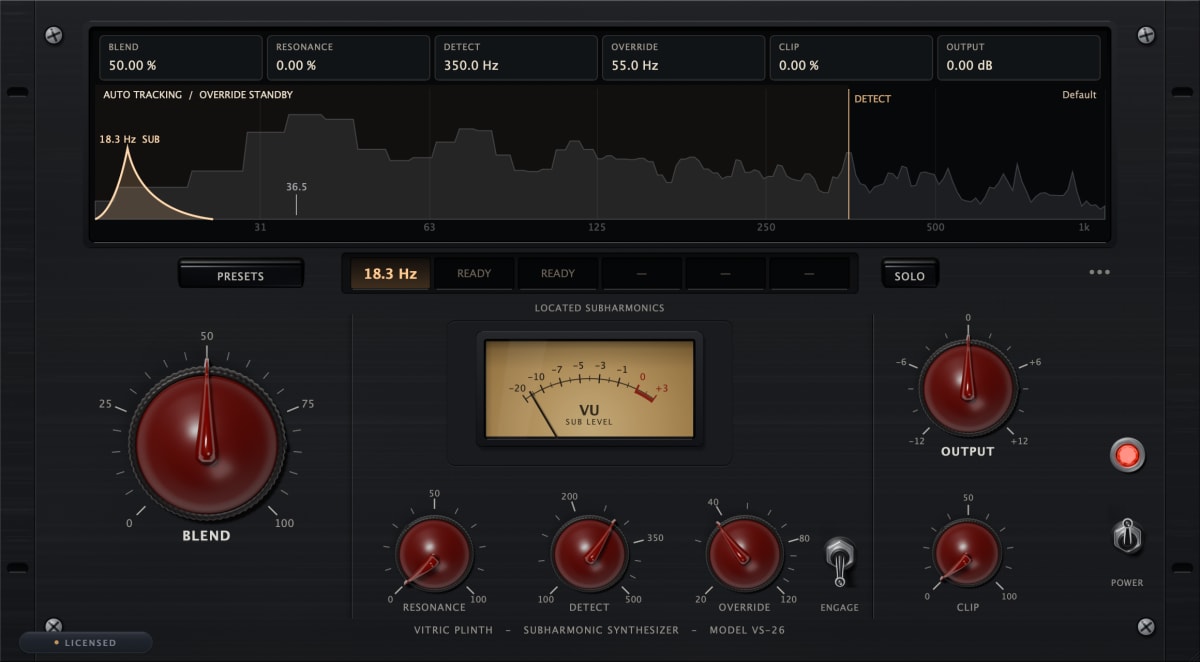
- Plinth Subharmonic Synthesizer generates a mono sub one octave beneath the fundamentals it detects in your audio, shows the source and the added sub together, and sets its level with Blend. It suits a kick or bass whose fundamental sits above the sub band.
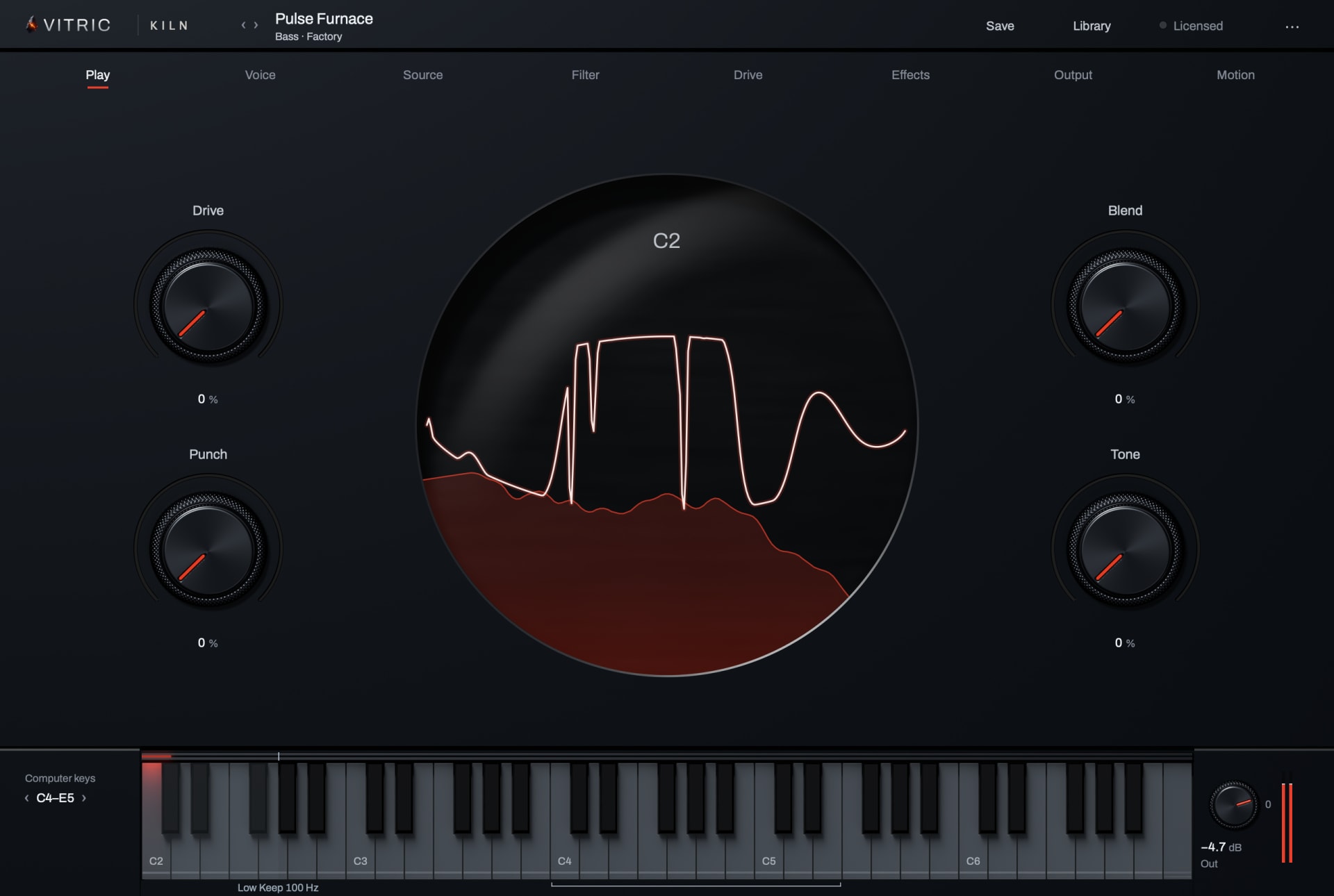
- Kiln Synthesizer has a dedicated sub source, Bass Mono below a frequency you set, and Low Keep, which holds the sub clean under heavy drive while the harmonics above rise.
Questions
What frequency is sub bass?
Roughly 20 to 60 Hz. Above that, about 60 to 250 Hz, is the low end: bass notes, kick body and warmth.
Is an 808 a sub bass?
An 808 is a long, pitched bass note built on the TR-808 kick. Its low notes sit in the sub band; its higher notes and its harmonics sit above.
Why can't I hear my sub bass on my phone?
Phone speakers cannot reproduce it. Add harmonics with gentle saturation so the ear can rebuild the note.