Synth bass: how to make sub, reese and wobble bass
Three synth basses come up again and again in modern production: a clean sub, a moving reese made from detuned saws, and a wobble made by an LFO on a filter. Here is how to build each one, and how to keep the low end solid in the mix.
A synth bass is a bass line played on a synthesizer instead of a bass guitar. Three kinds come up again and again in modern production: a clean sub that is felt as much as heard, a reese that moves and growls because its two oscillators drift against each other, and a wobble whose filter opens and closes in time with the track. All three start from the same synth parts, explained in what is a synthesizer.
How do you make a sub bass?
Start with a sine wave, the one waveform with no harmonics, and play the synth in mono so notes never overlap. In Sound On Sound's dubstep walkthrough, Peter Jenkins builds a sub from two sine waves an octave apart through a low-pass filter; the upper one is the bass's second harmonic. Give the amp envelope a fast attack and a short release so notes stop cleanly.
A pure sub often sits below what phone and laptop speakers can play. The ear can rebuild a missing fundamental from its harmonics, so a little saturation or a quiet upper octave keeps the line audible on small speakers; the human hearing range guide explains why. Keep the sub in the song's key: the 808 tuning guide has the note frequencies.
How do you make a reese bass?
The name comes from Kevin Saunderson, who released "Just Want Another Chance" as Reese in 1988. That bass line was played on a Casio CZ-series synth using phase distortion synthesis. It became very influential in jungle and drum and bass; Renegade's "Terrorist" (1994) was built on a sample of it. Today the sound is often built from detuned sawtooth oscillators:
- Two sawtooth oscillators at the same octave.
- Detune them in opposite directions. The Native Instruments recipe uses +0.3 and -0.3 semitones; half that gives slower movement.
- A low-pass filter to tame the top. The same recipe starts near 650 Hz.
- The synth in mono, so each new note replaces the last.
The movement is beating: two pitches a fraction apart drift in and out of phase. At A1, 55 Hz, two oscillators 30 cents either side of the note beat about twice a second, and every harmonic beats faster than the one below it, which is what makes a reese sound alive. The same drift makes the two fundamentals reinforce and cancel each other about twice a second, so the lowest octave pulses. A plain sine sub underneath keeps the low end steady while the reese moves above it.
How do you make a wobble bass?
The wobble of dubstep is a filter moving in time. Sound On Sound's recipe: combine a few waveforms, route them through a low-pass filter, and let an LFO move the cutoff. A sine LFO moves more smoothly than a saw or square, and syncing its rate to the track's tempo will often sound best. Dubstep runs at about 140 BPM.
Automate the LFO rate, or switch between a few synced rates, so the bass talks in rhythm with the drums. An LFO can also move volume or distortion instead of the cutoff. As with the reese, a clean sub underneath holds the low end while the wobble moves.
Starting settings
| Bass | Oscillators | Filter and movement |
|---|---|---|
| Sub | Sine, plus a quiet sine an octave up | Low-pass; mono; fast attack |
| Reese | Two saws, +0.3 and -0.3 semitones | Low-pass near 650 Hz; mono |
| Wobble | A mix of saw, square and triangle | Low-pass; sine LFO on cutoff, synced |
Mixing synth bass
- Keep the sub in mono. Width belongs higher up; the lowest octave should sit dead center.
- Share the low end with the kick. Give each its own frequency or its own moment, or duck the bass under the kick with sidechain compression.
- Add harmonics for small speakers. Saturation on the upper layer, not the sub, keeps the line audible on a phone.
Synth bass in Kiln
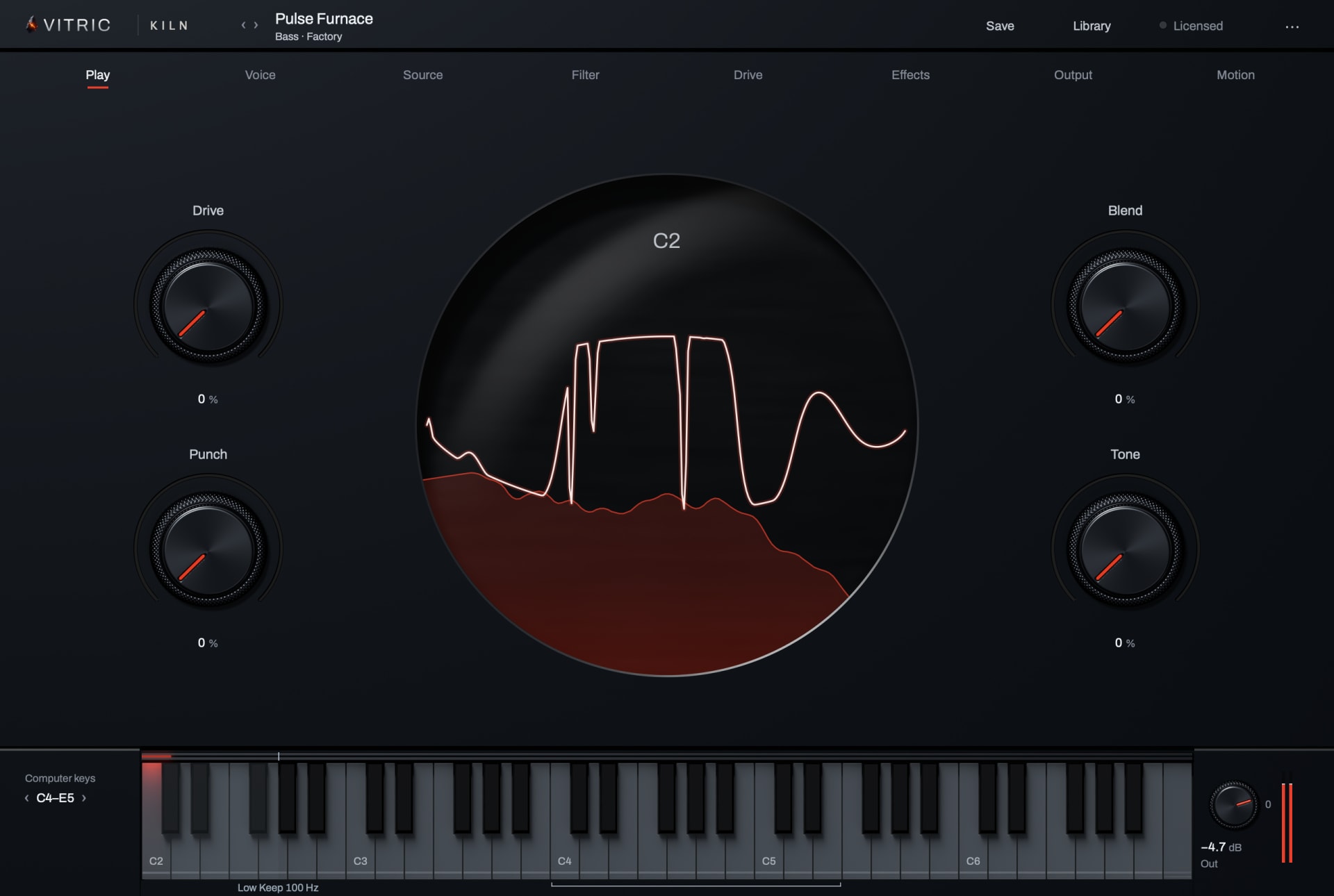
Kiln Synthesizer has a bass engine. Beside its three oscillator slots, each with up to 16-voice unison and detune, it has dedicated sub and noise sources. Every voice runs its own drive in six characters (Soft, Tube, Hard, Fold, Fuzz and Even), and Low Keep holds the sub clean underneath: within 2 dB under heavy drive while the harmonics above 150 Hz rise more than 12 dB. Bass Mono narrows the low end below a frequency you set, glide is exponential with clean legato, and two filter slots and four LFOs handle the movement. Its factory library includes sustained sub-bass synths, 808s, growls and grit basses.
The sub oscillator plays a sine, triangle or square one or two octaves below the note (Sub Wave and Sub Octave, in your DAW's parameter list). For a wobble, the Kiln manual routes LFO 1 to Filter 1's cutoff on the Motion page; turn on the LFO's Sync and it follows your DAW's tempo, at 1/8 by default (Sync Rate, in your DAW).
A sub under any bass
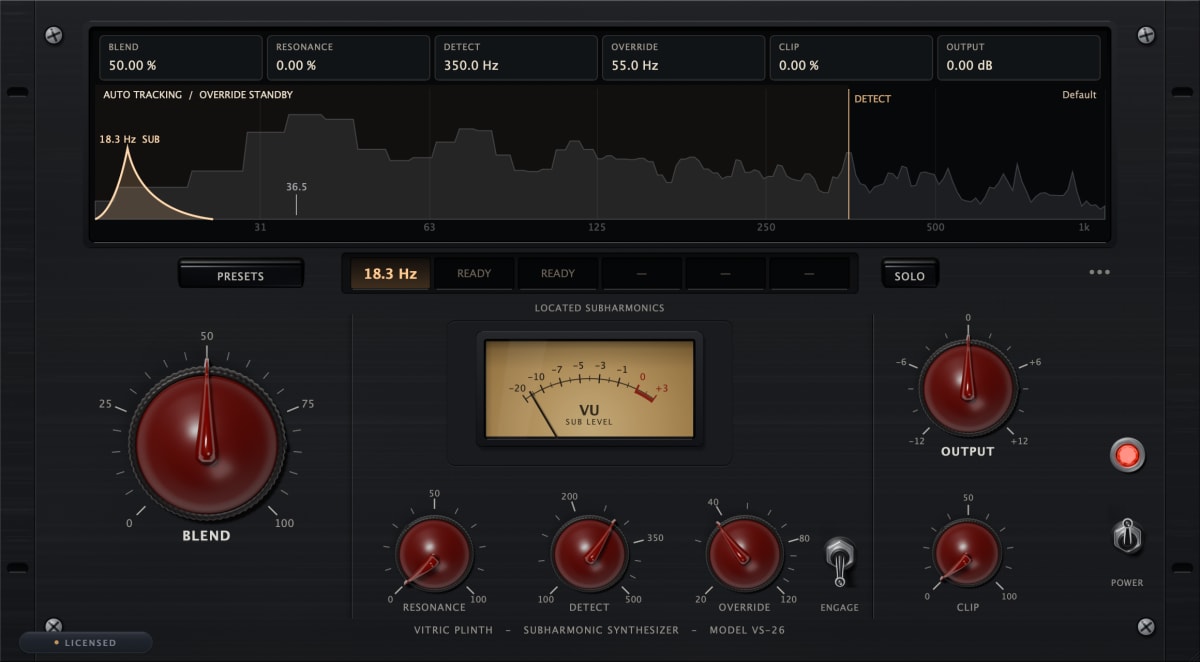
For a bass you have already recorded or sampled, Plinth Subharmonic Synthesizer generates a mono sub one octave beneath the fundamentals it detects, shows the source and the added sub together, and sets the sub's level with Blend.
Questions
What is a reese bass?
A thick, moving bass made from two detuned oscillators, named after Kevin Saunderson's 1988 track released as Reese. It has been a big influence on jungle and drum and bass.
What is a wobble bass?
A bass whose low-pass filter, volume or distortion is moved by an LFO, often synced to the tempo, so the sound opens and closes in rhythm. It is a characteristic sound of some dubstep.
What waveform is best for sub bass?
A sine wave, because it has no harmonics to clash with the rest of the mix. Add a little of an octave above, or some saturation, if it needs to be heard on small speakers.
Should synth bass be mono?
The sub should be. Wider layers above it can be stereo, as long as the mix still holds up when summed to mono.