What is a synthesizer? Oscillators, filters, envelopes and LFOs explained
A synthesizer makes sound from scratch with oscillators, then shapes it with filters, envelopes and LFOs. Here is what each part does, the main kinds of synthesis, and how to start a bass, a pad and a pluck.
A synthesizer is an electronic instrument that makes its own sound. Instead of recording a piano or a voice, it starts from an electrical or digital tone and shapes it until it becomes a bass, a pad, a lead or a drum. A synth can be a keyboard, a box of knobs or a plugin in your DAW; inside, most of them are built from the same few parts.
How a synthesizer makes sound
The sound flows in one direction: the oscillator produces a tone, the filter changes its brightness and the amplifier controls its level. Two kinds of controls move the settings while a note plays: an envelope shapes each note from the moment you press a key until it fades, and an LFO repeats a slow movement, like a hand turning a knob back and forth.
Oscillators and waveforms
The oscillator sets the pitch and the raw tone. Its waveform decides which harmonics the sound starts with, and that decides what the filter has to work with.
- Sine. The fundamental alone, with no harmonics. Pure and round: sub bass, 808-style tones and soft bells.
- Triangle. Odd harmonics that fall away quickly. Soft and flute-like.
- Sawtooth. Every harmonic, so it is the brightest and buzziest. The usual start for strings, brass, leads and most basses.
- Square and pulse. Odd harmonics only, which sounds hollow, like a clarinet. Changing the pulse width changes the tone.
- Noise. Every frequency at once, with no pitch: hi-hats, wind, risers and breath.
Two or more oscillators tuned slightly apart (detuned) beat against each other and sound wider. Many synths stack several copies of one oscillator for this, called unison.
Filters
A filter removes part of the spectrum. A low-pass filter, the most common, lets the lows through and cuts the highs above its cutoff frequency, so lowering the cutoff makes the sound darker. A high-pass filter does the opposite, and a band-pass keeps only a range in the middle. Resonance boosts the frequencies right at the cutoff; turned up, it gives the classic squelch of a filter sweep.
The slope says how steeply the filter cuts: 12 dB per octave is gentle and 24 dB per octave is steeper and more obvious. Sweeping the cutoff with an envelope or an LFO is where much of a synth's movement comes from. For more on cutoff, slope and bands, see what is a parametric EQ.
Envelopes: attack, decay, sustain and release
An envelope shapes each note over time. The most common is the ADSR envelope, named after its four stages:
- Attack: how long the note takes to rise to full level after the key goes down.
- Decay: how long it takes to fall from full level to the sustain level.
- Sustain: the level the note holds while the key stays down. It is a level, not a time.
- Release: how long the note takes to fade to silence after the key comes up.
On the amplifier, an envelope sets a sound's shape: a slow attack and long release make a pad, a fast attack with a short decay and no sustain makes a pluck. On the filter, a second envelope opens the cutoff at the start of each note and closes it again, so notes start bright and settle darker.
LFOs
An LFO, a low-frequency oscillator, is an oscillator too slow to hear as a pitch. Instead of making sound, it moves a setting up and down in a repeating cycle:
- On pitch: vibrato.
- On the filter cutoff: a wah or a dubstep-style wobble.
- On level: tremolo.
The rate is set in hertz or synced to the song's tempo, such as one cycle per bar or per eighth note. The delay calculator turns a tempo into note values in hertz if your synth wants a number.
Kinds of synthesis
- Subtractive: rich waveforms from the oscillators, shaped down with filters. The layout above, and the most common way to build a synth sound.
- Additive: many waves, usually sine waves, added together to build a sound up from its harmonics.
- FM (frequency modulation): one oscillator modulates the frequency of another. It makes bright, metallic and bell-like tones and complex basses.
- Wavetable: each oscillator moves smoothly through a table of different waveforms, so the raw tone itself can change as a note plays.
- Sample-based: the oscillator plays a recording instead of a waveform, then the same filters and envelopes shape it.
A little history: the Moog synthesizer, built by Robert Moog, was first sold in 1964; the smaller Minimoog of 1970 made the synth a self-contained instrument; and the Yamaha DX7, an FM synth released in 1983, was the first popular digital synthesizer and the first to sell more than 100,000 units (source: Wikipedia, Synthesizer). For how analog-style, wavetable and sample sources compare in a modern plugin, read wavetable, analog and sample synths.
Three patches to start with
Starting points for any subtractive synth. Change one thing at a time and listen.
- Bass: a sawtooth plus a sine an octave down for weight, a low-pass filter set low with a short filter envelope for the attack, the synth in mono with a little glide between notes.
- Pad: two sawtooths detuned slightly apart, an amp attack of half a second to a second, a long release, a low-pass filter with a slow LFO on the cutoff.
- Pluck: a sawtooth or square, a fast attack, a short decay, no sustain, and a filter envelope that closes quickly so each note starts bright and dies away.
For basses in particular, the 808 guide covers tuning and mixing sub-heavy notes.
A modern synth: Kiln
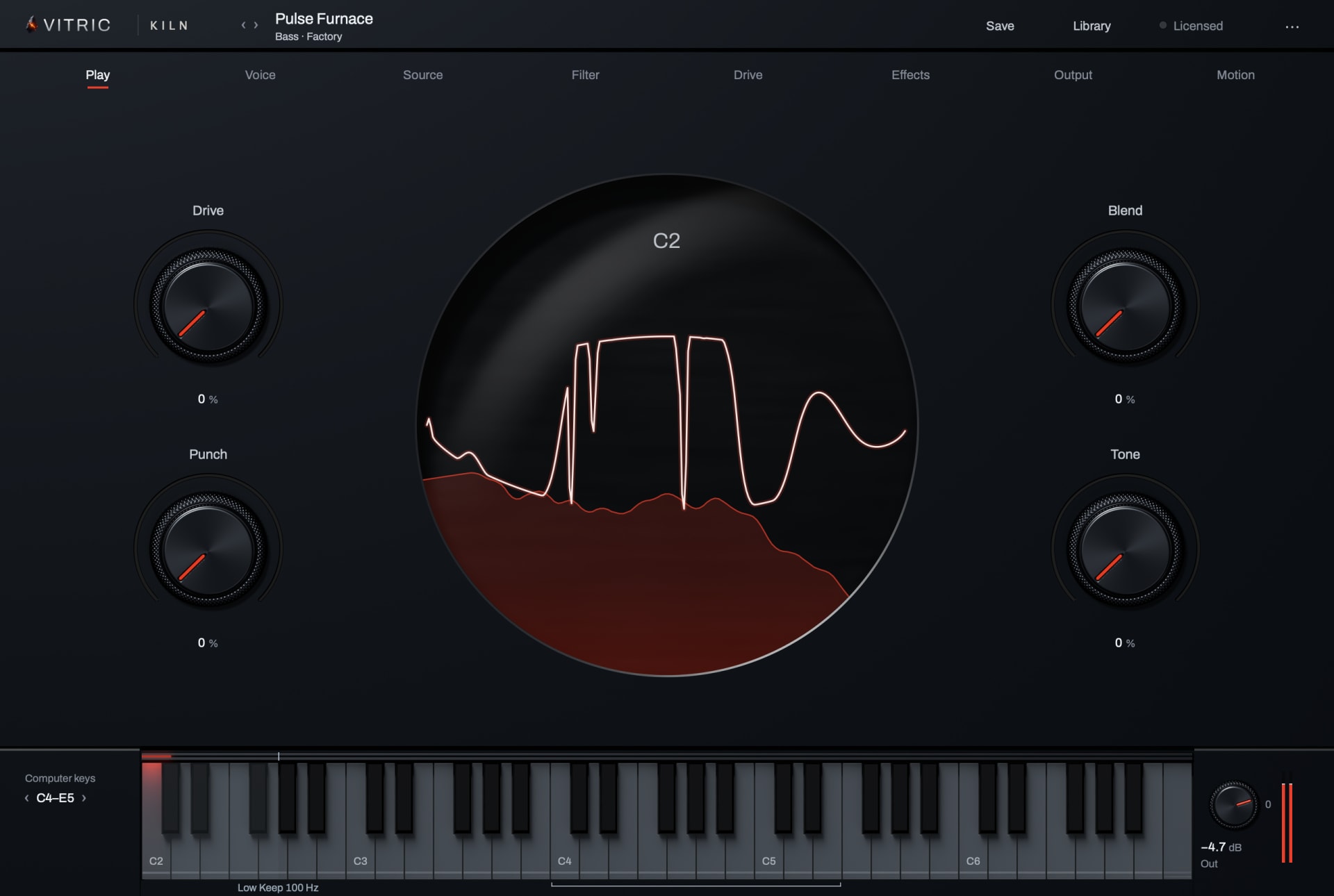
Kiln Synthesizer is a wavetable synth built from these parts. It has three oscillator slots, each running as a wavetable oscillator, an analog morph or a sample player, with up to 16-voice unison per slot and FM between slots. Two filter slots choose between SVF, ladder, comb, formant and Glass filters. Four DAHDSR envelopes (ADSR with a delay and a hold stage), four LFOs, random and chaos sources feed 48 modulation slots, and each LFO can fade in after the attack over up to 5 seconds. It ships with 624 factory presets to take apart and learn from.