Types of synthesis: subtractive, FM, wavetable, additive, granular and more
A synthesizer can make its raw sound in several ways: filtering a bright wave, modulating one oscillator with another, scanning through stored waveforms, adding sine waves, or chopping audio into grains. Here is how each type works and what it is good at.
Every synthesizer has to make a raw sound before it shapes it, and the method it uses is its type of synthesis. Subtractive synths filter a bright waveform; FM synths let one oscillator bend the pitch of another; wavetable synths scan through stored waveforms; additive synths add sine waves together; granular synths rebuild audio from tiny grains. Many modern synths combine several. The parts every synth shares, oscillators, filters, envelopes and LFOs, are covered in what is a synthesizer.
The types at a glance
| Type | How it makes sound | Good for |
|---|---|---|
| Subtractive | Filters harmonics out of a bright wave | Basses, leads, pads |
| FM | One oscillator modulates another's frequency | Bells, metallic and percussive tones |
| Wavetable | Moves through a table of single-cycle waves | Sounds that change over time |
| Additive | Adds sine waves, one per partial | Organ tones, resynthesis |
| Granular | Plays audio as 1 to 100 ms grains | Textures, clouds, time stretching |
| Sample-based | Plays back recordings | Real instruments, one-shots |
| Physical modeling | Computes a model of an instrument | Plucked strings and drums |
Subtractive synthesis
Start with a waveform full of harmonics, such as a sawtooth or square, or with noise, then take some away with a filter, usually a low-pass that turns the upper harmonics down. Classic subtractive synths include the Minimoog (1970), the ARP 2600 (1971) and the Korg MS-20 (1978). It is a good place to start because each control does one audible thing: the oscillator sets the raw tone, the filter its brightness.
FM synthesis
In frequency modulation synthesis, one oscillator, the modulator, changes the frequency of another, the carrier, at an audio rate. That creates new partials either side of the carrier. John Chowning developed it at Stanford from 1967; Yamaha licensed it in 1973, and the Yamaha DX7 of 1983 made it one of the sounds of the 1980s.
Two settings do most of the work. The ratio between carrier and modulator decides whether the result is harmonic or inharmonic: simple whole-number ratios give harmonic tones; other ratios give inharmonic bells and clangs. The modulation amount, or index, decides how many partials appear: the more modulation, the more complex and brighter the sound. An envelope on the modulation amount makes a note start bright and mellow out.
Wavetable synthesis
A wavetable is a set of single-cycle waveforms stored one after another. The oscillator loops one of them, and moving its position through the table changes the harmonics in real time, smoothly when the synth interpolates between neighbors. Max Mathews first used wavetables in 1958, in MUSIC II; Wolfgang Palm developed the swept wavetable in the late 1970s and published it in 1979, and his PPG Wave synthesizers made it their main method. Not everything sold as "wavetable" is: some PC sound cards used the word for plain sample playback. The guide to wavetable, analog and sample synths compares the three in practice.
Additive synthesis
Additive synthesis builds a timbre by adding sine waves, each a partial with its own frequency and level that can change over time. It is the Fourier series turned into an instrument: any periodic sound can be described as a sum of sine waves. The Telharmonium and the Hammond organ were additive instruments built from tonewheels. In software it can also resynthesize a recording: analyze it into sine waves, change them, and play them back.
Granular synthesis
Granular synthesis cuts audio into grains of about 1 to 100 milliseconds and plays them back layered, at their own speeds, pitches and positions. Played slowly, the grains blur into a cloud; played fast, they fuse into a note with a new timbre. Dennis Gabor proposed describing sound as grains in 1947, Iannis Xenakis made granular music with tape in 1959, Curtis Roads first ran it on a computer in 1974, and Barry Truax made it work in real time in 1986. It is behind many time-stretching and texture effects.
Sample-based synthesis and physical modeling
A sample-based synth plays recordings of real sounds, usually one per note or range, then shapes them with the same filters and envelopes as any synth. Physical modeling goes the other way: it computes the sound from a mathematical model of an instrument. The Karplus-Strong algorithm of 1983 models plucked strings, and the Yamaha VL1 of 1994 was the first commercial physical modeling synthesizer.
Several types in one synth: Kiln
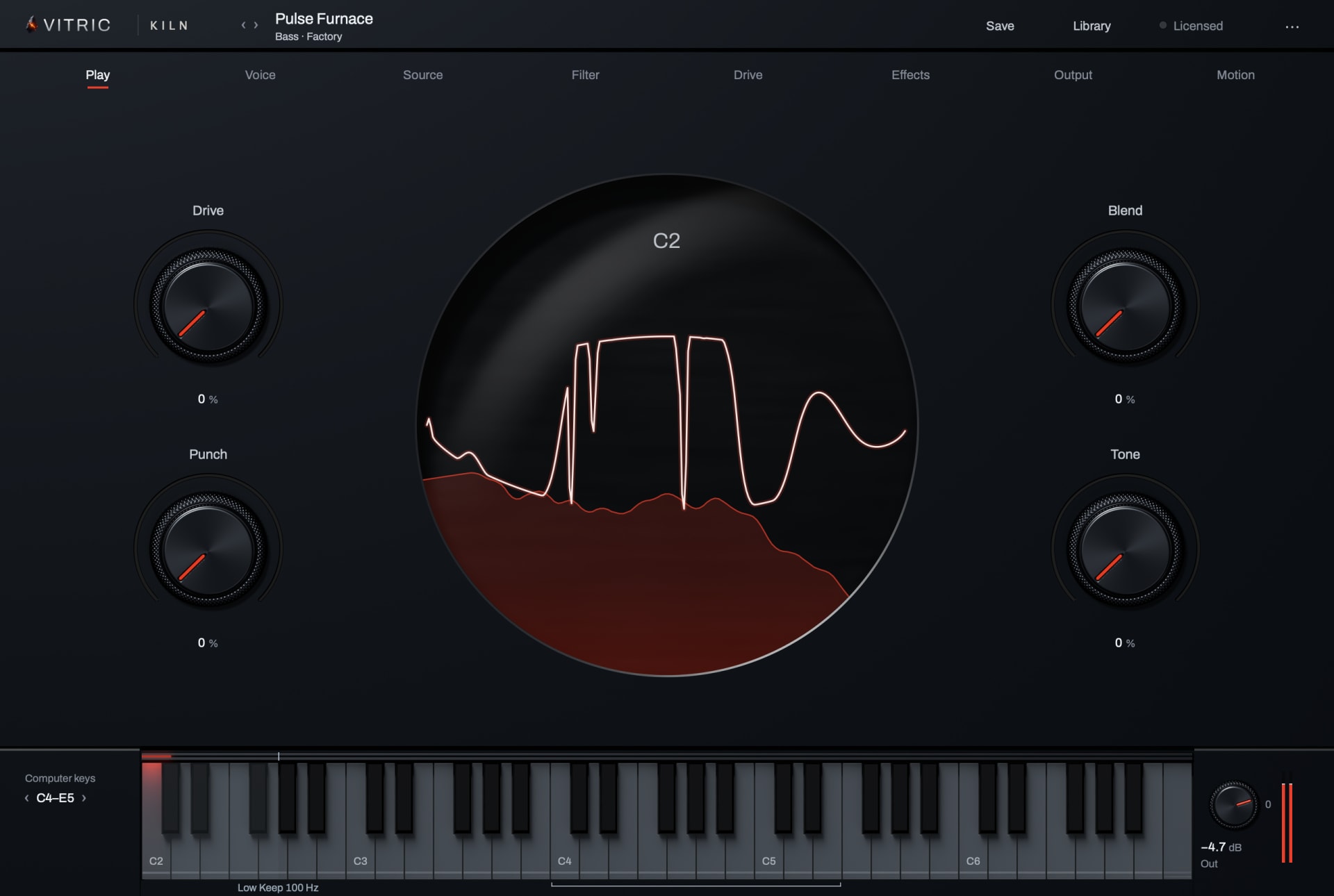
Kiln Synthesizer mixes these methods. Each of its three oscillator slots runs as a wavetable oscillator (from 80 in-house wavetables), an analog morph or a sample player for WAV, AIFF or FLAC files, and the slots can frequency-modulate each other. Two filter slots handle the subtractive part with SVF, ladder, comb and formant filters, and its Glass filter is a modal resonator with Material, Size, Position and Damp controls.
Questions
What are the main types of synthesis?
Subtractive, FM, wavetable, additive and granular, plus sample-based and physical modeling. Many synths combine two or more.
Which type of synthesis should a beginner learn first?
Subtractive. An oscillator, a filter and two envelopes cover most basses, leads and pads, and most other types reuse those parts.
Is wavetable synthesis subtractive?
Not by itself: wavetable is a way to make the raw sound. Most wavetable synths then run it through filters, so in practice they combine the two.
What is granular synthesis used for?
Textures and pads made from recordings, clouds of sound, and stretching audio in time without changing its pitch.