How to use a multiband compressor without smearing your mix
Splitting a mix into bands is not free. This guide walks the crossover phase problem, how allpass compensation fixes it, and when multiband is the wrong tool.
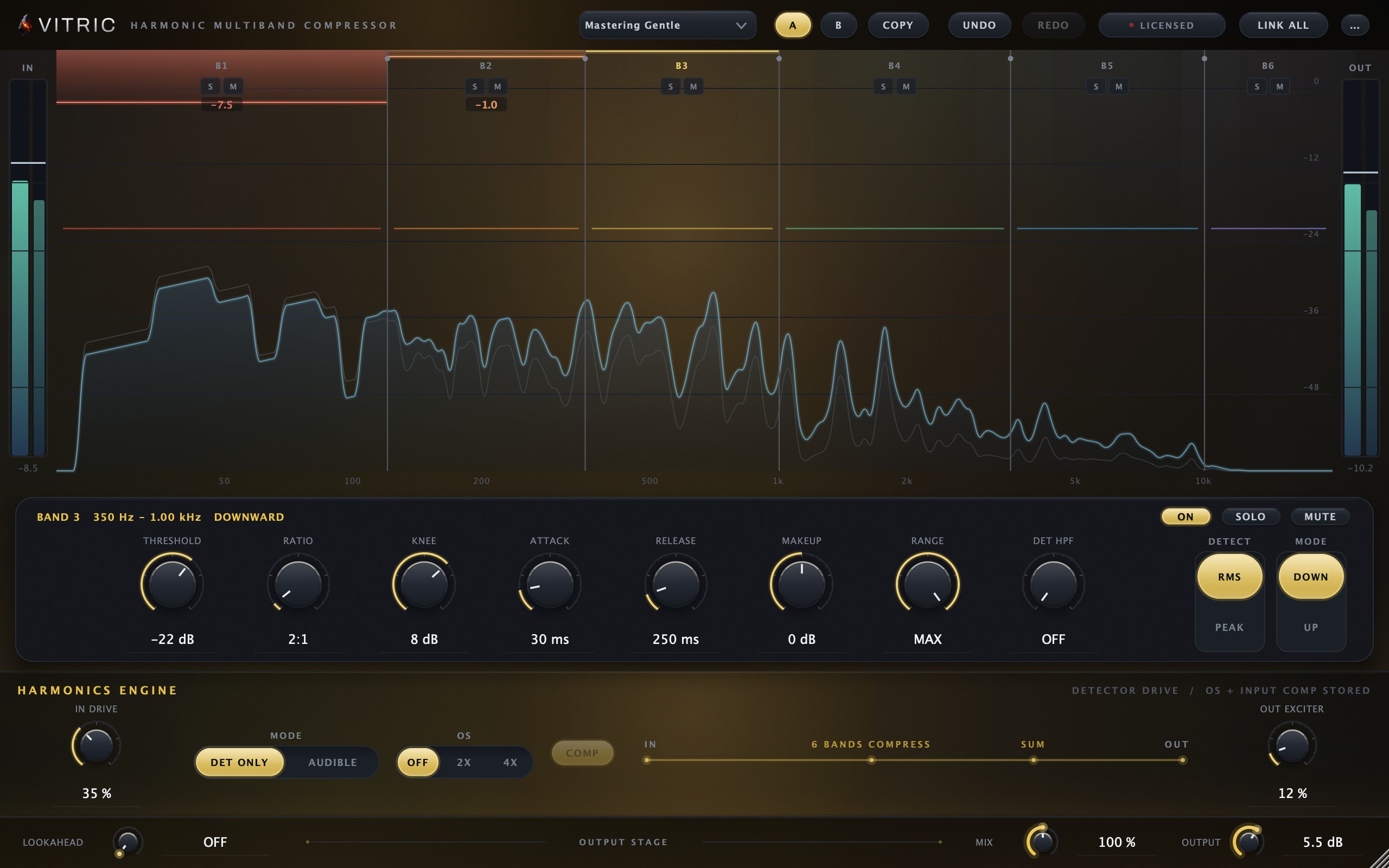
Here is an experiment worth running on whatever multiband compressor you own. Instantiate it on the mix bus, raise every threshold until no band shows a single dB of gain reduction, and bypass-compare. On some plugins the mix changes anyway: slightly hollow through the mids, a little smaller, a little less locked together. Nothing is compressing. The split itself is doing that.
Engineers call the result smearing, and most of the blame lands on the compression. Some of it belongs there. But a real share belongs to the crossover filters, and that share is a solved problem. This article walks the mechanism: what a crossover does to phase, why chained splits refuse to sum flat, what allpass compensation fixes, and when the honest answer is to not use a multiband at all.
A crossover is a filter, and filters rotate phase
To compress bands separately you first have to make bands, and that means crossover filters: a lowpass and a highpass sharing a corner frequency. The standard choice is Linkwitz-Riley, usually fourth order (LR4, 24 dB per octave), because it has a property mix engineers need: at the crossover frequency each band sits exactly 6 dB down, the two outputs are in phase with each other, and their magnitudes sum back to flat.
Flat magnitude is not the whole story. Recombine an LR4 pair and the result equals the original signal passed through an allpass filter: every frequency at its original level, but with a phase rotation that varies with frequency. A single split, summed directly, is close to benign. The trouble starts when you need more than two bands.
Why serial splits refuse to sum flat
Six bands require five splits, and the common structure is a tree: cut the signal at the lowest crossover, take the high branch, cut again, and so on up the spectrum. Each split imposes its phase rotation on the two branches that pass through it. And here is the catch: a band that was peeled off earlier never passes through the later splits, so it never receives their rotation.
That would not matter if a filter's phase shift stayed inside its own crossover region. It does not. An LR4's phase rotation stretches well beyond its corner frequency in both directions. So the low band arrives at the summing bus carrying the phase of one split, while the band right next to it carries the accumulated phase of two or three. Near each seam, the neighbors are rotated against each other. Where two signals sum out of phase, they partially cancel.
The audible result is a set of dips parked around the crossover frequencies, and it gets worse as bands multiply and crossovers move closer together. Worse, the coloration follows the crossovers: drag a band edge to chase a problem frequency and you are also dragging a notch around your mix. A crossover move becomes an EQ move you never asked for, with every compressor bypassed.
Allpass compensation, the fix that keeps the tree
The repair has been standard in loudspeaker design for decades. For every split a band bypasses, insert an allpass filter into that band matching the phase rotation of the split it missed. An allpass changes no level at any frequency; it only rotates phase. Once every band carries the same cumulative rotation, the seams line up again and the magnitudes sum flat.
The cost is a handful of cheap filters and nothing else: no added latency, no change to how the bands feel under compression. The summed output is still an allpass system overall, meaning the mix picks up some frequency-dependent group delay concentrated around the low crossovers. At sane band counts and crossover placements this is a far smaller effect than the ripple it removes, and it is the same class of phase behavior an analog crossover would impose.
You can test any multiband on your shelf for this in two minutes. Raise all thresholds so nothing compresses, set every makeup gain to zero, and bypass-compare on program material. Then run pink noise through it and watch an analyzer while you drag a crossover. A compensated design holds a flat line; an uncompensated one shows the dips moving with your mouse.
Linear phase, and what it charges
There is a second escape route: build the crossovers as linear-phase FIR filters. Every band then receives the same pure time delay instead of a rotation, the sum is exactly flat, and no allpass network is needed. Mastering chains use this for a reason. But linear phase sends a bill.
| Behavior | Compensated LR4 tree | Linear-phase FIR |
|---|---|---|
| Magnitude sum | Flat, within the design tolerance | Exactly flat |
| Phase | Allpass: group delay near low crossovers | Pure delay, identical at all frequencies |
| Latency | None from the crossover itself | Substantial, and it grows as low crossovers get steeper |
| Transient artifact | None beyond the group delay | Pre-ring: filter energy arrives before the hit |
Pre-ring deserves the emphasis. A linear-phase filter's impulse response is symmetric, so half of its ringing lands ahead of the transient in time. On a kick drum crossed over steeply at 100 Hz, that is a low-frequency swell arriving before the beater: a softened, smeared attack, the exact complaint linear phase was hired to fix. Neither approach is free. The compensated tree trades a little group delay for zero latency and clean transients; linear phase trades latency and pre-ring for perfect phase. For mixing, the tree usually wins. For surgical mastering moves, linear phase earns its delay.
When multiband is the wrong tool
Even a perfect crossover cannot rescue a wrong tool choice. Every band that compresses independently tilts the spectrum around its seams dynamically, because that is the job. So make sure the job actually calls for it.
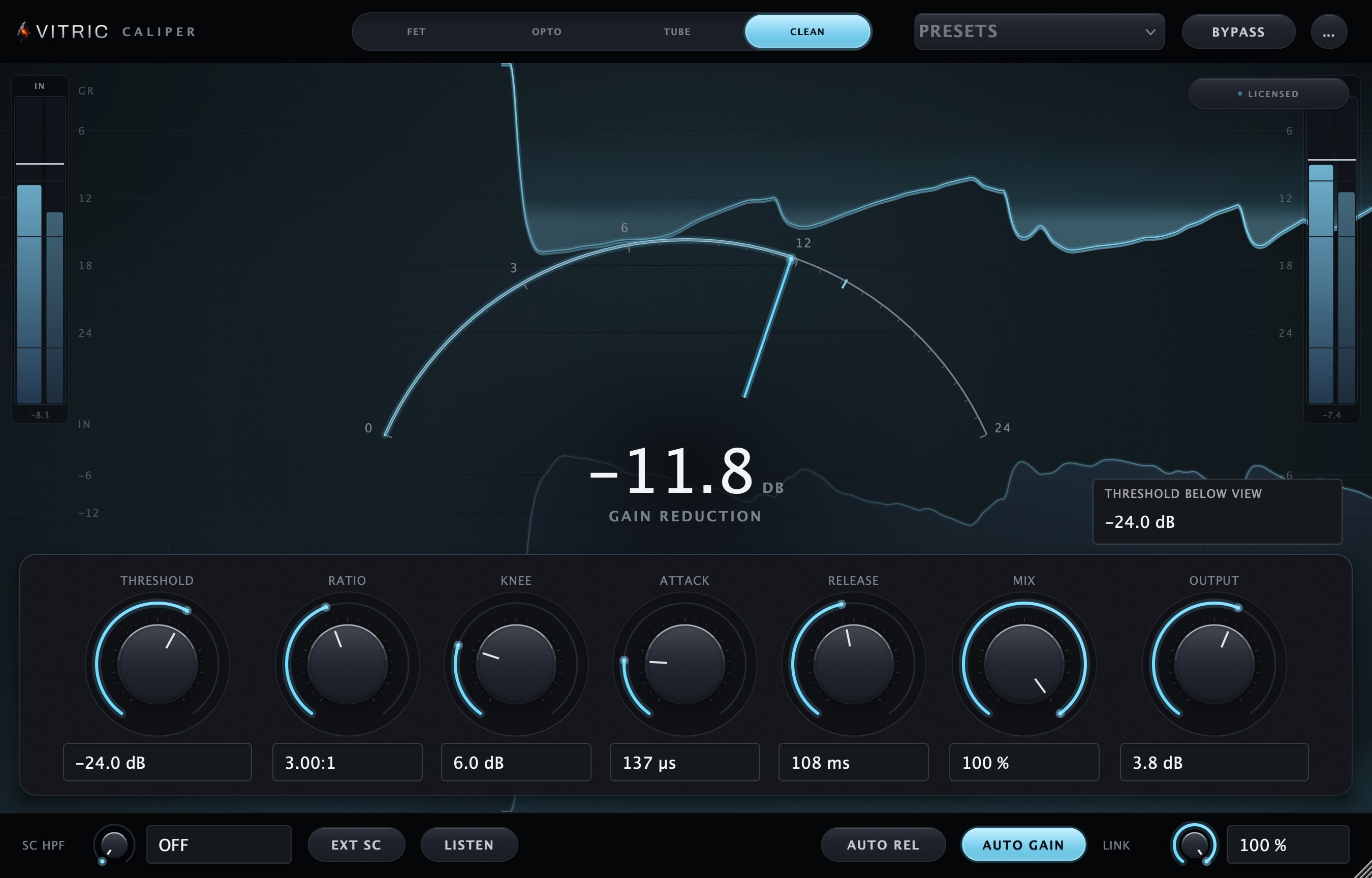
- The problem is broadband. If the whole mix pumps because the kick triggers the compressor, you do not need bands. You need a high-passed detector. A wideband compressor with a sidechain high-pass filter, like Caliper with its sidechain filter and listen mode, stops the bass from driving gain reduction without splitting the signal at all.
- The problem is static. If a band is always 3 dB too loud, on every section, at every level, that is an EQ move. A compressor that ends up pinned at constant gain reduction is an expensive, phase-bearing shelf. Cut it with a parametric EQ and keep the dynamics untouched.
- The problem is one narrow resonance. A vocal that spits at 7 kHz or a snare ringing at 900 Hz wants a narrow dynamic move, not a full-spectrum split. A de-esser or a dynamic EQ band touches only the offender.
- You are tracking. Lookahead and linear-phase filtering both cost latency. If the multiband sits in a monitoring path while someone performs, every millisecond is felt in the hands.
Making it behave in a session
When the job does call for multiband, a few habits keep the split from costing more than the compression earns.
- Use the fewest bands that solve the problem. Every extra band adds two seams of dynamic tilt. Two or three bands fix most bus problems; six is for genuine full-spectrum work.
- Test the split naked first. Thresholds up, makeup at zero, bypass-compare. If the tone changes before any gain reduction happens, the crossover is coloring and everything you do afterward sits on that coloration.
- Keep crossovers away from fundamentals. A seam parked on the bass fundamental or the vocal's core register means the most important energy in the mix straddles two independently moving gain elements. Put seams in the gaps.
- Match time constants across neighboring bands. A slow low band next to a fast low-mid band makes the seam itself breathe. Unless you want that as an effect, keep adjacent releases in the same family.
- Level-match before you judge. Makeup gain across several bands adds up fast, and louder reads as better. Match the output to the bypass before deciding the processing helped.