How to make amapiano: the log drum, the groove, piano chords and tempo
Amapiano is South African house music at about 110 to 115 BPM, usually built on a four-on-the-floor kick, busy shakers and percussion, jazzy electric piano chords and the log drum, a wide percussive bassline. Here is how to build the groove, the log drum and the rest.
Amapiano is South African dance music related to deep house, usually at 110 to 115 BPM. Its sound is usually a kick on every beat under constant shakers and percussion, jazzy electric piano chords, and the log drum: a wide, percussive bassline that is part kick, part bass. To make it, build the groove first, design the log drum and layer a sub under it, add the chords, then arrange it in four and eight bar blocks.
What is amapiano?
The name is Zulu for "the pianos". Amapiano emerged in South Africa in the mid-2010s, out of township house scenes around Pretoria and Johannesburg; the exact birthplace is disputed, and there is no single agreed founder. Its influences include kwaito, 1990s deep house, jazz, soul, gqom and lounge. It spread through file-sharing apps and DJs before exploding around 2019 and became widely popular in the early 2020s. It is mostly sung in South African languages, and names associated with it include Kabza De Small, DJ Maphorisa, Focalistic, Kelvin Momo and MDU aka TRP.
What BPM is amapiano?
Most amapiano falls between 110 and 115 BPM, according to Splice; Roland gives 108 to 115, the slow end of house tempos. Native Instruments builds its example at 114 and Roland at 112. See BPM by genre to compare it with house.
Step 1: the groove
Roland notes that kwaito drums typically use a four-on-the-floor kick with rhythmic accents from percussion, and its first amapiano groove does the same; its second example swaps the steady kick for a more syncopated one with a different clave. The producer Kooldrink, interviewed by Splice, calls amapiano percussion-driven, says the drum groove has to be right for it to be amapiano, and always keeps one element marking time; his example is offbeat trumpets playing quarter notes. Roland adds that whistles and bird sounds are one of the most distinctive elements of the style. Native Instruments layers a drum loop, a kick on every beat and a shaker loop.
Step 2: the log drum
The log drum is the amapiano bass: an electronic take on the West African log drum, used as a wide, percussive bassline. Kooldrink puts it simply: "Without the log drum, it's not amapiano." The producer MDU aka TRP is widely credited with the sound: Kabza De Small has said "he's the one who came up with the log drum sound", and in 2023 amapiano artists pledged money to him in thanks, though he has said no one can claim to own it.
- In FL Studio: Kooldrink points to Fruity DX10 as the home of the original amapiano "Log Drum" preset, and runs it through Fruity WaveShaper or DECAP's KNOCK plugin; a soft clipper on the log drum adds drive.
- In any DAW: Roland describes the sound as a hybrid somewhere between a kick drum, an 808, a synth bass and real log drum percussion, and builds it in layers: a synth kick, a sine wave, a marimba sample blended with a synth bass, and a kalimba with some pitch modulation, then a slight cutoff adjustment and a General MIDI log drum on top.
- The sub: Kooldrink always layers the log drum with a sub that follows the same envelope, keeps the two phase-aligned, and does not cut the log drum's low end: "more is more here".
- The pattern: Roland plays the log drum as a punchy accent to the drums: follow the chords, but use syncopated rhythms for motion.
Step 3: piano chords
Roland names Rhodes, vibes and other electric piano tones as typical, and Splice lists smooth piano melodies and jazzy chords. Roland's example goes past sevenths: Cm9, F7, Bbmaj9, Gm7 and G7b9. Native Instruments plays four seventh chords on a tremolo electric piano, with an extra chord at the end of each of the first three (Abmaj7, Fm7, then Abmaj7 again), a quiet pad doubling them, and a bass on the chord roots:
| Chord | Notes |
|---|---|
| Fm7 | F Ab C Eb |
| Dbmaj7 (written C#maj7) | Db F Ab C |
| Abmaj7 (written G#maj7) | Ab C Eb G |
| Gm7 | G Bb D F |
The Gm7 uses D natural, the major sixth of F Dorian, while the Dbmaj7 keeps F minor's Db (see music scales). A mallet lead on top completes the example.
Step 4: arrange it
Native Instruments' arrangement starts with a beats-only intro and adds and removes elements every four or eight bars to keep things moving.
Amapiano with Vitric plugins
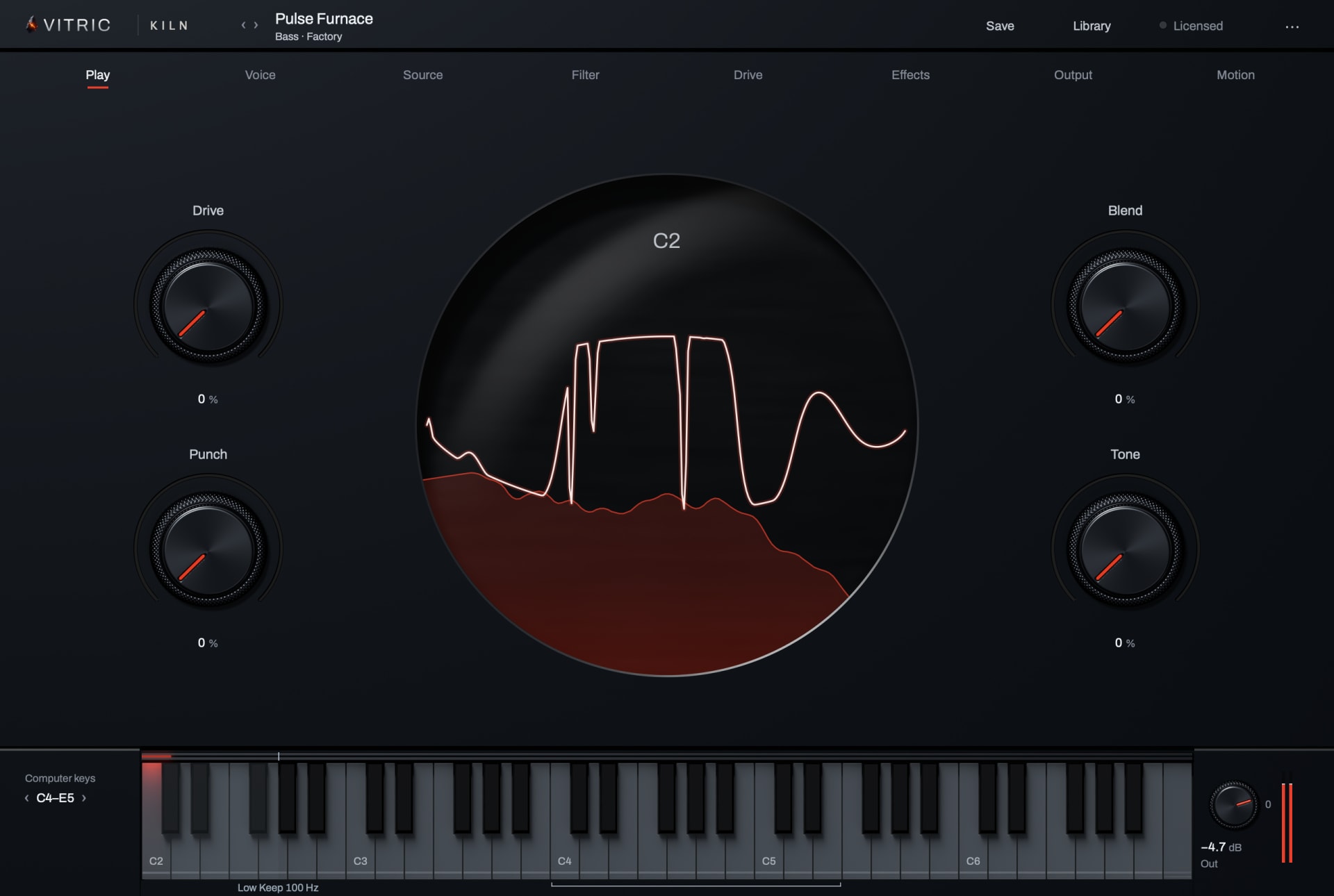
- Kiln Synthesizer: a pitch knock that sweeps into every note, per-voice drive with a Low Keep that holds the sub clean, a sub oscillator, FM between oscillators and a Glass resonator whose material runs from glass toward metal toward wood, for building a punchy, pitched, wooden-sounding bass of your own.
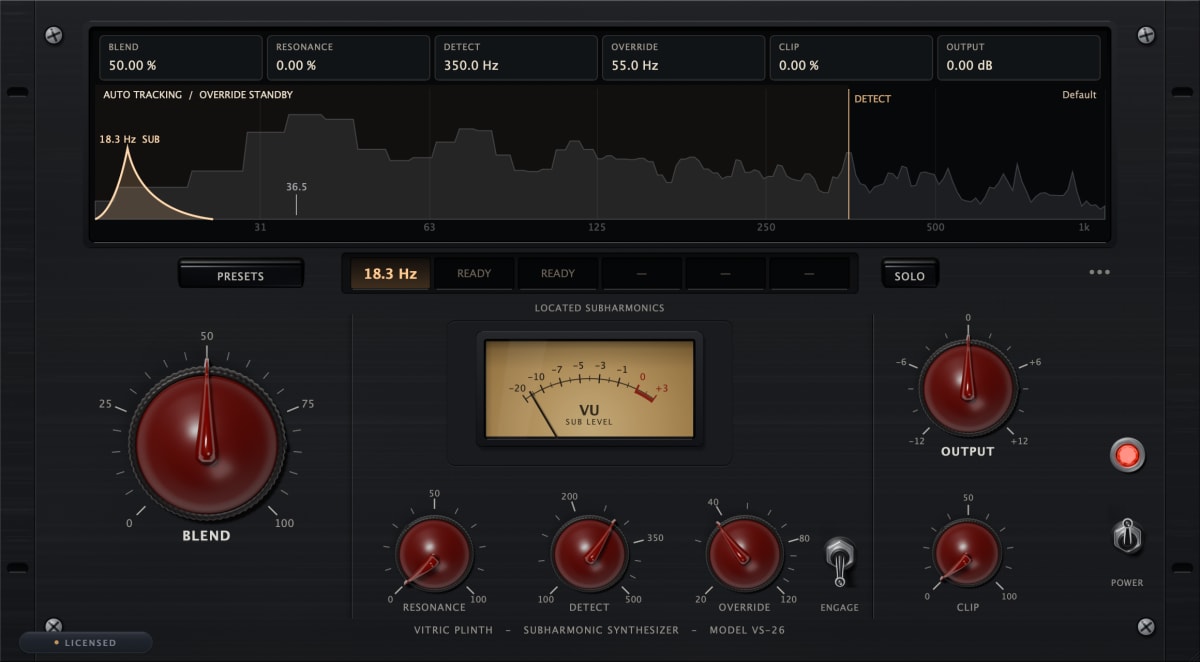
- Plinth Subharmonic Synthesizer: generates a clean sine sub one octave below the notes it detects, phase-locked to the source so the two never cancel each other out. It sits an octave under the log drum rather than doubling it, and fades in over the first part of each hit, so it suits longer log drum notes best.
Questions
What is a log drum in amapiano?
The genre's bass sound: a wide, percussive bassline modeled on the West African log drum, somewhere between a kick, an 808 and a synth bass.
How do you make a log drum in FL Studio?
Start from the "Log Drum" preset in Fruity DX10, shape it with a waveshaper or transient plugin and a soft clipper, and layer a sub under it.
Who created the amapiano log drum?
The producer MDU aka TRP is widely credited with it, including by Kabza De Small.
What BPM is amapiano?
Usually 110 to 115 BPM.
What does amapiano mean?
"The pianos" in Zulu.