White noise vs pink noise vs brown noise: the differences, and how producers use them
White noise has equal power at every frequency, so it sounds bright and hissy. Pink noise has equal power in every octave, so it sounds even and full. Brown noise falls faster still and sounds like a low rumble. Here is why, and what each is used for in music.
Noise is a random signal with energy spread across the whole spectrum. Its "color" describes how that energy is spread. White noise has equal power in every hertz of bandwidth, so it sounds bright, like hiss. Pink noise has equal power in every octave, so it turns down 3 dB with each octave and sounds softer and more even. Brown noise turns down 6 dB with each octave and sounds like a deep rumble.
Why does white noise sound so bright?
Every octave holds twice as many hertz as the one below it: 10 to 20 kHz is 10,000 Hz wide, 20 to 40 Hz only 20 Hz wide. White noise puts the same power in every hertz, so the top octaves carry far more energy than the bottom ones, and the ear hears mostly hiss.
Why is pink noise used to test speakers?
Pink noise puts the same energy in every octave, which suits checking a system octave by octave. Engineers play it through a sound system, measure it with a microphone and an analyzer, and correct any uneven range with an EQ. It is also used to test microphones, and as a long burn-in signal for amplifiers. White noise is a poor choice for this: it puts too much energy in the top octaves.
How do producers use noise?
- Drums. Synthesis uses white noise to recreate cymbals and snares, which have a lot of noise in their sound: a short burst through a high-pass makes a hi-hat, and layered under a tone with a quick envelope it makes a snare.
- Risers and sweeps. White noise through a low-pass filter whose cutoff rises over a few bars builds tension into a drop; a falling cutoff makes a downlifter. See how filters work.
- Texture. A little filtered noise under a pad or a vocal adds air and movement.
- Seeing it. Drop a recording of white or pink noise into the spectrum analyzer to see the difference in its slope.
The colors at a glance
| Noise | Spectrum | Sounds like | Used for |
|---|---|---|---|
| White | Flat: equal power per hertz | Bright hiss | Snares, cymbals, risers |
| Pink | -3 dB per octave: equal power per octave | Softer, even | Testing speakers and rooms |
| Brown | -6 dB per octave | Low rumble | Low texture |
Brown noise is named after Brownian motion, the random movement it models, not after the color.
Noise in Kiln
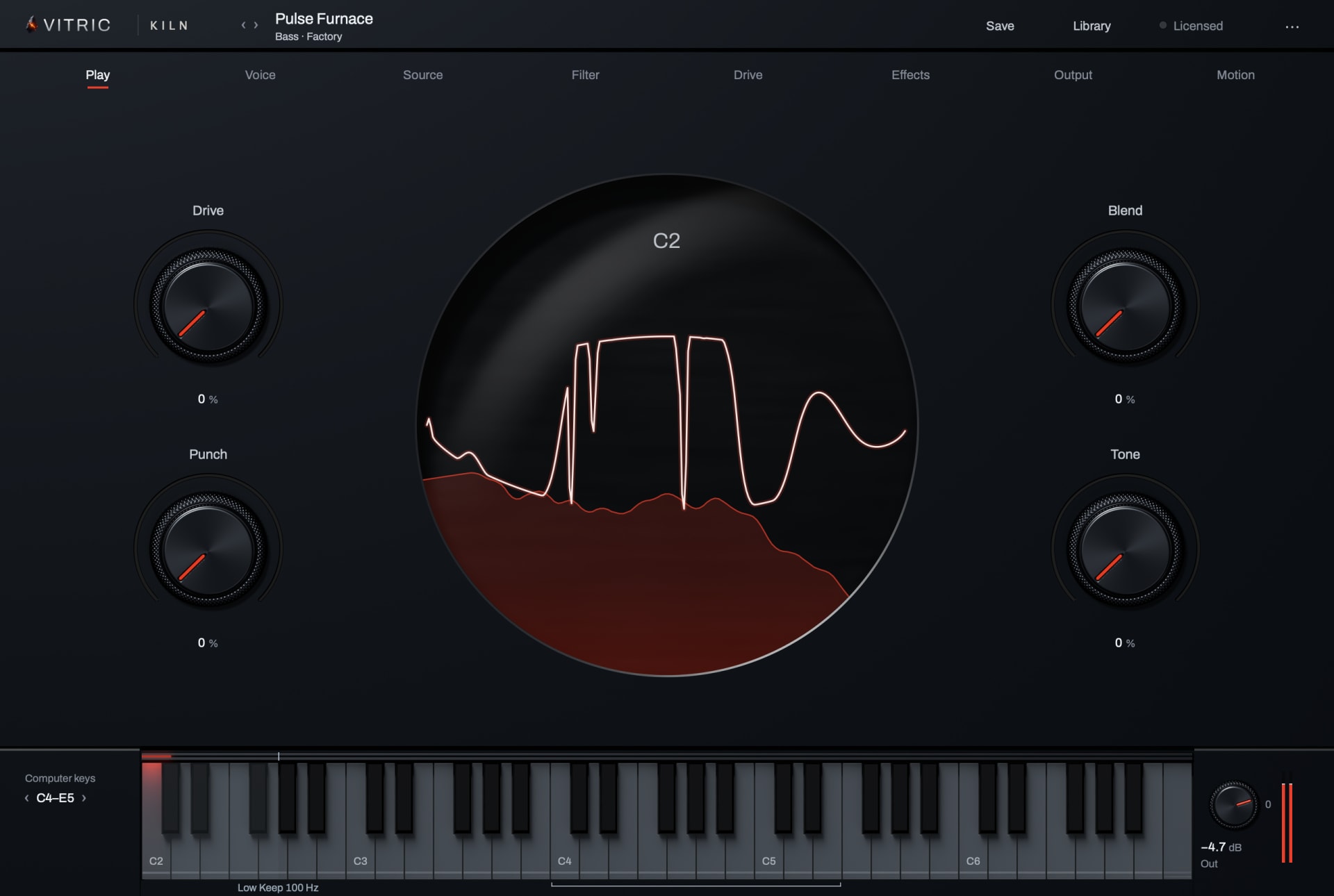
Kiln Synthesizer has dedicated sub and noise sources beside its three oscillator slots.
Questions
What is the difference between white noise and pink noise?
White noise has equal power in every hertz and sounds bright; pink noise has equal power in every octave, falling 3 dB per octave, and sounds fuller and less hissy.
Is brown noise the same as red noise?
Yes. Brown, red and Brownian noise are names for the same spectrum, falling about 6 dB per octave.
Can people hear the difference between white and pink noise?
Easily: white noise sounds hissy and bright, pink noise fuller and softer on top.