Decibels in audio: dB, dBFS, dBu, dBV and dB SPL explained, with conversion tables
A decibel is a ratio on a logarithmic scale, so every dB unit needs a reference: dBFS counts down from digital full scale, dBu and dBV measure voltage, and dB SPL measures sound pressure. Plus 6 dB doubles a signal's level and plus 3 dB doubles its power. Here is what each unit means and how to convert.
A decibel (dB) compares two levels on a logarithmic scale, so a number in dB always needs a reference. In audio the common ones are dBFS (digital full scale, where 0 is the highest level a 16- or 24-bit file or your converters can hold), dBu and dBV (voltage on analog gear) and dB SPL (sound pressure in the air). A change of 6 dB roughly doubles or halves a signal's level; a change of 3 dB doubles or halves its power.
What is a decibel?
A decibel is one tenth of a bel, a unit for the ratio between two quantities on a logarithmic scale. For power, the level in dB is 10 times the base-10 logarithm of the ratio; for root-power quantities such as voltage or the sample values in an audio file, it is 20 times. That is why doubling the power is about +3 dB but doubling a voltage or a sample value is about +6 dB: doubling a voltage quadruples the power.
| Change | Level (amplitude) | Power |
|---|---|---|
| +20 dB | x 10 | x 100 |
| +10 dB | x 3.16 | x 10 |
| +6 dB | x 2.00 | x 3.98 |
| +3 dB | x 1.41 | x 2.00 |
| +1 dB | x 1.12 | x 1.26 |
| 0 dB | x 1 | x 1 |
| -1 dB | x 0.891 | x 0.794 |
| -3 dB | x 0.708 | x 0.501 |
| -6 dB | x 0.501 | x 0.251 |
| -10 dB | x 0.316 | x 0.1 |
| -20 dB | x 0.1 | x 0.01 |
| -40 dB | x 0.01 | x 0.0001 |
| -60 dB | x 0.001 | x 0.000001 |
Faders, gain knobs and plugin levels work in the amplitude column: pulling a fader down 6 dB halves the signal, and 20 dB down leaves a tenth of it. Two identical, in-phase copies of a sound add up to twice the level, so +6 dB; two unrelated sounds at the same level add their power, so about +3 dB; and two identical copies in opposite polarity cancel completely.
What is dBFS?
dBFS means decibels relative to full scale. 0 dBFS is assigned to the highest level a fixed-point system can represent, so every peak below it reads as a negative number. A peak at -6 dBFS uses about half of the available sample range, -20 dBFS a tenth. A DAW that mixes in floating point can show a channel or bus above 0 dBFS without clipping inside the mix, but anything over 0 dBFS clips once it reaches your converters or a 16- or 24-bit export, so bring it back under before it leaves the DAW.
Each bit of a fixed-point file adds about 6 dB of theoretical dynamic range: about 98 dB for 16-bit and about 146 dB for 24-bit (often quoted as 96 and 144 dB, which leave out the 1.76 dB a full-scale sine adds). That is why 24-bit recording leaves room to record well below 0 dBFS without raising the noise you can hear; for the last step down to 16-bit, see what dither is. Sample peaks also miss something: the waveform between samples can rise above the highest sample, which is what true peak (dBTP) measures; see true peak vs sample peak.
RMS vs peak
A peak reading is the single highest point; an RMS (root mean square) reading is an average of the signal's energy over time, which is closer to how loud it sounds. The gap between them is the crest factor. A sine wave peaks about 3.01 dB above its RMS level, and a square wave has no gap at all. Music varies widely: typical figures are a crest factor of about 4 to 8 (roughly 12 to 18 dB) for a processed mix, usually one with compression, and 8 to 10 (18 to 20 dB) for an unprocessed recording, and loud modern masters often sit lower.
Meters do not all agree on RMS. Under the AES17 convention a full-scale sine reads 0 dBFS RMS, while under the mathematical definition the same sine reads about -3 dB, so two RMS meters can differ by 3 dB on the same signal. For streaming loudness, use LUFS instead (see LUFS targets for streaming); the free loudness meter measures integrated loudness, true peak and loudness range in your browser.
dBu, dBV and line level
Analog gear measures voltage. 0 dBu is about 0.775 volts RMS, a value that comes from the voltage that delivers 1 milliwatt into 600 ohms; 0 dBV is 1 volt RMS. Both are plain voltages, whatever the load. Professional equipment usually runs at a nominal +4 dBu, about 1.228 volts RMS; consumer equipment at -10 dBV, about 0.316 volts RMS. The two labels differ by 14, but because the references differ, the real gap is about 11.8 dB, so consumer gear plugged into a professional input arrives about 12 dB below what it expects.
| Unit | 0 dB means | Used for |
|---|---|---|
| dBFS | Digital full scale | Levels in your DAW and files |
| dBTP | Full scale, measured as true peak | True-peak ceilings |
| dBu | 0.775 V | Pro line level (+4 dBu) |
| dBV | 1 V | Consumer line level (-10 dBV) |
| dB SPL | 20 micropascals | Sound pressure in air |
How do dBFS and dBu relate?
There is no fixed conversion: dBFS is a digital level and dBu an analog voltage, and the link between them is however your converters are calibrated. Common alignments are +18 dBu at 0 dBFS, under the European EBU R68 recommendation, so 0 dBu reads -18 dBFS; +24 dBu at 0 dBFS in many US installations; and, in American post-production, -20 dBFS = 0 VU = +4 dBu. Check your interface's specifications for its maximum input and output level in dBu: that figure is its 0 dBFS.
What is dB SPL?
dB SPL is sound pressure level in the air, measured against a reference pressure of 20 micropascals, which is often taken as the threshold of human hearing around 1 kHz; 1 pascal is 94 dB SPL. It is the unit for how loud a room, a speaker or a concert is. How loud a level sounds also depends on frequency; see the human hearing range guide.
Decibels at the end of the chain
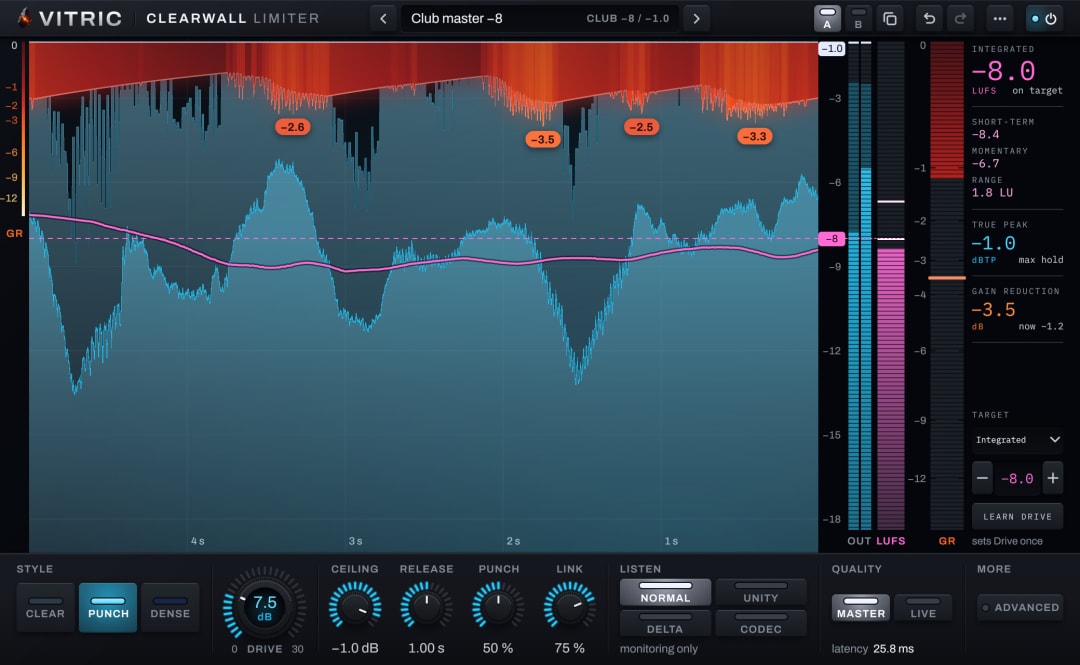
On a master, the peak that counts is the one after the last plugin, measured as true peak. Clearwall Limiter sets its ceiling in dBTP, from -12 to 0. An 8x oversampled detector and a final verify stage hold it on the inter-sample peak: on 16 test mixes at -8 LUFS, the worst overshoot measured at 32x was 0.0012 dB in Master. Lossy codecs can still add peaks when they decode, so a ceiling below 0 dBTP leaves them room.
Questions
What does dBFS mean?
Decibels relative to full scale: 0 dBFS is the highest level a fixed-point system (a 16- or 24-bit file, or your converters) can represent, and every level below it is negative.
How many dB is double the volume?
About 6 dB doubles a signal's level (amplitude) and about 3 dB doubles its power. To sound twice as loud, a sound needs to rise by roughly 10 dB, because hearing is not linear.
What is the difference between dBu and dBV?
The reference: 0 dBu is about 0.775 volts and 0 dBV is 1 volt, so the same voltage reads about 2.2 dB higher in dBu than in dBV.
What is the difference between RMS and peak?
Peak is the highest instantaneous level; RMS is the average energy over time. For a sine wave, RMS is about 3 dB below peak by the mathematical definition; meters using the AES17 convention show both as the same number.
How do I convert dBFS to dBu?
It depends on your converter's calibration. If your interface reaches 0 dBFS at +18 dBu, then -18 dBFS is 0 dBu; if it reaches 0 dBFS at +24 dBu, then -20 dBFS is +4 dBu.
Is +4 dBu louder than -10 dBV?
Yes, by about 11.8 dB: +4 dBu is about 1.228 volts and -10 dBV about 0.316 volts.