WAV vs MP3 vs FLAC: lossless and lossy audio, and which to use
WAV stores audio uncompressed, FLAC compresses it without losing anything, and MP3 makes files far smaller by throwing away detail the ear is least likely to miss. Use WAV or FLAC while you work and for masters; use MP3 only for previews and sharing.
WAV, FLAC and MP3 all hold the same music; they differ in how much of it they keep. A WAV file usually stores the audio uncompressed, every sample as recorded. FLAC compresses it like a zip file: smaller, but it decodes back to an identical copy, so it is lossless. MP3 is lossy: it uses a model of human hearing to discard detail the ear is least likely to notice, which makes files far smaller but cannot be undone.
What is the difference between lossless and lossy audio?
Lossless formats keep every bit of the original: WAV by storing it as is, FLAC by packing it more tightly. Lossy formats such as MP3 and AAC make the file smaller by removing information, using psychoacoustic models to choose what to remove. Compared with CD audio, an MP3 is typically 75 to 95 percent smaller; at 128 kbps it is about one eleventh of the size.
WAV vs MP3: which should you use?
| Format | Type | Use it for |
|---|---|---|
| WAV | Uncompressed | Recording, stems, mixes, masters, delivery |
| FLAC | Lossless, compressed | Archiving and sharing full quality in less space |
| MP3 | Lossy | Quick previews, demos to listen on a phone |
Every time a lossy file is decoded, edited and encoded again, it loses a little more. That is why masters and stems go out as WAV, and streaming services encode their own versions from the files you deliver.
What bit depth and sample rate should a WAV be?
CDs use 16-bit, 44.1 kHz stereo. For files you will keep working on, export 24-bit or 32-bit float at your session's sample rate, and dither only when you reduce the bit depth for a final release; the dither guide explains why. A standard WAV tops out at 4 GB, about four hours of 24-bit, 48 kHz stereo; longer recordings use the RF64 or W64 variants.
Why can a lossy file clip when the WAV did not?
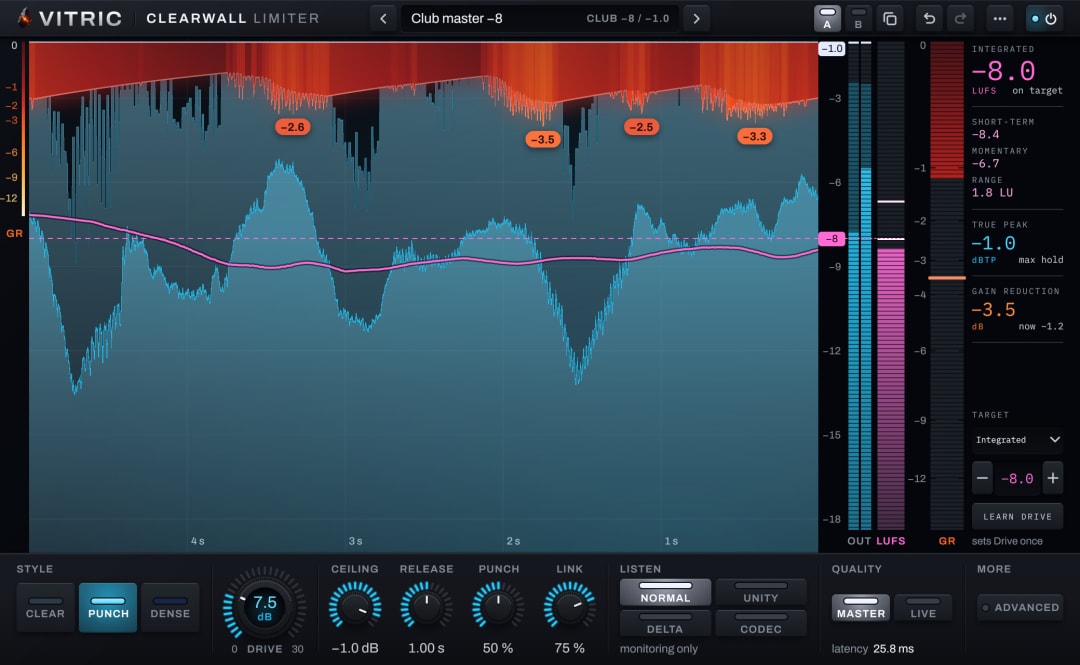
Lossy encoding changes the waveform, and the decoded result can have peaks higher than the original. That is why masters leave true-peak headroom, commonly -1 dBTP, and loud masters may need more (Spotify asks for -2 dBTP above -14 LUFS): see true peak vs sample peak. Clearwall Limiter is a true-peak mastering limiter: it holds the true-peak ceiling you set, and its Codec margin option, off by default, holds it 1 dB lower while the master is louder than -14 LUFS. If you deliver an MP3 yourself, decode it and measure that file.
Questions
Is WAV better quality than MP3?
Yes: a WAV of the same source keeps everything, while an MP3 has discarded detail. At high bit rates the difference can be hard to hear, but it adds up when a file is processed or re-encoded.
Is FLAC as good as WAV?
Yes, for 16-bit and 24-bit files: FLAC is lossless and decodes to exactly the same audio as the WAV, in typically 50 to 70 percent of the space. FLAC does not store floating-point audio, so keep 32-bit float files as WAV.
Does converting an MP3 to WAV improve it?
No. The detail removed when the MP3 was made is gone; the WAV is just a bigger copy of the MP3.
What is lossless audio on streaming services?
A stream that delivers the music in a lossless format, the full-quality file, instead of a lossy version.