MPE and microtuning: what they are and how to use them
MPE lets each note in a chord bend, swell and change tone on its own. Microtuning changes the notes themselves, so a keyboard can play quarter tones or any other scale. Here is how each works and how to set them up.
MPE and microtuning are two ways to play beyond the twelve fixed notes of a keyboard. MPE, MIDI Polyphonic Expression, lets each note in a chord bend, swell and change tone on its own. Microtuning changes the notes themselves, so the keys can play quarter tones, just intonation or any other scale.
What is MPE?
In ordinary MIDI, pitch bend and channel pressure apply to every note on the channel at once, so bending one note of a chord bends the whole chord. MPE gets around this by giving each note its own MIDI channel, so pitch bend and other expressive controls can move each note separately and continuously. The MIDI Manufacturers Association published the specification in January 2018.
Controllers such as the Continuum Fingerboard, LinnStrument, ROLI Seaboard, Sensel Morph and Eigenharp let you shape the pitch, timbre and other nuances of single notes inside a chord.
How to set up MPE
- Set the controller to send MPE.
- Record it on a DAW track that passes MPE to the instrument.
- Turn on the synth's MPE mode, and map pressure and slide to something you can hear, such as filter cutoff or level.
What is microtuning?
Western music normally uses twelve equal steps per octave, called 12-tone equal temperament or 12-TET; each step is a semitone of 100 cents. Microtonal music uses intervals smaller than a semitone, or any tuning outside that standard. Quarter-tone music divides the octave into 24 equal steps of 50 cents. Many traditions tune differently too: Indian music describes 22 śruti in the octave, and gamelan, just intonation and meantone temperaments all sit outside 12-TET.
Scala files and MTS-ESP
The Scala .scl file has become a standard way to describe microtonal scales. Scala itself is freeware by Manuel Op de Coul, its archive holds over 5,000 scale files, and the Scala site lists more than thirty applications that read the format. A .kbm keyboard map, used alongside a scale, sets which key plays the reference note and at what frequency.
MTS-ESP works at the session level instead: a tuning master plugin sets the tuning, and every synth that supports it follows, so you can change the scale for a whole project in one place.
MPE and microtuning in Kiln
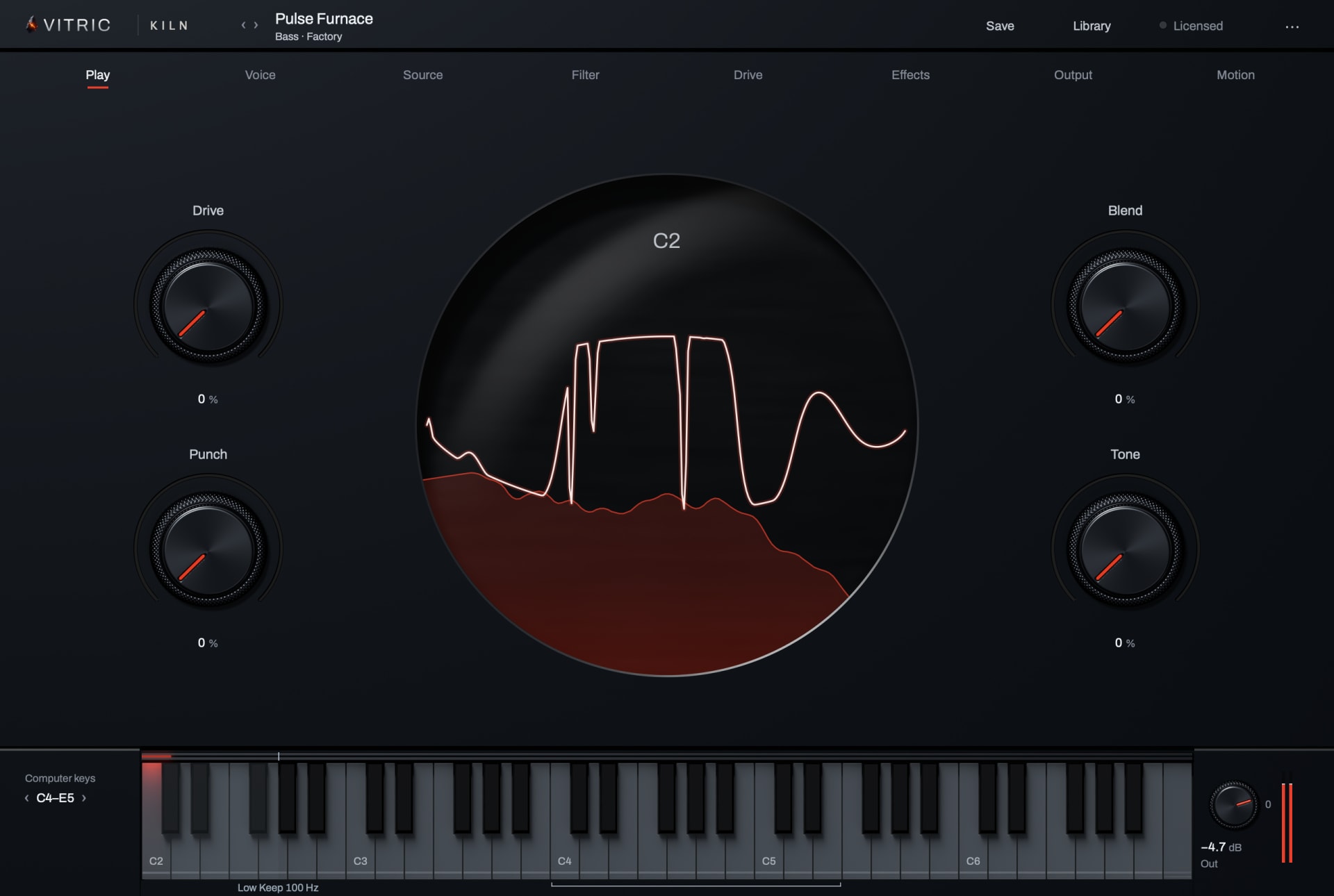
Kiln Synthesizer reads MPE with per-note bend over the standard 48-semitone range, pressure and slide, and its library has 28 MPE patches. Its MPE setting (Auto, On or Off) is in your DAW's parameter list for Kiln, and MPE Pressure, Slide and Lift appear as sources in the modulation matrix. For tuning, Kiln loads Scala .scl scales and .kbm keyboard maps from its Options menu and saves them with your session; a scale on its own maps from C4 at 261.63 Hz. When an MTS-ESP tuning master is running, its tuning takes over. See the Kiln manual.
Questions
Does MPE work with any synth?
No. The synth has to read MPE, and the DAW track has to pass it through. Without that, per-note bends move the whole chord or are ignored.
What is 12-TET?
Twelve-tone equal temperament: the octave split into twelve equal semitones of 100 cents, the standard tuning of Western keyboards.
Where do I find microtonal scales?
The Scala archive has over 5,000 .scl files, and any synth that reads Scala can load them.