Time signatures explained: 4/4, 3/4, 6/8, 12/8 and odd meters like 5/4 and 7/8
A time signature tells you how many beats are in each bar and which note counts as one beat: 4/4 is four quarter-note beats, 3/4 is three, and 6/8 is six eighth notes felt as two beats of three. Here is how to read, count and set the common ones.
A time signature is the pair of numbers at the start of a piece. The top number says how many beats are in each bar; the bottom number says which note value counts as one beat. 4/4 means four quarter-note beats per bar, 3/4 means three, and 6/8 means six eighth notes, which are felt as two beats of three.
What do the two numbers mean?
The bottom number names the note value being counted: 2 is a half note, 4 a quarter note, 8 an eighth note and 16 a sixteenth note. The top number says how many of those make one bar. So 3/4 is three quarter notes per bar and 6/8 is six eighth notes per bar. Both bars are the same length, but they are grouped differently, and that grouping is what you hear. Music with two beats to the bar is in duple meter, three in triple, four in quadruple.
Simple and compound meter
In a simple meter each beat divides into two equal parts: 2/4, 3/4 and 4/4 are simple, and the top number is the number of beats. In a compound meter each beat divides into three, so the bottom note value is grouped in threes: 6/8 is felt as two beats, each a dotted quarter note holding three eighth notes, 9/8 as three beats and 12/8 as four. In a compound meter the top number counts the subdivisions, not the felt beats.
| Signature | Felt as | Often used for |
|---|---|---|
| 2/4 | 2 beats of 2 | Polkas, marches, Latin styles |
| 3/4 | 3 beats of 2 | Waltzes, ballads, R&B |
| 4/4 | 4 beats of 2 | Most rock, blues, country, funk, pop |
| 6/8 | 2 beats of 3 | Double jigs, marches, some rock |
| 9/8 | 3 beats of 3 | Slip jigs; otherwise rare |
| 12/8 | 4 beats of 3 | Slow blues |
| 5/4 | 5 beats, 3+2 | "Take Five" |
| 7/8 | 7 eighths, uneven | Parts of "Paranoid Android" |
4/4: common time
4/4 is the most common time signature in rock, blues, country, funk and pop, and it is also called common time. It is sometimes written as a C instead of numbers, a sign that comes from a broken circle in medieval notation rather than from the word "common". Count it 1 2 3 4, or 1 & 2 & 3 & 4 & in eighth notes. In popular music the snare usually plays the backbeat, beats 2 and 4. Its close relative 2/2, cut time or alla breve, has the same bar length counted as two half-note beats. A four-on-the-floor house kick and a trap beat with its snare on beat 3 are both in 4/4: the half-time feel of trap changes where the snare lands, not the time signature (see drum patterns and BPM by genre).
6/8 and 12/8: beats in threes
6/8 has six eighth notes per bar, but you feel two beats, each a group of three: ONE two three FOUR five six. That rolling, lilting pulse is the difference from 3/4, which has the same six eighth notes grouped in pairs. 12/8 doubles it to four groups of three, a triplet feel common in slower blues. If you can tap your foot twice per bar and each tap splits into three, you are in 6/8; four taps that each split into three is 12/8.
3/4: three beats
3/4 has three quarter-note beats per bar, with the weight on the first: ONE two three. It is the waltz meter, and it also turns up in country ballads, R&B and some pop.
Odd meters: 5/4 and 7/8
Odd or irregular meters group the bar unevenly, usually in twos and threes. In 5/4 the five beats are equal and the grouping is uneven: "Take Five", composed by Paul Desmond and recorded by the Dave Brubeck Quartet in 1959, splits its five beats 3 + 2. In 7/8 the groups of eighth notes become the beats, so one beat is longer than the others. The common groupings are 2 + 2 + 3 (the most common in popular music), 3 + 2 + 2 and, less often, 2 + 3 + 2. Count all seven and stress the first note of each group: ONE two THREE four FIVE six seven for 2 + 2 + 3.
How do you find the time signature of a song?
- Find the beat. Tap along at the speed that feels natural.
- Find the bar. Listen for where the pattern restarts, such as a chord change, a crash or the start of the drum loop, and count your taps until it comes round again.
- Twos or threes? Count between the taps. If each beat splits naturally into two, it is a simple meter: 2, 3 or 4 beats gives 2/4, 3/4 or 4/4. If each splits into three, it is compound: 2, 3 or 4 beats gives 6/8, 9/8 or 12/8. If the count comes out at 5 or 7, or the beats feel uneven, it is an odd meter.
2/4 and 4/4, or 6/8 and 12/8, can be hard to tell apart by ear: the difference is mostly how long you make the bar. A metronome helps you check: the Vitric metronome plays 6/8 as six eighth notes with accents on 1 and 4, so its tempo there counts eighth notes.
How do you set the time signature in your DAW?
- FL Studio: open Project settings (F11) and, under Time Settings, choose Set as time signature, then set the numerator (beats per bar) and denominator (beat length). For a change partway through, add a time signature marker in the Playlist or Piano roll (Shift+Alt+T on Windows, Shift+Opt+T on Mac).
- Ableton Live 12: type the numerator and denominator into the Time Signature fields in the Control Bar; the change applies from the current play position. To change meter partway through, place the insert marker, then use Insert Time Signature Change from the Create menu or the scrub area's context menu.
- Logic Pro: for a project with one time signature, choose a new signature from the LCD. To add a change, click the Signature track with the Pencil tool where it should start and set the values in the Time Signature dialog; double-click an existing signature to edit it. For 7/8, its Beat Grouping field takes the grouping: 223 for 2 + 2 + 3.
The tempo number does not always count the same note. FL Studio's manual says that with other denominators, 6/8 included, BPM still counts quarter notes per minute, and that changing the denominator changes the grid, not the playback speed. A dotted quarter, the felt beat of 6/8, is one and a half quarter notes, so at 120 BPM it lasts 750 ms and the felt beat runs at 80 per minute. The Vitric metronome counts eighth notes in 6/8, so 180 there matches 90 BPM in FL Studio. The delay calculator gives straight, dotted and triplet note times for any tempo from 20 to 300 BPM.
Time signatures and delay times
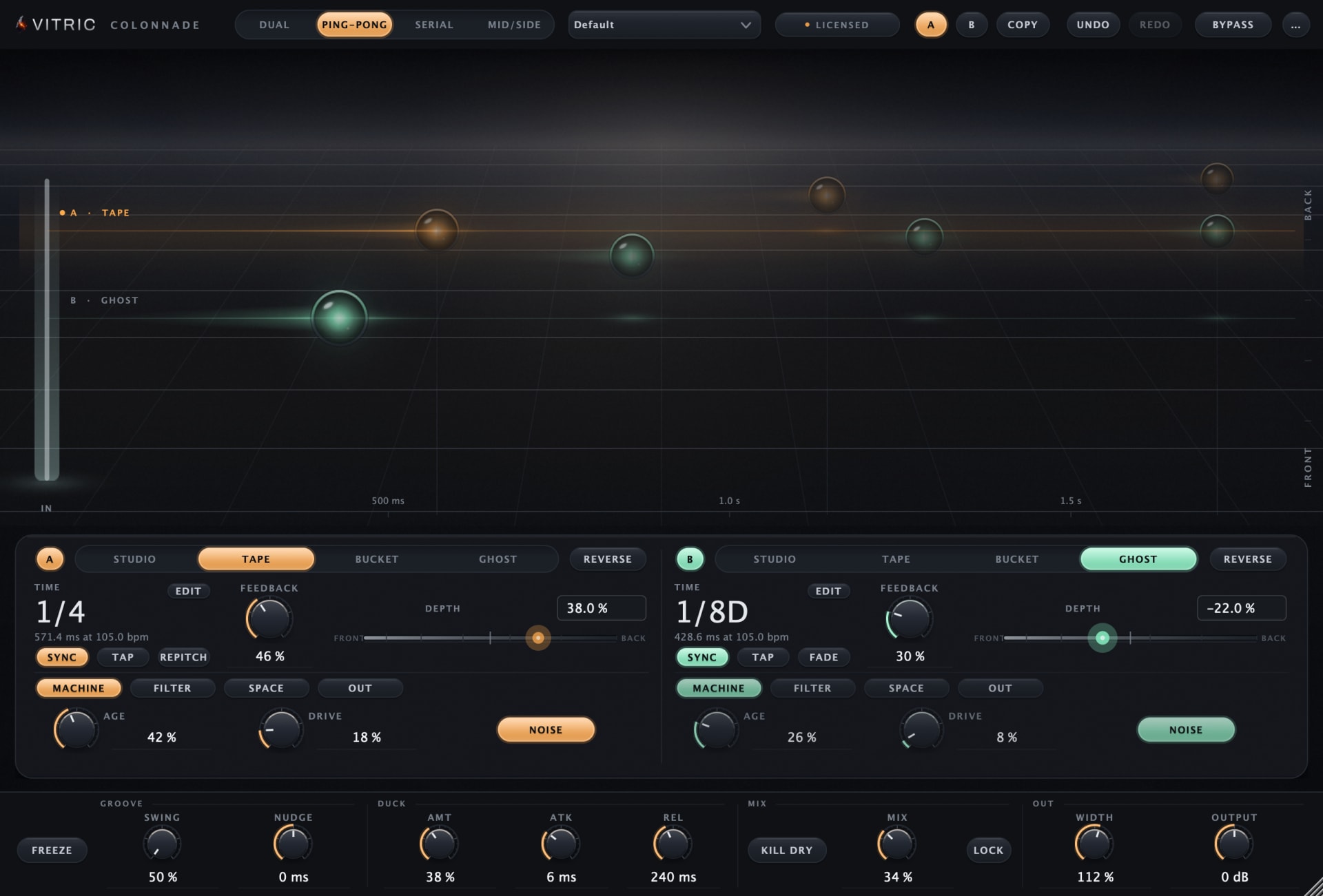
In 6/8 the felt beat is a dotted quarter note, so a dotted-quarter delay repeats once per felt beat and a straight eighth-note delay once per eighth. Colonnade Delay syncs to 21 divisions from 1/64 to 1/1, including dotted and triplet values, or runs free from 1 ms to 4 seconds.
Questions
What does 4/4 mean?
Four beats per bar, each a quarter note. It is the most common time signature in rock, blues, country, funk and pop.
What is 6/8 time?
Six eighth notes per bar, grouped in two sets of three, so it is felt as two beats: ONE two three FOUR five six.
What is the difference between 3/4 and 6/8?
Both bars hold six eighth notes. 3/4 groups them in pairs, three beats of two; 6/8 groups them in threes, two beats of three.
What is common time?
Another name for 4/4, sometimes written as a C on the staff.
Can a song change time signature?
Yes. FL Studio, Ableton Live and Logic Pro all let you add time signature changes partway through a song, and some songs switch for a single bar or a whole section.